

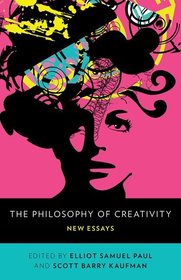
The Philosophy of Creativity
New Essays
-
10% KEDVEZMÉNY?
- A kedvezmény csak az 'Értesítés a kedvenc témákról' hírlevelünk címzettjeinek rendeléseire érvényes.
- Kiadói listaár GBP 83.00
-
37 474 Ft (35 690 Ft + 5% áfa)
Az ár azért becsült, mert a rendelés pillanatában nem lehet pontosan tudni, hogy a beérkezéskor milyen lesz a forint árfolyama az adott termék eredeti devizájához képest. Ha a forint romlana, kissé többet, ha javulna, kissé kevesebbet kell majd fizetnie.
- Kedvezmény(ek) 10% (kb. 3 747 Ft)
- Kedvezményes ár 33 727 Ft (32 121 Ft + 5% áfa)
Iratkozzon fel most és részesüljön kedvezőbb árainkból!
Feliratkozom
37 474 Ft

Beszerezhetőség
Megrendelésre a kiadó utánnyomja a könyvet. Rendelhető, de a szokásosnál kicsit lassabban érkezik meg.
Why don't you give exact delivery time?
A beszerzés időigényét az eddigi tapasztalatokra alapozva adjuk meg. Azért becsült, mert a terméket külföldről hozzuk be, így a kiadó kiszolgálásának pillanatnyi gyorsaságától is függ. A megadottnál gyorsabb és lassabb szállítás is elképzelhető, de mindent megteszünk, hogy Ön a lehető leghamarabb jusson hozzá a termékhez.
A termék adatai:
- Kiadó OUP USA
- Megjelenés dátuma 2014. május 29.
- ISBN 9780199836963
- Kötéstípus Keménykötés
- Terjedelem336 oldal
- Méret 165x236x30 mm
- Súly 607 g
- Nyelv angol 0
Kategóriák
Rövid leírás:
Creativity pervades human life. It is the mark of individuality, the vehicle of self-expression, and the engine of progress in every human endeavor. It also raises a wealth of neglected and yet evocative philosophical questions. The Philosophy of Creativity takes up these questions and, in doing so, illustrates the value of interdisciplinary exchange.
TöbbHosszú leírás:
Creativity pervades human life. It is the mark of individuality, the vehicle of self-expression, and the engine of progress in every human endeavor. It also raises a wealth of neglected and yet evocative philosophical questions: What is the role of consciousness in the creative process? How does the audience for a work for art influence its creation? How can creativity emerge through childhood pretending? Do great works of literature give us insight into human nature? Can a computer program really be creative? How do we define creativity in the first place? Is it a virtue? What is the difference between creativity in science and art? Can creativity be taught?
The new essays that comprise The Philosophy of Creativity take up these and other key questions and, in doing so, illustrate the value of interdisciplinary exchange. Written by leading philosophers and psychologists involved in studying creativity, the essays integrate philosophical insights with empirical research.
The essays in this anthology explore many of [creativity's] aspects, presenting familiar philosophical issues in less familiar contexts, which is an encouragement to take a fresh look at those issues and perhaps rethink our opinions. Creativity is looked at in relation to literature, music, audience response, character, imagination, the unconscious, and artificial intelligence ... the compilers of the anthology are to be congratulated on its range and variety.
Tartalomjegyzék:
I. Introduction
Elliot Samuel Paul & Scott Barry Kaufman
Introducing The Philosophy of Creativity
II. The Concept of Creativity
1) Bence Nanay
An Experiential Account of Creativity
III. Aesthetics & Philosophy of Art
2) Gregory Currie
Creativity and Insight
3) Noël Carroll
The Creative Audience: Some Ways in which Readers, Viewers and/or Listeners Use their Imaginations to Engage Fictional Artworks
4) Christopher Peacocke
The Products of Musical Creativity
IV. Ethics & Value Theory
5) Owen Flanagan
Performing Oneself
6) Matthew Kieran
Creativity as a Virtue of Character
V. Philosophy of Mind & Cognitive Science
7) Simon Blackburn
Creativity and Not So Dumb Luck
8) Dustin Stokes
The Role of Imagination in Creativity
9) Roy F. Baumeister, Brandon J. Schmeichel, & C. Nathan DeWall
Creativity, Consciousness, and Free Will: Evidence from Psychology Experiments
10) Elizabeth Picciuto & Peter Carruthers
The Origins of Creativity
11) Margaret Boden
Creativity and Artificial Intelligence: a Contradiction in Terms?
VI. Philosophy of Science
12) Dean Keith Simonton
Hierarchies of Creative Domains: Disciplinary Constraints on Blind-Variation and Selective-Retention
VII. Philosophy of Education (& Education of Philosophy)
13) Berys Gaut
Educating for Creativity
14) Alan Hájek
Philosophical Heuristics

