

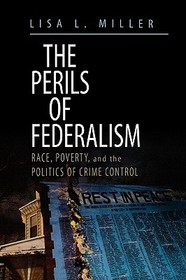
The Perils of Federalism
Race, Poverty, and the Politics of Crime Control
-
10% KEDVEZMÉNY?
- A kedvezmény csak az 'Értesítés a kedvenc témákról' hírlevelünk címzettjeinek rendeléseire érvényes.
- Kiadói listaár GBP 55.00
-
24 832 Ft (23 650 Ft + 5% áfa)
Az ár azért becsült, mert a rendelés pillanatában nem lehet pontosan tudni, hogy a beérkezéskor milyen lesz a forint árfolyama az adott termék eredeti devizájához képest. Ha a forint romlana, kissé többet, ha javulna, kissé kevesebbet kell majd fizetnie.
- Kedvezmény(ek) 10% (kb. 2 483 Ft)
- Kedvezményes ár 22 349 Ft (21 285 Ft + 5% áfa)
Iratkozzon fel most és részesüljön kedvezőbb árainkból!
Feliratkozom
24 832 Ft

Beszerezhetőség
Megrendelésre a kiadó utánnyomja a könyvet. Rendelhető, de a szokásosnál kicsit lassabban érkezik meg.
Why don't you give exact delivery time?
A beszerzés időigényét az eddigi tapasztalatokra alapozva adjuk meg. Azért becsült, mert a terméket külföldről hozzuk be, így a kiadó kiszolgálásának pillanatnyi gyorsaságától is függ. A megadottnál gyorsabb és lassabb szállítás is elképzelhető, de mindent megteszünk, hogy Ön a lehető leghamarabb jusson hozzá a termékhez.
A termék adatai:
- Kiadó OUP USA
- Megjelenés dátuma 2008. augusztus 28.
- ISBN 9780195331684
- Kötéstípus Keménykötés
- Terjedelem264 oldal
- Méret 241x157x21 mm
- Súly 517 g
- Nyelv angol
- Illusztrációk 8 black and white line illustrations 0
Kategóriák
Rövid leírás:
In The Perlis of Federalism, Lisa L. Miller speaks to three major social science disciplines-American politics, criminology, and sociology-on a topic of great import to all of them: interest group participation in the development of crime and justice policy across the local, state and national levels of government. Much of the existing research on race and crime focuses on the manipulation of crime by political elites or the racially biased nature of crime policy. In contrast, Miller's unique study zeroes in on the specific political and socio-legal institutions and actors that drive these developments and their relationship to the politics of race and poverty; in particular, the degree to which citizens at most risk of victimization-primarily racial minorities and the poor-play a role in the development of political responses to crime and violence. Ultimately, The Perils of Federalism challenges the conventional wisdom about the advantages of federalization and explains one of the key disadvantages that local communities face in trying to change policy.
TöbbHosszú leírás:
In the past dozen years, a number of American cities plagued by gun violence have tried to enact local laws to stem gun-related crime. Yet policymakers at the state and federal levels have very frequently stymied their efforts. This is not an atypical phenomenon. In fact, for a whole range of pressing social problems, state and federal policymakers ignore the demands of local communities that suffer from such ills the most. Lisa L. Miller asks, how does America's multi-tiered political system shape crime policy in ways that empower the higher levels of government yet demobilize and disempower local communities? After all, crime has a disproportionate impact on poor and minority communities, which typically connect crime and violence to broader social and economic inequities at the local level. As The Perils of Federalism powerfully demonstrates, though, the real control to set policy lies with the state and federal governments, and at these levels single-issue advocates--gun rights groups as well as prison, prosecutorial and law enforcement agencies--are able to shape policy over the heads of the people most affected by the issue.
There is a tragic irony in this. The conventional wisdom that emerged from the Civil Rights era was that the higher levels of government--and the federal level in particular--best served the disadvantaged, while localities were most likely to ignore the social problems resulting from racial and economic inequality. Crime policy, Miller argues, teaches us an opposite lesson: as policy control migrates to higher levels, the priorities of low-income minority communities are ignored, the realities of racial and economic inequality are marginalized, and citizens lose their voices. Taking readers from the streets of Philadelphia to the halls of Congress, she details how and why our system operates in the way that it does. Ultimately, the book not only challenges what we think about the advantages of relying of federal power for sensible and fair solutions to longstanding social problems. It also highlights the deep disconnect between the structure of the American political system and the ideals of democratic accountability.
This is a breakthrough book that for the first time brings structure of American federalism into the center of the analysis of America's punitive turn and the politics of crime control. Miller has produced compelling evidence that our political institutions, rather than our social peculiarities, provide the most significant explanation for our unprecedented degree of punitiveness.
Tartalomjegyzék:
Abbreviations of Group Names
Interests, Venues and Group Participation
A Political History of Crime on the Congressional Agenda
Contemporary Crime Politics in Congress
Interest Groups and Crime Politics at the State Level
Crime, Law, and Group Politics in Two Urban Locales
Citizenship Through Participation
Democratic Accountability and Social Control
Appendix 1: Congressional Hearings Data
Appendix 2: Pennsylvania Legislative Hearings and Interview Data
Appendix 3: Philadelphia and Pittsburg Legislative Hearings and Interview Data
Notes
Works Cited
Index

