

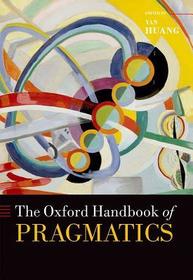
The Oxford Handbook of Pragmatics
Sorozatcím: Oxford Handbooks;
-
10% KEDVEZMÉNY?
- A kedvezmény csak az 'Értesítés a kedvenc témákról' hírlevelünk címzettjeinek rendeléseire érvényes.
- Kiadói listaár GBP 150.00
-
67 725 Ft (64 500 Ft + 5% áfa)
Az ár azért becsült, mert a rendelés pillanatában nem lehet pontosan tudni, hogy a beérkezéskor milyen lesz a forint árfolyama az adott termék eredeti devizájához képest. Ha a forint romlana, kissé többet, ha javulna, kissé kevesebbet kell majd fizetnie.
- Kedvezmény(ek) 10% (kb. 6 773 Ft)
- Kedvezményes ár 60 953 Ft (58 050 Ft + 5% áfa)
Iratkozzon fel most és részesüljön kedvezőbb árainkból!
Feliratkozom
67 725 Ft

Beszerezhetőség
Megrendelésre a kiadó utánnyomja a könyvet. Rendelhető, de a szokásosnál kicsit lassabban érkezik meg.
Why don't you give exact delivery time?
A beszerzés időigényét az eddigi tapasztalatokra alapozva adjuk meg. Azért becsült, mert a terméket külföldről hozzuk be, így a kiadó kiszolgálásának pillanatnyi gyorsaságától is függ. A megadottnál gyorsabb és lassabb szállítás is elképzelhető, de mindent megteszünk, hogy Ön a lehető leghamarabb jusson hozzá a termékhez.
A termék adatai:
- Kiadó OUP Oxford
- Megjelenés dátuma 2017. január 26.
- ISBN 9780199697960
- Kötéstípus Keménykötés
- Terjedelem742 oldal
- Méret 246x171 mm
- Súly 1365 g
- Nyelv angol 0
Kategóriák
Rövid leírás:
This volume brings together distinguished scholars from all over the world to present an authoritative, thorough, and yet accessible state-of-the-art survey of current issues in pragmatics. It covers a wide range of topics and will be an indispensable reference for scholars and students in pragmatics, philosophy of language, and related fields.
TöbbHosszú leírás:
This volume brings together distinguished scholars from all over the world to present an authoritative, thorough, and yet accessible state-of-the-art survey of current issues in pragmatics. Following an introduction by the editor, the volume is divided into five thematic parts. Chapters in Part I are concerned with schools of thought, foundations, and theories, while Part II deals with central topics in pragmatics, including implicature, presupposition, speech acts, deixis, reference, and context. In Part III, the focus is on cognitively-oriented pragmatics, covering topics such as computational, experimental, and neuropragmatics. Part IV takes a look at socially and culturally-oriented pragmatics such as politeness/impoliteness studies, cross- and intercultural, and interlanguage pragmatics. Finally, the chapters in Part V explore the interfaces of pragmatics with semantics, grammar, morphology, the lexicon, prosody, language change, and information structure.
The Oxford Handbook of Pragmatics will be an indispensable reference for scholars and students of pragmatics of all theoretical stripes. It will also be a valuable resource for linguists in other fields, including philosophy of language, semantics, morphosyntax, prosody, psycholinguistics, and sociolinguistics, and for researchers and students in the fields of cognitive science, artificial intelligence, computer science, anthropology, and sociology.
the handbook very successful in promoting recent novel ideas, particularly those that arise from an interdisciplinary approach to central issues in pragmatics.
Tartalomjegyzék:
Preface and acknowledgements
List of symbols and abbreviations
The contributors
Introduction: What is pragmatics?
I: Schools of thought, foundations, and theories
Contextualism vs semantic minimalism
Neo-Gricean pragmatics
Relevance theory
Formal pragmatics: Optimality-theoretic, game-theoretic, and decision-theoretic pragmatics
European Continental perspective view
Sociological foundations
Part II: Central topics
Implicature
Presupposition and givenness
Speech acts
Deixis
Reference
Context
Part III: Macro-pragmatics and cognition
Cognitive pragmatics
Developmental pragmatics
Experimental pragmatics
Computational pragmatics
Clinical pragmatics
Neuropragmatics
Part IV: Macro-pragmatics and society/culture
Politeness and impoliteness
Cross-cultural and intercultural pragmatics
Interlanguage pragmatics
Conversation analysis
Part V: Interfaces
Pragmatics and semantics
Pragmatics and grammar
Pragmatics and morphology: Morphopragmatics
Pragmatics and the lexicon: Lexical pragmatics
Pragmatics and prosody
Pragmatics and language change: Historical pragmatics
Pragmatics and information structure
References
Index

