

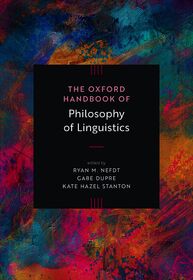
The Oxford Handbook of Philosophy of Linguistics
Sorozatcím: Oxford Handbooks;
-
10% KEDVEZMÉNY?
- A kedvezmény csak az 'Értesítés a kedvenc témákról' hírlevelünk címzettjeinek rendeléseire érvényes.
- Kiadói listaár GBP 150.00
-
67 725 Ft (64 500 Ft + 5% áfa)
Az ár azért becsült, mert a rendelés pillanatában nem lehet pontosan tudni, hogy a beérkezéskor milyen lesz a forint árfolyama az adott termék eredeti devizájához képest. Ha a forint romlana, kissé többet, ha javulna, kissé kevesebbet kell majd fizetnie.
- Kedvezmény(ek) 10% (kb. 6 773 Ft)
- Kedvezményes ár 60 953 Ft (58 050 Ft + 5% áfa)
Iratkozzon fel most és részesüljön kedvezőbb árainkból!
Feliratkozom
67 725 Ft

Beszerezhetőség
Becsült beszerzési idő: A Prosperónál jelenleg nincsen raktáron, de a kiadónál igen. Beszerzés kb. 3-5 hét..
A Prosperónál jelenleg nincsen raktáron.
Why don't you give exact delivery time?
A beszerzés időigényét az eddigi tapasztalatokra alapozva adjuk meg. Azért becsült, mert a terméket külföldről hozzuk be, így a kiadó kiszolgálásának pillanatnyi gyorsaságától is függ. A megadottnál gyorsabb és lassabb szállítás is elképzelhető, de mindent megteszünk, hogy Ön a lehető leghamarabb jusson hozzá a termékhez.
A termék adatai:
- Kiadó OUP Oxford
- Megjelenés dátuma 2026. május 28.
- ISBN 9780198879640
- Kötéstípus Keménykötés
- Terjedelem704 oldal
- Méret 253x182x45 mm
- Súly 1372 g
- Nyelv angol
- Illusztrációk 16 black-and-white illustrations 784
Kategóriák
Rövid leírás:
This Handbook introduces key issues in the philosophy of linguistics as currently practised. It provides an advanced introduction to some topics in the philosophy of linguistics and offers fresh approaches to new problems in the language sciences.
TöbbHosszú leírás:
This Handbook presents cutting edge articles on the present state-of-the-art in the philosophy of linguistics. It features prominent linguists, philosophers, and cognitive scientists investigating foundational issues across subdisciplines of linguistics, cognitive science, and computational approaches to the study of language. In addition to providing a broad overview of the field, it offers novel interpretations and accounts of pressing issues across the interdisciplinary landscape of the language sciences.
With chapters on the foundations of syntax, metasemantics, phonology, computational linguistics, developmental linguistics, and cognitive neurolinguistics, the Handbook will be a valuable resource for those interested in the origins of language, its formal underpinnings, its cognitive implementation, and its social manifestations. The collected chapters both introduce a wide range of related fields and identifies core philosophical assumptions and implications. Previously neglected topics in philosophy of language and philosophical reflections on linguistics covered here include field linguistics and research, sociolinguistics, and the intersecting history of the philosophy of language and linguistic theory. The Handbook aims to inspire new research by thoroughly investigating, analyzing, and clarifying the foundations of linguistics while promoting unique avenues for future collaborations.
Tartalomjegyzék:
Introduction
PART I: ONTOLOGY
Platonism in the Philosophy of Linguistics
Rules of Grammar
Levels and Strata in Linguistic Modeling: Cross-Domain Considerations
What Phonology Is and Why it Should Be
Merge
Words
PART II: METHODOLOGY
Breadth versus Depth: Theoretical Reasons for System-Independent Comparison of Languages
Research Methods in Armchair Linguistics
Some Thoughts on Formalization in Linguistics
What Experimentation Reveals about Linguistic Meaning and its Cognitive Structure
Philosophical and Linguistic Intuitions and the Core-Periphery Distinction
Do the Laws of Semantics Lie?
How and Why To Draw The Competence/Performance Distinction
PART III: METASEMANTICS AND METAPRAGMATICS
The Inferential Construal of Meaning
Lexical Semantics and Philosophy
Acquiring a Meaning for More
Degrees of Grammaticalization in Scalar and Quantity-Based Implicatures
Pragmatics as Psychology: Language, Animal Communication, and Protolanguage
Dynamic Syntax: Foundations and Developments
Minimal Bayesian Foundations for Pragmatics
PART IV: PHILOSOPHY OF UNDEREXPLORED LINGUISTIC DISCIPLINES
Research Ethics in Linguistic Fieldwork
A Guide to Sociolinguistics as De-idealisation
Explanation in the Neuroscience of Language
Language Models as Models of Language
PART V: EXTENSIONS AND APPLICATIONS
Pictorial Language and Linguistics
The Primate Gestural Meaning Continuum
The Philosophy of Online Speech
Countability: Linguistic Thoughts for Philosophers; Philosophic Thoughts for Linguists
Some Linguistic Truths about True Sentences
Creativity: Creative and Uncreative

