

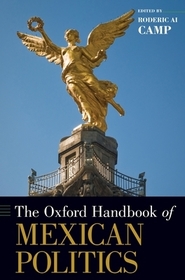
The Oxford Handbook of Mexican Politics
Sorozatcím: Oxford Handbooks;
-
10% KEDVEZMÉNY?
- A kedvezmény csak az 'Értesítés a kedvenc témákról' hírlevelünk címzettjeinek rendeléseire érvényes.
- Kiadói listaár GBP 175.00
-
83 606 Ft (79 625 Ft + 5% áfa)
Az ár azért becsült, mert a rendelés pillanatában nem lehet pontosan tudni, hogy a beérkezéskor milyen lesz a forint árfolyama az adott termék eredeti devizájához képest. Ha a forint romlana, kissé többet, ha javulna, kissé kevesebbet kell majd fizetnie.
- Kedvezmény(ek) 10% (cc. 8 361 Ft off)
- Kedvezményes ár 75 246 Ft (71 663 Ft + 5% áfa)
Iratkozzon fel most és részesüljön kedvezőbb árainkból!
Feliratkozom
83 606 Ft

Beszerezhetőség
Megrendelésre a kiadó utánnyomja a könyvet. Rendelhető, de a szokásosnál kicsit lassabban érkezik meg.
Why don't you give exact delivery time?
A beszerzés időigényét az eddigi tapasztalatokra alapozva adjuk meg. Azért becsült, mert a terméket külföldről hozzuk be, így a kiadó kiszolgálásának pillanatnyi gyorsaságától is függ. A megadottnál gyorsabb és lassabb szállítás is elképzelhető, de mindent megteszünk, hogy Ön a lehető leghamarabb jusson hozzá a termékhez.
A termék adatai:
- Kiadó OUP USA
- Megjelenés dátuma 2012. február 16.
- ISBN 9780195377385
- Kötéstípus Keménykötés
- Terjedelem840 oldal
- Méret 249x178x66 mm
- Súly 1520 g
- Nyelv angol 0
Kategóriák
Rövid leírás:
Over the course of the thirty-one essays in The Oxford Handbook of Mexican Politics some of the world's leading scholars of Mexico will provide a comprehensive view of the remarkable transformation of the nation's political system to a democratic model. In turn they will assess the most influential institutions, actors, policies and issues in its current evolution toward democratic consolidation.
TöbbHosszú leírás:
Since achieving independence from Spain and establishing its first constitution in 1824, Mexico has experienced numerous political upheavals. The country's long and turbulent journey toward democratic, representative government has been marked by a tension between centralized, autocratic governments (historically depicted as a legacy of colonial institutions) and federalist structures. The years since Mexico's independence have seen a major violent social revolution, years of authoritarian rule, and, finally, in the past two decades, the introduction of a fair and democratic electoral process.
Over the course of the thirty-one essays in The Oxford Handbook of Mexican Politics some of the world's leading scholars of Mexico will provide a comprehensive view of the remarkable transformation of the nation's political system to a democratic model. In turn they will assess the most influential institutions, actors, policies and issues in its current evolution toward democratic consolidation. Following an introduction by Roderic Ai Camp, sections will explore the current state of Mexico's political development; transformative political institutions; the changing roles of the military, big business, organized labor, and the national political elite; new political actors including the news media, indigenous movements, women, and drug traffickers; electoral politics; demographics and political attitudes; and policy issues.
Mexican politics are complicated, but they are not inexplicable. In this timely contribution, Roderic Camp has overseen a large-scale effort to decipher the rules and traditions of political activity in Mexico. To understand how Mexico came to this moment, this book of essays is indispensable. Policymakers on both sides of the border, students and professors, as well as the educated public with an interest in the region, would do well to take on this volume, to read and digest the deep learning of the contributors, and, by doing so, form a more coherent and intellectually honest vision of the future of Mexican politics.
Tartalomjegyzék:
About the Contributors
Part I: Introduction
1. The Democratic Transformation of Mexican Politics- Roderic Ai Camp
Part II: Political Development
2. Democracy from Independence to Revolution - Jaime E. Rodríguez O.
3. Mexican Elections, 1910 to 1994: Voters, Violence and Veto Power - Paul Gillingham
4. Mexican Democracy in Comparative Perspective - Peter H. Smith
Part III: Institutions as Transformational Actors
5. Municipalities and Policy Making - Andrew Selee
6. Invigorating Federalism: the Emergence of Governors and State Legislatures as Powerbrokers and Policy Innovators - Caroline C. Beer
7. The Dinosaur that Evolved: Changes to the PRI's Gubernatorial Candidate Selection, 1980 to 2009 - Joy Langston
8. Holding Power: The PAN as Mexico's Incumbent Party - Steven T. Wuhs
9. PRD and the Left - Kathleen Bruhn
10. Ulysses, the Sirens, and Mexico's Judiciary: Increasing Pre-Commitments to Strengthen the Rule of Law - Todd A. Eisenstadt and Jennifer Yelle
11. The Fall of the Dominant Presidency: Lawmaking under Divided Government in Mexico - Benito Nacif
Part IV: Changing Roles
12. Civil-Military Relations in Mexico: The Unfinished Transition - Jordi Diez
13. Mexican Political Elites in a Democratic Setting - Roderic Ai Camp
14. Big Business, Democracy, and the Politics of Competition - Strom Thacker
15. Organized Labor and Politics in Mexico - Graciela Bensusán and Kevin J. Middlebrook
Part V: New Actors
16. Democracy in the Newsroom: The Evolution of Journalism and the News Media - Sallie Hughes
17. Social and Indigenous Movements in Mexico's Transition to Democracy
- Shannan Mattiace
18. Human Rights and NGO's - Mariclaire Acosta
19. Women and Grassroots Politics - Victoria E. Rodríguez
20. Drug-Traffickers as Political Actors in Mexico's Nascent Democracy - John Bailey
Part VI: Electoral Politics and the Changing Political Landscape
21. Changing Dimensions of National Political Elections - James A. McCann
22. Mexico's Campaigns and the Benchmark Elections of 2000 and 2006 - Jorge I. Domínguez
23. The Return of "the Local " to Mexican Politics - Jonathan Hiskey
Part VII: Demographics and Political Attitudes
24. Who is the Mexican Voter? - Alejandro Moreno
25. Polling and Pollsters as Agents of Change: An Historical Account of Public Opinion
Research in Mexico from 1938 to 2010 - Pablo Páras and Miguel Basáñez
26. Regionalism in Mexican Electoral Politics - Joseph L. Klesner
Part VIII: Politics and Policy Issues
27. United States-Mexican Relations and Mexican Domestic Politics - Pamela K. Starr
28. Domestic and National Security Challenges in Mexico - David A. Shirk
29. Mexico-US Migration Policy: Historical Review and Contemporary Challenges
- Marc R. Rosenblum
30. Economy as Grand-Guignol: The Post-reform Era in Mexico- William P. Glade
31. The Path of Economic Liberalism - Mark Eric Williams
Index

