

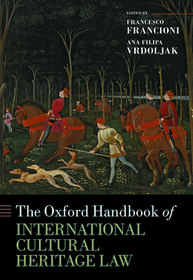
The Oxford Handbook of International Cultural Heritage Law
Sorozatcím: Oxford Handbooks;
-
10% KEDVEZMÉNY?
- A kedvezmény csak az 'Értesítés a kedvenc témákról' hírlevelünk címzettjeinek rendeléseire érvényes.
- Kiadói listaár GBP 215.00
-
97 072 Ft (92 450 Ft + 5% áfa)
Az ár azért becsült, mert a rendelés pillanatában nem lehet pontosan tudni, hogy a beérkezéskor milyen lesz a forint árfolyama az adott termék eredeti devizájához képest. Ha a forint romlana, kissé többet, ha javulna, kissé kevesebbet kell majd fizetnie.
- Kedvezmény(ek) 10% (cc. 9 707 Ft off)
- Kedvezményes ár 87 365 Ft (83 205 Ft + 5% áfa)
Iratkozzon fel most és részesüljön kedvezőbb árainkból!
Feliratkozom
97 072 Ft

Beszerezhetőség
Megrendelésre a kiadó utánnyomja a könyvet. Rendelhető, de a szokásosnál kicsit lassabban érkezik meg.
Why don't you give exact delivery time?
A beszerzés időigényét az eddigi tapasztalatokra alapozva adjuk meg. Azért becsült, mert a terméket külföldről hozzuk be, így a kiadó kiszolgálásának pillanatnyi gyorsaságától is függ. A megadottnál gyorsabb és lassabb szállítás is elképzelhető, de mindent megteszünk, hogy Ön a lehető leghamarabb jusson hozzá a termékhez.
A termék adatai:
- Kiadó OUP Oxford
- Megjelenés dátuma 2020. július 23.
- ISBN 9780198859871
- Kötéstípus Keménykötés
- Terjedelem1086 oldal
- Méret 259x173x57 mm
- Súly 1818 g
- Nyelv angol 206
Kategóriák
Rövid leírás:
This Handbook provides a cutting edge study of international cultural heritage law, taking stock of the recent developments, core concepts, and current challenges.
TöbbHosszú leírás:
This Handbook provides a cutting edge study of the fast developing field of international law on the protection of cultural heritage by taking stock of the recent developments and of the core concepts and current challenges. The legal protection of cultural heritage has come under renewed focus from the international community and states since the 1990s. This is evidenced by the adoption of a range of international instruments. Countries are also enacting cultural heritage legislation or overhauling existing laws within their own national territory.
Contributions address the protection of immovable and movable, tangible and intangible cultural heritage in peacetime and in the event of armed conflict as well as the interaction between specific regimes of cultural heritage protection with other fields of international law, including international criminal law, human rights and humanitarian law, environmental law, international trade, investments, and intellectual property. The last part of the Handbook covers diverse regional systems of heritage protection.
Tartalomjegyzék:
Introduction
Part I: Historical Overview
The Intellectual Cooperation Organisation, UNESCO and Culture Conventions: A Historical Overview
Part II: Substantive Aspects
Cultural Heritage and International Humanitarian Law
Intentional Destruction of Heritage
Cultural Heritage and International Criminal Law
Cultural Heritage and the Responsibility to Protect
Cultural Heritage and Disasters
Cultural Heritage, Transitional Justice and Rule of Law
Theft and Illicit Excavation
Illicit Export, Import, and Transfer
World Heritage
Landscapes as Cultural Heritage
Underwater Cultural Heritage
Cultural Heritage and the Environment
Intangible Cultural Heritage
Language as Cultural Heritage
Cultural Heritage and Human Rights
Cultural Heritage and Indigenous Peoples
Cultural Heritage and Women
Cultural Heritage and Intellectual Property
Cultural Heritage and International Investment Law
Cultural Heritage, Cultural Diversity, and International Trade Law
Part III: General International Law
The Role of Custom and General Principles of International Law
Cultural Heritage and State Immunity
Cultural Heritage and State Succession
Cultural Heritage and State Responsibility
Remedies
Part IV: Procedural and Institutional Aspects
International Dispute Adjudication Mechanisms
The Role of Domestic Courts
Alternative Dispute Settlement Mechanisms
Institutional Aspects
Participation of Non-state Actors
Codes of Ethics
Part V: Regional Approaches
Africa
Asia
Oceania
Central and South America
Europe (EU and Council of Europe)
Middle East
North America

