

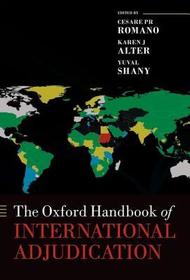
The Oxford Handbook of International Adjudication
Sorozatcím: Oxford Handbooks;
-
10% KEDVEZMÉNY?
- A kedvezmény csak az 'Értesítés a kedvenc témákról' hírlevelünk címzettjeinek rendeléseire érvényes.
- Kiadói listaár GBP 52.00
-
23 478 Ft (22 360 Ft + 5% áfa)
Az ár azért becsült, mert a rendelés pillanatában nem lehet pontosan tudni, hogy a beérkezéskor milyen lesz a forint árfolyama az adott termék eredeti devizájához képest. Ha a forint romlana, kissé többet, ha javulna, kissé kevesebbet kell majd fizetnie.
- Kedvezmény(ek) 10% (cc. 2 348 Ft off)
- Kedvezményes ár 21 130 Ft (20 124 Ft + 5% áfa)
Iratkozzon fel most és részesüljön kedvezőbb árainkból!
Feliratkozom
23 478 Ft

Beszerezhetőség
Becsült beszerzési idő: A Prosperónál jelenleg nincsen raktáron, de a kiadónál igen. Beszerzés kb. 3-5 hét..
A Prosperónál jelenleg nincsen raktáron.
Why don't you give exact delivery time?
A beszerzés időigényét az eddigi tapasztalatokra alapozva adjuk meg. Azért becsült, mert a terméket külföldről hozzuk be, így a kiadó kiszolgálásának pillanatnyi gyorsaságától is függ. A megadottnál gyorsabb és lassabb szállítás is elképzelhető, de mindent megteszünk, hogy Ön a lehető leghamarabb jusson hozzá a termékhez.
A termék adatai:
- Kiadó OUP Oxford
- Megjelenés dátuma 2015. november 5.
- ISBN 9780198748281
- Kötéstípus Puhakötés
- Terjedelem1072 oldal
- Méret 246x171 mm
- Súly 1424 g
- Nyelv angol 0
Kategóriák
Rövid leírás:
This Oxford Handbook provides interdisciplinary perspectives on international adjudication, analysing the proliferation of international courts and tribunals from the perspective of both international law and political science. It presents the different theoretical approaches to these courts, their main functions, and the issues confronting them.
TöbbHosszú leírás:
The post-Cold War proliferation of international adjudicatory bodies and increase in litigation has greatly affected international law and politics. A growing number of international courts and tribunals, exercising jurisdiction over international crimes and sundry international disputes, have become, in some respects, the lynchpin of the international legal system.
The Oxford Handbook of International Adjudication charts the transformations in international adjudication that took place astride the twentieth and twenty-first century, bringing together the insight of 47 prominent legal, philosophical, ethical, political, and social science scholars. Overall, the 40 contributions in this Handbook provide an original and comprehensive understanding of the various contemporary forms of international adjudication. The Handbook is divided into six parts. Part I provides an overview of the origins and evolution of international adjudicatory bodies, from the nineteenth century to the present, highlighting the dynamics driving the multiplication of international adjudicative bodies and their uneven expansion. Part II analyses the main families of international adjudicative bodies, providing a detailed study of state-to-state, criminal, human rights, regional economic, and administrative courts and tribunals, as well as arbitral tribunals and international compensation bodies. Part III lays out the theoretical approaches to international adjudication, including those of law, political science, sociology, and philosophy. Part IV examines some contemporary issues in international adjudication, including the behavior, role, and effectiveness of international judges and the political constraints that restrict their function, as well as the making of international law by international courts and tribunals, the relationship between international and domestic adjudicators, the election and selection of judges, the development of judicial ethical standards, and the financing of international courts. Part V examines key actors in international adjudication, including international judges, legal counsel, international prosecutors, and registrars. Finally, Part VI overviews select legal and procedural issues facing international adjudication, such as evidence, fact-finding and experts, jurisdiction and admissibility, the role of third parties, inherent powers, and remedies.
The Handbook is an invaluable and thought-provoking resource for scholars and students of international law and political science, as well as for legal practitioners at international courts and tribunals.
Tartalomjegyzék:
Part I: Mapping International Adjudicative Bodies
Mapping International Adjudicative Bodies, the Issues, and Players
Illustrations: A Reader's Guide
The History of International Adjudication
The Multiplication of International Courts and Tribunals after the End of the Cold War
The Shadow Zones of International Judicialization
Trial and Error in International Judicialization
The Challenge of "Proliferation": An Anatomy of the Debate
What are International Judges For? The Main Functions of International Adjudication
Part II: Orders and Families of International Adjudicative Bodies
International Judicial Bodies for Resolving Disputes Between States
International Criminal Courts
International Human Rights Courts
Courts of Regional Economic and Political Integration Agreements
International Claims and Compensation Bodies
Investment Arbitration
International Administrative Tribunals
Part III: Theoretical Approaches to Studying International Adjudication
Transnational Legal Process Theories
Political Science and International Adjudication
Sociological Approaches to International Courts
Legal Philosophical Issues of International Adjudication: Getting Over the "Amour Impossible" between International Law and Adjudication
Part IV: Contemporary Issues in International Adjudication
Compliance with Judgments and Decisions
The Effectiveness of International Adjudicators
Political Constraints on International Courts
The Spell of Precedents: Lawmaking by International Courts and Tribunals
Conversations among Courts: Domestic and International Adjudicators
International Judicial Behavior
Who Litigates and Why
The Financing of International Adjudication
Part V: Key Actors
Who are International Judges?
The International Bar
Communities of International Litigators
The Role of the International Prosecutor
Defense Counsel in International Criminal Trials
The Role of Registries and Legal Secretariats in International Judicial Institutions
Part VI: Selected Legal and Procedural Issues of International Adjudication
The Selection of International Judges
International Judicial Ethics
Jurisdiction and Admissibility
Third Parties
Inherent Powers in International Adjudication
Evidence, Fact-Finding, and Experts
Remedies
Annex 1: International Judicial Bodies: Recapitulation
Annex 2: States Subject to Compulsory Jurisdiction

