

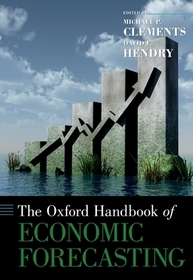
The Oxford Handbook of Economic Forecasting
Sorozatcím: Oxford Handbooks;
-
10% KEDVEZMÉNY?
- A kedvezmény csak az 'Értesítés a kedvenc témákról' hírlevelünk címzettjeinek rendeléseire érvényes.
- Kiadói listaár GBP 167.50
-
75 626 Ft (72 025 Ft + 5% áfa)
Az ár azért becsült, mert a rendelés pillanatában nem lehet pontosan tudni, hogy a beérkezéskor milyen lesz a forint árfolyama az adott termék eredeti devizájához képest. Ha a forint romlana, kissé többet, ha javulna, kissé kevesebbet kell majd fizetnie.
- Kedvezmény(ek) 10% (kb. 7 562 Ft)
- Kedvezményes ár 68 064 Ft (64 823 Ft + 5% áfa)
Iratkozzon fel most és részesüljön kedvezőbb árainkból!
Feliratkozom
75 626 Ft

Beszerezhetőség
Megrendelésre a kiadó utánnyomja a könyvet. Rendelhető, de a szokásosnál kicsit lassabban érkezik meg.
Why don't you give exact delivery time?
A beszerzés időigényét az eddigi tapasztalatokra alapozva adjuk meg. Azért becsült, mert a terméket külföldről hozzuk be, így a kiadó kiszolgálásának pillanatnyi gyorsaságától is függ. A megadottnál gyorsabb és lassabb szállítás is elképzelhető, de mindent megteszünk, hogy Ön a lehető leghamarabb jusson hozzá a termékhez.
A termék adatai:
- Kiadó OUP USA
- Megjelenés dátuma 2011. július 28.
- ISBN 9780195398649
- Kötéstípus Keménykötés
- Terjedelem744 oldal
- Méret 180x249x40 mm
- Súly 1333 g
- Nyelv angol
- Illusztrációk 49 line drawings 0
Kategóriák
Rövid leírás:
This Handbook provides up-to-date coverage of both new developments and well-established fields in the sphere of economic forecasting. The chapters are written by world experts in their respective fields, and are authoritative yet accessible.
TöbbHosszú leírás:
This Handbook provides up-to-date coverage of both new developments and well-established fields in the sphere of economic forecasting. The chapters are written by world experts in their respective fields, and provide authoritative yet accessible accounts of the key concepts, subject matter and techniques in a number of diverse but related areas. It covers the ways in which the availability of ever more plentiful data and computational power have been used in forecasting, either in terms of the frequency of observations, the number of variables, or the use of multiple data vintages. Greater data availability has been coupled with developments in statistical theory and economic theory to allow more elaborate and complicated models to be entertained; the volume provides explanations and critiques of these developments. These include factor models, DSGE models, restricted vector autoregressions, and non-linear models, as well as models for handling data observed at mixed frequencies, high-frequency data, multiple data vintages, and methods for forecasting when there are structural breaks, and how breaks might be forecast.
Also covered are areas which are less commonly associated with economic forecasting, such as climate change, health economics, long-horizon growth forecasting, and political elections. Econometric forecasting has important contributions to make in these areas, as well as their developments informing the mainstream. In the early 21st century, climate change and the forecasting of health expenditures and population are topics of pressing importance.
The Oxford Handbook of Economic Forecasting by Clements and Hendry is an impressive collection of surveys by some of the leaders in the profession. These surveys explain and update many of the important intellectual contributions to the theory of forecasting. Along the way there are descriptions of data issues and detailed applications.
Tartalomjegyzék:
Introduction. Michael Clements and David Hendry
Part 1. Forecasting models and methods
1. VARs, cointegration and common cycle restrictions
Heather Anderson and Farshid Vahid
2. Dynamic factor models
James Stock and Mark Watson
3 Forecasting with non-linear models
Anders Kock and Timo Teräsvirta
4 Forecasting with DSGE models
Kai Christoffel , Günter Coenen and Anders Warne
5 Unobserved components
Siem Jan Koopman and Marius Ooms
6 Judgmental forecasting
Paul Goodwin, Dilek Önkal and Michael Lawrence
Part 2. Data issues
7 Nowcasting
Marta Ba?bura, Domenico Giannone and Lucrezia Reichlin
8 Forecasting with mixed-frequency data
Elena Andreou, Eric Ghysels and Andros Kourtellos
9 Forecasting with real-time data vintages
Dean Croushore
Part 3. Forecasting and Structural breaks
10 Forecasting and structural breaks
Michael Clements and David Hendry
11 Forecasting breaks and forecasting during breaks
Jennifer Castle, David Hendry, and Nicholas Fawcett
12 Forecast combination
Marco Aiolfi, Carlos Capistrán and Allan Timmermann
Part 4. Forecast evaluation
13 Multiple forecast model evaluation
Valentina Corradi and Walter Distaso
14 Testing for unconditional predictive ability
Todd Clark and Michael McCracken
15 Testing for conditional predictive ability
Raffaella Giacomini
16 Interpreting and Combining Heterogeneous Survey Forecasts
Charles Manski
17 Use and Evaluation of Panels of Forecasts
Antony Davies, Kajal Lahiri and Xuguang Sheng
Part 5. Financial forecasting
18 Forecasting Financial Time Series
Terence Mills
19 Volatility Forecasting Using High Frequency Data
Peter Hansen and Asger Lunde
Part 6. Special Interest Areas
20 Economic value of weather and climate Forecasts
Richard Katz and Jeff Lazo
21 Long-horizon Growth forecasting And Demography
Thomas Lindh
22 Energy Market forecasting
Derek Bunn and Nektaria Karakatsani
23 Models for Health Care
Andrew Jones
24 Political and election forecasting
Michael Lewis-Beck and Charles Tien
25 Marketing & sales
Philip-Hans Franses

