

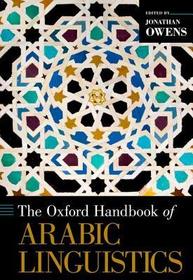
The Oxford Handbook of Arabic Linguistics
Sorozatcím: Oxford Handbooks;
-
10% KEDVEZMÉNY?
- A kedvezmény csak az 'Értesítés a kedvenc témákról' hírlevelünk címzettjeinek rendeléseire érvényes.
- Kiadói listaár GBP 170.00
-
76 755 Ft (73 100 Ft + 5% áfa)
Az ár azért becsült, mert a rendelés pillanatában nem lehet pontosan tudni, hogy a beérkezéskor milyen lesz a forint árfolyama az adott termék eredeti devizájához képest. Ha a forint romlana, kissé többet, ha javulna, kissé kevesebbet kell majd fizetnie.
- Kedvezmény(ek) 10% (cc. 7 676 Ft off)
- Kedvezményes ár 69 080 Ft (65 790 Ft + 5% áfa)
Iratkozzon fel most és részesüljön kedvezőbb árainkból!
Feliratkozom
76 755 Ft

Beszerezhetőség
Megrendelésre a kiadó utánnyomja a könyvet. Rendelhető, de a szokásosnál kicsit lassabban érkezik meg.
Why don't you give exact delivery time?
A beszerzés időigényét az eddigi tapasztalatokra alapozva adjuk meg. Azért becsült, mert a terméket külföldről hozzuk be, így a kiadó kiszolgálásának pillanatnyi gyorsaságától is függ. A megadottnál gyorsabb és lassabb szállítás is elképzelhető, de mindent megteszünk, hogy Ön a lehető leghamarabb jusson hozzá a termékhez.
A termék adatai:
- Kiadó OUP USA
- Megjelenés dátuma 2013. október 3.
- ISBN 9780199764136
- Kötéstípus Keménykötés
- Terjedelem624 oldal
- Méret 249x178x43 mm
- Súly 1179 g
- Nyelv angol
- Illusztrációk 14 black and white drawings 0
Kategóriák
Rövid leírás:
Gives critical expression to a language which covers large populations and geographical areas, has a long written tradition, and has been the locus of major intellectual fervor and debate.
TöbbHosszú leírás:
Until about 60 years ago, linguistic research on the Arabic language in the West was restricted to inquiries on Classical Arabic and the Classical tradition, and spoken Arabic dialects, with historical studies embedded within the broader field of Semitic languages. This situation is changing quickly, not only through the continuation of older research traditions, but also with the integration of new research fields and perspectives. With this expansion comes the danger of specialists in Arabic losing an overview of the field, and of leaving non-specialists without basic resources for evaluating domains of research which they may be interested in for comparative purposes. The Oxford Handbook of Arabic Linguistics will confront this problem by combining state-of-the-art overviews with essays on issues of perspective, controversy, and point of view. In twenty-four chapters, leading experts from around the world will lay out their own stances on controversial issues. The book not only evaluates ways in which questions and theories established in general linguistics and its sub-fields elucidate Arabic, but also challenges approaches which might result in accommodating Arabic to "non-Arabic" interpretations, and brings out the Arabic specificity of individual problems. The Handbook, in one compact volume, gives critical expression to a language which covers large populations and geographical areas, has a long written tradition, and has been the locus of major intellectual fervor and debate.
TöbbTartalomjegyzék:
1. A house of sound structure, of marvelous form and proportion: An Introduction
Jonathan Owens
2. Phonetics
Mohamed Embarki
3. Phonology
Sam Hellmuth
4. Morphology
Robert Ratcliffe
5. Arabic Linguistic Tradition I: NaHw and Sarf
Ramzi Baalbaki
6. The Syntax of Arabic from a Generative Perspective
Elabbas Benmamoun and Lina Choueiri
7. The Philological Approach to Arabic Grammar
Lutz Edzard
8. The Arabic Linguistic Tradition II: Beyond Grammar
Pierre Larcher
9. Issues in Arabic Computational Linguistics
Everhard Ditters
10. Sociolinguistics
Enam Al-Wer
11. Arabic Folk Linguistics: Between Mother-tongue and Native Language
Yasir Suleiman
12. Orality, Culture and Language
Clive Holes
13. Dialects and Dialectology
Peter Behnstedt and Manfred Woidich,
14. Codeswitching and Codemixing Involving Arabic
Abdelali Bentahila, Eirlys Davies, and Jonathan Owens
15. Borrowing
Maarten Kossmann
16. Psycholinguistics
Sami Boudelaa
17. Arabic Second Language Acquisition
Karin Ryding
18. The Arabic Writing System
Peter Daniels
19. What is Arabic?
Jan Retsö
20. History
Jonathan Owens
21. The Arabic Literary Language: The NahDa (and Beyond)
Daniel Newman
22. Creoles and Pidgins
Mauro Tosco and Stefano Manfredi
23. Lexicography in the Classical Era
Solomon Sara, Georgetown University
24. Modern Lexicography
Tim Buckwalter and Dilworth Parkinson

