

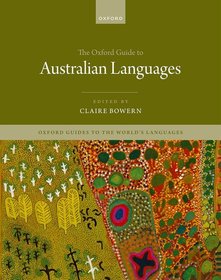
The Oxford Guide to Australian Languages
Sorozatcím: Oxford Guides to the World's Languages;
-
10% KEDVEZMÉNY?
- A kedvezmény csak az 'Értesítés a kedvenc témákról' hírlevelünk címzettjeinek rendeléseire érvényes.
- Kiadói listaár GBP 152.50
-
68 853 Ft (65 575 Ft + 5% áfa)
Az ár azért becsült, mert a rendelés pillanatában nem lehet pontosan tudni, hogy a beérkezéskor milyen lesz a forint árfolyama az adott termék eredeti devizájához képest. Ha a forint romlana, kissé többet, ha javulna, kissé kevesebbet kell majd fizetnie.
- Kedvezmény(ek) 10% (cc. 6 885 Ft off)
- Kedvezményes ár 61 968 Ft (59 018 Ft + 5% áfa)
Iratkozzon fel most és részesüljön kedvezőbb árainkból!
Feliratkozom
68 853 Ft

Beszerezhetőség
Becsült beszerzési idő: A Prosperónál jelenleg nincsen raktáron, de a kiadónál igen. Beszerzés kb. 3-5 hét..
A Prosperónál jelenleg nincsen raktáron.
Why don't you give exact delivery time?
A beszerzés időigényét az eddigi tapasztalatokra alapozva adjuk meg. Azért becsült, mert a terméket külföldről hozzuk be, így a kiadó kiszolgálásának pillanatnyi gyorsaságától is függ. A megadottnál gyorsabb és lassabb szállítás is elképzelhető, de mindent megteszünk, hogy Ön a lehető leghamarabb jusson hozzá a termékhez.
A termék adatai:
- Kiadó OUP Oxford
- Megjelenés dátuma 2023. június 13.
- ISBN 9780198824978
- Kötéstípus Keménykötés
- Terjedelem1178 oldal
- Méret 284x226x61 mm
- Súly 2862 g
- Nyelv angol 412
Kategóriák
Rövid leírás:
This book is a wide-ranging reference work covering the more than 550 Indigenous languages of Australia. The chapters in the book explore typology and classification; linguistic structures; sociolinguistics and language variation; and language in the community. The final part offers sketches of a selection of languages, sub-groups, and families.
TöbbHosszú leírás:
The Oxford Guide to Australian Languages is a wide-ranging reference work that explores the more than 550 traditional and new Indigenous languages of Australia. Australian languages have long played an important role in diachronic and synchronic linguistics and are a vital testing ground for linguistic theory. Until now, however, there has been no comprehensive and accessible guide to the their vast linguistic diversity. This volume fills that gap, bringing together leading scholars and junior researchers to provide an up-to-date guide to all aspects of the languages of Australia. The chapters in the book explore typology, documentation, and classification; linguistic structures from phonology to pragmatics and discourse; sociolinguistics and language variation; and language in the community. The final part offers grammatical sketches of a selection of languages, sub-groups, and families. At a time when the number of living Australian languages is significantly reduced even compared to twenty year ago, this volume establishes priorities for future linguistic research and contributes to the language expansion and revitalization efforts that are underway.
Bowern and her seventy-six contributors (fifty-five of them based in Australian institutions) masterfully deliver on the book's promise advanced in several thoughtfully detailed introductory chapters exploring both the historical landscape and taxonomies of these languages (both old and new) and the intricacies of documentation methods that aim to preserve them [...] Moreover, the Guide goes the extra mile to correct widespread misconceptions stemming from broad over-generalisations about the capabilities and characteristics of Indigenous languages, ensuring that they are presented in an authentic light and given just representation.
Tartalomjegyzék:
Detailed contents
Series preface
Abbreviations and conventions
The contributors
Language maps
Australian language families and linguistic classifications
Foreword
Introduction
Part I: Background
A history of the early description of Australian languages
Documentation of Australian languages
Australian languages and syntactic theory
Australian languages and interdisciplinary approaches to the past
Nineteenth-century classifications of Australian languages
How many languages are and were spoken in Australia?
Philological methods for Australian languages
Part II: Structures
A: Phonetics and phonology
Articulatory and acoustic phonetics
Segment inventories
Phonotactics
Morphophonology: Lenition and assimilation
Nasal cluster dissimilation
Lexical stress
Intonation
Sound change
B: Morphosyntax
Word classes
The noun phrase
Noun classes
Ergativity
Semantic case
Possession
Demonstratives
Pronouns
Adjectives and adverbs
Complex predication and serialization
Conjugation classes
Agreement morphology
Suppletion
Valency change and causation
Reflexives and reciprocals
Tense and aspect
Modality and mood
Negation
Word order
Questions
Subordination
Relative clauses
Antipassives
Morphological change
C: Semantics, pragmatics, and discourse
Quantification
Direction and location
Kinship, marriage, and skins
Toponyms
Discourse and social interaction
Narrative
Interjections
Insults and compliments
Language names
Part III: Sociolinguistics and language variation
The verbal arts in Indigenous Australia
Sociolinguistic variation
Australian Indigenous sign languages
Gender-based dialects
Multilingualism
Code-switching
Language contact
Kriol
Young people's varieties
Restricted respect registers and auxiliary languages
Language input and child-directed speech
Part IV: Language in the Community
Language policy, planning, and standardization
Indigenous children's language practices in Australia
Technology for Australian languages
Language revival
Language, land, identity, and well-being
Part V: Structural sketches of languages, subgroups, and families
Contact language case studies
The Gunwinyguan languages
Anindilyakwa
Languages of the Kimberley region
The Maningrida languages
Living languages of Victoria
Lamalamic (Paman)
The Bandialangic languages and dialects
Noongar
The Wati (Western Desert) subgroup of Pama-Nyungan
Ngumpin-Yapa languages
Wajarri
The revitalization of the sleeping Tasmanian Aboriginal languages: palawa kani
References
Index

