

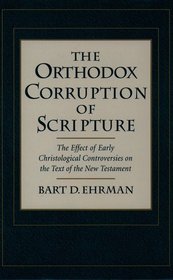
The Orthodox Corruption of Scripture
The Effect of Early Christological Controversies on the Text of the New Testament
-
10% KEDVEZMÉNY?
- A kedvezmény csak az 'Értesítés a kedvenc témákról' hírlevelünk címzettjeinek rendeléseire érvényes.
- Kiadói listaár GBP 17.00
-
7 675 Ft (7 310 Ft + 5% áfa)
Az ár azért becsült, mert a rendelés pillanatában nem lehet pontosan tudni, hogy a beérkezéskor milyen lesz a forint árfolyama az adott termék eredeti devizájához képest. Ha a forint romlana, kissé többet, ha javulna, kissé kevesebbet kell majd fizetnie.
- Kedvezmény(ek) 10% (kb. 767 Ft)
- Kedvezményes ár 6 908 Ft (6 579 Ft + 5% áfa)
Iratkozzon fel most és részesüljön kedvezőbb árainkból!
Feliratkozom
7 675 Ft

Beszerezhetőség
A kiadónál véglegesen elfogyott, nem rendelhető. Érdemes újra keresni a címmel, hátha van újabb kiadás.
Why don't you give exact delivery time?
A beszerzés időigényét az eddigi tapasztalatokra alapozva adjuk meg. Azért becsült, mert a terméket külföldről hozzuk be, így a kiadó kiszolgálásának pillanatnyi gyorsaságától is függ. A megadottnál gyorsabb és lassabb szállítás is elképzelhető, de mindent megteszünk, hogy Ön a lehető leghamarabb jusson hozzá a termékhez.
A termék adatai:
- Kiadás sorszáma New ed
- Kiadó Oxford University Press
- Megjelenés dátuma 1996. június 13.
- ISBN 9780195102796
- Kötéstípus Puhakötés
- Terjedelem328 oldal
- Méret 234x155x22 mm
- Súly 474 g
- Nyelv angol 0
Kategóriák
Rövid leírás:
Ehrman explores how early struggles between Christian `heresy' and `orthodoxy' affected proto-orthodox scribes of the second and third centuries, who occasionally altered their sacred texts for polemical reasons. By making their texts `say' what they were already thought to `mean', these anonymous copyists effected `the orthodox corruption of scripture'.
TöbbHosszú leírás:
Ehrman explores how early struggles between Christian `heresy' and `orthodoxy' affected proto-orthodox scribes of the second and third centuries, who occasionally altered their sacred texts for polemical reasons. By making their texts `say' what they were already thought to `mean', these anonymous copyists effected `the orthodox corruption of scripture'.
Több
