

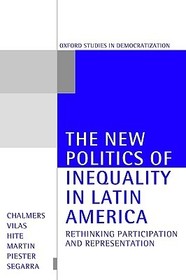
The New Politics of Inequality in Latin America
Rethinking Participation and Representation
Sorozatcím: Oxford Studies in Democratization;
-
10% KEDVEZMÉNY?
- A kedvezmény csak az 'Értesítés a kedvenc témákról' hírlevelünk címzettjeinek rendeléseire érvényes.
- Kiadói listaár GBP 192.50
-
86 913 Ft (82 775 Ft + 5% áfa)
Az ár azért becsült, mert a rendelés pillanatában nem lehet pontosan tudni, hogy a beérkezéskor milyen lesz a forint árfolyama az adott termék eredeti devizájához képest. Ha a forint romlana, kissé többet, ha javulna, kissé kevesebbet kell majd fizetnie.
- Kedvezmény(ek) 10% (kb. 8 691 Ft)
- Kedvezményes ár 78 222 Ft (74 498 Ft + 5% áfa)
Iratkozzon fel most és részesüljön kedvezőbb árainkból!
Feliratkozom
86 913 Ft

Beszerezhetőség
Megrendelésre a kiadó utánnyomja a könyvet. Rendelhető, de a szokásosnál kicsit lassabban érkezik meg.
Why don't you give exact delivery time?
A beszerzés időigényét az eddigi tapasztalatokra alapozva adjuk meg. Azért becsült, mert a terméket külföldről hozzuk be, így a kiadó kiszolgálásának pillanatnyi gyorsaságától is függ. A megadottnál gyorsabb és lassabb szállítás is elképzelhető, de mindent megteszünk, hogy Ön a lehető leghamarabb jusson hozzá a termékhez.
A termék adatai:
- Kiadó OUP Oxford
- Megjelenés dátuma 1997. január 30.
- ISBN 9780198781844
- Kötéstípus Keménykötés
- Terjedelem672 oldal
- Méret 234x156x33 mm
- Súly 945 g
- Nyelv angol
- Illusztrációk tables, 1 figure 0
Kategóriák
Rövid leírás:
Against a broader backdrop of globalization and worldwide moves toward political democracy, this collection of essays examines the unfolding relationships among social change, equity, and the democratic representation of the poor in Latin America.
TöbbHosszú leírás:
Against a broader backdrop of globalization and worldwide moves toward political democracy, The New Politics of Inequality in Latin America examines the unfolding relationships among social change, equity, and the democratic representation of the poor in Latin America.
Recent Latin American governments have turned away from redistributive policies; at the same time, popular political and social organizations have been generally weakened, inequality has increased, and the gap between rich and poor has grown. Hanging in the balance is the consolidation and the quality of new or would-be democracies; this volume suggests that governments must find not just short-term programmes to alleviate poverty, but long-term means to ensure the effective integration of the poor into political life.
The New Politics of Inequality in Latin America bridges the intellectual chasm between, on the one hand, studies of grassroots politics, and on the other, explorations of elite politics and formal institution-building. It will be of interest to students and scholars of contemporary Latin American politics and society and, more generally, in the vicissitudes of democracy and citizenship in the late twentieth-century global system.
will probably remain as a seminal work. It brilliantly embodies a highly welcomed evolution in the way the political changes in Latin America are studied
Tartalomjegyzék:
Introduction
Participation, Inequality, and the Whereabouts of Democracy
Section I: Traditional Actors, New Settings
Beyond Corporatism: New Patterns of Representation in the Brazilian Auto Industry
Union Politics, Market-Orientated Reforms and the Reshaping of Argentine Corporatism
The Crisis of Developmentalism and the Rural Labor Movement in Northeast Brazil
Section II: Searching for New Forms of Participation
The Rise of Causa R in Venezuela
The Seven-Month Itch?: Neoliberal Politics, Popular Movements, and the Left in Mexico
The Politics of Identity Reconstruction: Indians and Democracy in Ecuador
The Evolution of the Brazilian Environmental Movement and Its Political Roles
The Authoritarian Alternative: Anti-Politics Among the Popular Sectors of Lima
Section III: The Stubbornness of Violence
The Quetzal is Red: Military States, Popular Movements, and Political Violence in Guatemala
Popular Responses to State-Sponsored Violence in Brazil
Political Violence and the Grassroots in Lima, Peru
Section IV: Dilemmas of a Social Democratic Project
Rethinking Economic Alternatives: Left Parties and the Articulation of Popular Demands in Chile and Peru
Market-Orientated Development Strategies and State-Society Relations in New Democracies: Lessons from Contemporary Chile and Spain
Putting Conservatism to Good Use?: Long Crisis and Vetoed Alternatives in Uruguay
Section V: Reconstructing Representation
The Difficult Transition from Clientelism to Citizenship: Lessons from Mexico
Reconstructing the Workers Party (PT): Lessons from Northeastern Brazil
Can a Leftist Government Make a Difference?: The Frente Amplio Administration of Montevideo, 1990-1994
Targeting the Poor: The Politics of Social Policy Reforms in Mexico
Redefining the Public/Private Mix: NGOs and the Emergency Social Investment Fund in Ecuador
Regional Integration and Transnational Politics: Popular Sector Strategies in the NAFTA Era
Conclusion
Associative Networks: New Structures of Representation for the Popular Sectors?
Contributors List
Bibliography

