

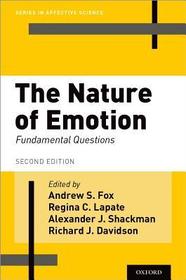
The Nature of Emotion
Fundamental Questions, Second Edition
Sorozatcím: Series in Affective Science;
-
10% KEDVEZMÉNY?
- A kedvezmény csak az 'Értesítés a kedvenc témákról' hírlevelünk címzettjeinek rendeléseire érvényes.
- Kiadói listaár GBP 68.00
-
30 702 Ft (29 240 Ft + 5% áfa)
Az ár azért becsült, mert a rendelés pillanatában nem lehet pontosan tudni, hogy a beérkezéskor milyen lesz a forint árfolyama az adott termék eredeti devizájához képest. Ha a forint romlana, kissé többet, ha javulna, kissé kevesebbet kell majd fizetnie.
- Kedvezmény(ek) 10% (kb. 3 070 Ft)
- Kedvezményes ár 27 632 Ft (26 316 Ft + 5% áfa)
Iratkozzon fel most és részesüljön kedvezőbb árainkból!
Feliratkozom
30 702 Ft

Beszerezhetőség
Megrendelésre a kiadó utánnyomja a könyvet. Rendelhető, de a szokásosnál kicsit lassabban érkezik meg.
Why don't you give exact delivery time?
A beszerzés időigényét az eddigi tapasztalatokra alapozva adjuk meg. Azért becsült, mert a terméket külföldről hozzuk be, így a kiadó kiszolgálásának pillanatnyi gyorsaságától is függ. A megadottnál gyorsabb és lassabb szállítás is elképzelhető, de mindent megteszünk, hogy Ön a lehető leghamarabb jusson hozzá a termékhez.
A termék adatai:
- Kiadás sorszáma 2
- Kiadó OUP USA
- Megjelenés dátuma 2018. október 25.
- ISBN 9780190612573
- Kötéstípus Puhakötés
- Terjedelem632 oldal
- Méret 251x173x38 mm
- Súly 1293 g
- Nyelv angol 0
Kategóriák
Rövid leírás:
The Editors of this unique volume asked some of the world's leading emotion researchers to address 14 fundamental questions about the nature and origins of emotion. Each chapter addresses one of these questions, with often divergent answers from the more than 100 experts represented here. At the end of each chapter, the Editors highlight key areas of agreement and disagreement. In the final chapter, they outline the most important challenges facing the field and the most fruitful avenues for future research. Not a textbook offering a single viewpoint, The Nature of Emotion reveals the central issues in emotion research and theory in the words of the leading scientists working in the field today, providing a unique and highly accessible guide for students, researchers, and clinicians.
TöbbHosszú leírás:
Building on the legacy of the groundbreaking first edition, the Editors of this unique volume have selected more than 100 leading emotion researchers from around the world and asked them to address 14 fundamental questions about the nature and origins of emotion.
For example: What is an emotion? How are emotions organized in the brain? How do emotion and cognition interact? How are emotions embodied in the social world? How and why are emotions communicated? How are emotions physically embodied? What develops in emotional development?
Each chapter addresses one of these questions, with often divergent answers from the experts represented here: Adam Anderson, Lauren Atlas, Yair Bar-Haim, Lisa Feldman Barrett, Kent Berridge, Jennifer Urbano Blackford, Caroline Blanchard, Margaret Bradley, Ralph Adolphs, Joshua Carlson, Laura Carstensen, Luke Chang, Joan Chiao, Gerald Clore, Roshan Cools, Eveline Crone, Antonio Damasio, Hanna Damasio, Richard Davidson, Mauricio Delgado, Nazanin Derakshan, Nancy Eisenberg, Naomi Eisenberger, Paul Ekman, Phoebe Ellsworth, Andrew Fox, Nathan Fox, Barbara Fredrickson, Jonathan Freeman, Karl Friston, Matthias Gamer, Beatrice de Gelder, Paul Glimcher, Hill Goldsmith, Todd Hare, Lasana Harris, Catherine Hartley, Aaron Heller, Ursula Hess, Quentin Huys, Tom Johnstone, Jerome Kagan, Dacher Keltner, Brian Knutson, Peter Lang, Regina Lapate, Edward Lemay, Robert Levenson, Wen Li, Matthew Lieberman, Bruce McEwen, Katie McLaughlin, Andrew Meltzoff, Mohammed Milad, Elisabeth Murray, Kristin Naragon-Gainey, Charles Nelson, Paula Niedenthal, Hadas Okon-Singer, Jaak Panksepp, Carolyn Parkinson, Luiz Pessoa, Rosalind Picard, Carien van Reekum, Edmund Rolls, Melissa Rosenkranz, Carol Ryff, Tim Salomons, Anil Seth, Alexander Shackman, Rebecca Shiner, Tania Singer, Peter Sokol-Hessner, Leah Somerville, Daniel Tranel, Kay Tye, Tor Wager, Leanne Williams, Rachel Yehuda, and David Zald.
At the end of each chapter, the Editors--Andrew Fox, Regina Lapate, Alexander Shackman, and Richard Davidson--highlight key areas of agreement and disagreement.
In the final chapter--The Nature of Emotion: A Research Agenda for the 21st Century--the Editors outline their own perspective on the most important challenges facing the field today and the most fruitful avenues for future research.
Not a textbook offering a single viewpoint, The Nature of Emotion reveals the central issues in emotion research and theory in the words of many of the leading scientists working in the field today, from senior researchers to rising stars, providing a unique and highly accessible guide for students, researchers, and clinicians.
Tartalomjegyzék:
Acknowledgments
Contributors
Introduction
Preface to Paul Ekman's Essay
Richard J. Davidson
How emotions might work
Paul Ekman
Question 1. What is an emotion?
Emotions and feelings: William James and the present
Antonio Damasio & Hanna Damasio
Emotions are functional states that cause feelings and behavior
Ralph Adolphs
What is emotion? A natural science perspective
Peter J. Lang & Margaret M. Bradley
Affect is essential to emotion
Kent C. Berridge
Emotions: Causes and consequences
Gerald L. Clore
What are emotional states, and what are their functions?
Edmund T. Rolls
Active inference and emotion
Karl J. Friston, Mateus Joffily, Lisa Feldman Barrett & Anil K. Seth
Emotions are constructed with interoception and concepts within a predicting brain
Lisa Feldman Barrett
Afterword
Regina C. Lapate & Alexander J. Shackman
Question 2. How are emotions, mood and temperament related?
Distinguishing affective constructs: Structure, trait- vs. state-ness, and responses to affect
Kristin Naragon-Gainey
Inhibited temperament and intrinsic versus extrinsic influences on fear circuits
Jennifer Urbano Blackford & David H. Zald
Distinctions among moods and temperaments
Jerome Kagan
Distinctions between temperament and emotion: Examining reactivity, regulation, and social understanding
Lindsay C. Bowman & Nathan A. Fox
Afterword
Alexander J. Shackman, Regina C. Lapate & Andrew S. Fox
Question 3. What are the dimensions and bases for lasting individual differences in emotion?
Personality as lasting individual differences in emotions
Rebecca L. Shiner
The bases for preservation of emotional biases
Jerome Kagan
The psychological and neurobiological bases of dispositional negativity
Alexander J. Shackman, Melissa D. Stockbridge, Edward P. Lemay, Jr. & Andrew S. Fox
Reactivity, recovery, regulation: The three R's of emotional responding
Richard J. Davidson
Afterword
Alexander J. Shackman & Andrew S. Fox
Question 4. What is the added value of studying the brain for understanding emotion?
Studying the brain is necessary for understanding emotion
Tom Johnstone
Brain and emotion research: Contributions of patient and activation studies
Robert W. Levenson
Understanding emotion by unraveling complex structure-function mappings
Luiz Pessoa
Brain studies can advance psychological understanding
Kent C. Berridge
Afterword
Alexander J. Shackman & Regina C. Lapate
Question 5. How are emotions organized in the brain?
Discrete and dimensional contributions to emotion arise from multiple brain circuits
Ralph Adolphs
Brain limbic systems as flexible generators of emotion
Kent C. Berridge
At primal levels, via vast subcortical brain networks that mediate instinctual emotional reactions that help program higher-order emotional-cognitive abilities in higher regions of the brain and mind.
Jaak Panksepp
Brain architecture and principles of the organization of emotion in the brain
Luiz Pessoa
Variation and degeneracy in the brain basis of emotion.
Lisa Feldman Barrett
How are emotions organized in the brain?
Tor D. Wager, Anjali Krishnan & Emma Hitchcock
The brain is organized to emote
Andrew S. Fox
Neural circuit mechanisms for switching emotional tracks: From positive to negative and back again
Kay M. Tye
Afterword
Alexander J. Shackman & Andrew S. Fox
Question 6. When and in what ways are emotions adaptive and maladaptive?
The ambiguous issue of adaptive emotions
Jerome Kagan
Maladaptive emotions are inseparable from inaccurate appraisals
Phoebe C. Ellsworth
Emotions aren't maladaptive
Aaron S. Heller
Cultural neuroscience of emotion
Joan Y. Chiao
Positive emotions broaden and build: Consideration for how and when pleasant subjective experiences are adaptive and maladaptive
Barbara L. Fredrickson
The social nature of emotions: Context matters
Amy Lehrner & Rachel Yehuda
Afterword
Andrew S. Fox & Regina C. Lapate
Question 7. How are emotions regulated by context and cognition?
Emotion as an evolutionary adaptive pattern: The roles of context and cognition
D. Caroline Blanchard & Brandon L. Pearson
Individual differences in fear conditioning and extinction paradigms: Insights for emotion regulation
Marie-France Marin & Mohammed R. Milad
The role of context and cognition in the placebo effect
Lauren Y. Atlas
Emotional Intensity: It is the thought that counts
Gerald L. Clore & David A. Reinhard
Emotion regulation as a change of goals and priorities
Carien M. van Reekum & Tom Johnstone
Searching for implicit emotion regulation
Matthew D. Lieberman
Fighting fire with fire: Endogenous emotion generation as a means of emotion regulation
Haakon G. Engen & Tania Singer
Afterword
Alexander J. Shackman & Regina C. Lapate
Question 8. How do emotion and cognition interact?
The interplay of emotion and cognition
Hadas Okon-Singer, Daniel M. Stout, Melissa D. Stockbridge, Matthias Gamer, Andrew S. Fox & Alexander J. Shackman
The impact of affect depends on its object
Gerald L. Clore
Thoughts on cognition-emotion interactions and their role in the diagnosis and treatment of psychopathology
Keren Maoz and Yair Bar-Haim
Beyond cognition and emotion: Dispensing with a cherished psychological narrative
Alexandra Touroutoglou & Lisa Feldman Barrett
Can we advance our understanding of emotional behavior by reconceptualizing it as involving valuation?
Roshan Cools, Hanneke den Ouden, Verena Ly & Quentin Huys
Beyond the threat bias: Reciprocal links between emotion and cognition
Nick Berggren & Nazanin Derakshan
The cognitive-emotional brain
Luiz Pessoa
Emotional vs. rational systems, and decisions between them
Edmund T. Rolls
Afterword
Alexander J. Shackman & Regina C. Lapate
Question 9. How are emotions embodied in the social world?
Connections between emotions and the social world: Numerous and complex
Nancy Eisenberg & Maciel M. Hernández
Effects of emotion on interpersonal behavior: A motivational perspective
Edward P. Lemay, Jr.
Emotion in the social world
Carolyn Parkinson
The affective nature of social interactions
Dominic S. Fareri & Mauricio R. Delgado
On the significance of implicit emotional communication
Andrew S. Fox
Deconstructing social emotions: Empathy and compassion and their relation to prosocial behavior
Haakon G. Engen & Tania Singer
Afterword
Andrew S. Fox & Alexander J. Shackman
Question 10. How and why are emotions communicated?
Form of facial expression communication originates in sensory function
Daniel H. Lee & Adam K. Anderson
Expression of emotion: New principles for future inquiry
Dacher Keltner, Daniel T. Cordaro, Jessica Tracy, & Disa Sauter
The (more or less accurate) communication of emotions serves social problem solving
Ursula Hess
Making sense of the senses in emotion communication
Wen Li, Lucas R. Novak, & Yuqi You
Movement and manipulation: the how and why of emotion communication
Lasana T. Harris
Concepts are key to the "communication" of emotion
Maria Gendron & Lisa Feldman Barrett
The web of emotion understanding in human infants
Betty M. Repacholi and Andrew N. Meltzoff
The dynamic-interactive model approach to the perception of facial emotion
Jonathan B. Freeman
Afterword
Regina C. Lapate & Andrew S. Fox
Question 11. How are emotions physically embodied?
How and why emotions are embodied
Adrienne Wood, Jared Martin & Paula Niedenthal
Emotion in body and brain: Context-dependent action and reaction
Margaret M. Bradley & Peter J. Lang
The importance of the mind for understanding how emotions are embodied
Naomi I. Eisenberger
How are emotions physically embodied?
Rosalind W. Picard
Pain as an embodied emotion
Tim V. Salomons
How are emotions organized and physically embodied?
Bruce S. McEwen
The complex tapestry of emotion: immune and microbial contributions
Melissa A. Rosenkranz
Afterword
Andrew S. Fox & Alexander J. Shackman
Question 12. What is the role of conscious awareness in emotion?
Emotions are more than their subjective feelings
Kent C. Berridge
Reactive emotional processing in the absence of conscious awareness
Joshua M. Carlson
What is the role of unconscious emotions and of conscious awareness in emotion?
Beatrice de Gelder and Marco Tamietto
Self-regulating our emotional states when we are conscious of them and when we are not
Leanne Williams
Regulatory benefits of conscious awareness: Insights from the emotion misattribution paradigm and a role for lateral prefrontal cortex
Regina C. Lapate
Afterword
Regina C. Lapate & Andrew S. Fox
Question 13. How are emotions integrated into choice?
How can affect influence choice?
Brian Knutson & Mirre Stallen
Emotions through the lens of economic theory
Agnieszka Tymula & Paul Glimcher
Emotions as computational signals of goal error
Luke J. Chang & Eshin Jolly
Affect is the foundation of value
Catherine Hartley & Peter Sokol-Hessner
Emotion, value, and choice
Jolie Wormwood & Lisa Feldman Barrett
Emotions can bias decision-making processes by promoting specific behavioral tendencies
Jan B. Engelmann & Todd A. Hare
Emotions are important for advantageous decision-making: A neuropsychological perspective
Justin Reber & Daniel Tranel
From emotion to motion: Making choices based on current states and biological needs
Elisabeth A. Murray
Afterword
Andrew S. Fox & Regina C. Lapate
Question 14. What develops in emotional development?
The recognition of emotion during the first years of life
Julia Cataldo & Charles A. Nelson
Everything develops during emotional development
Hill H. Goldsmith
Stability and change in emotion-relevant personality traits in childhood and adolescence
Rebecca L. Shiner
Normative trajectories and sources of psychopathology risk in adolescence
Leah H. Somerville & Katie A. McLaughlin
What happens in emotional development? Adolescent emotionality
Eveline A. Crone & Jennifer H. Pfeifer
Goals change with age and benefit emotional experience
Candice Hogan, Tamara Sims & Laura L. Carstensen
Ideal ends in emotional development
Carol D. Ryff
Afterword
Regina C. Lapate & Alexander J. Shackman
Epilogue-The nature of emotion: A research agenda for the 21st century
Andrew S. Fox, Regina C. Lapate, Richard J. Davidson & Alexander J. Shackman
References
Index

