

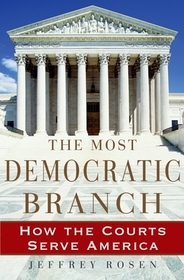
The Most Democratic Branch
How the Courts Serve America
Sorozatcím: Institutions of American Democracy;
-
10% KEDVEZMÉNY?
- A kedvezmény csak az 'Értesítés a kedvenc témákról' hírlevelünk címzettjeinek rendeléseire érvényes.
- Kiadói listaár GBP 36.99
-
16 700 Ft (15 905 Ft + 5% áfa)
Az ár azért becsült, mert a rendelés pillanatában nem lehet pontosan tudni, hogy a beérkezéskor milyen lesz a forint árfolyama az adott termék eredeti devizájához képest. Ha a forint romlana, kissé többet, ha javulna, kissé kevesebbet kell majd fizetnie.
- Kedvezmény(ek) 10% (kb. 1 670 Ft)
- Kedvezményes ár 15 030 Ft (14 315 Ft + 5% áfa)
Iratkozzon fel most és részesüljön kedvezőbb árainkból!
Feliratkozom
16 700 Ft

Beszerezhetőség
Megrendelésre a kiadó utánnyomja a könyvet. Rendelhető, de a szokásosnál kicsit lassabban érkezik meg.
Why don't you give exact delivery time?
A beszerzés időigényét az eddigi tapasztalatokra alapozva adjuk meg. Azért becsült, mert a terméket külföldről hozzuk be, így a kiadó kiszolgálásának pillanatnyi gyorsaságától is függ. A megadottnál gyorsabb és lassabb szállítás is elképzelhető, de mindent megteszünk, hogy Ön a lehető leghamarabb jusson hozzá a termékhez.
A termék adatai:
- Kiadó OUP USA
- Megjelenés dátuma 2006. június 29.
- ISBN 9780195174434
- Kötéstípus Keménykötés
- Terjedelem256 oldal
- Méret 217x153x22 mm
- Súly 413 g
- Nyelv angol 0
Kategóriák
Rövid leírás:
Many critics attack federal judges as anti-democratic elitists, activists out of step with the mainstream of American thought. But others argue that judges should stand alone as the ultimate guardians of American values, placing principle before the views of the people. In The Most Democratic Branch, Jeffrey Rosen disagrees with both assertions. To illustrate, Rosen provides a penetrating look at some of the most important Supreme Court cases in American history - cases involving racial equality, affirmative action, abortion, gay rights and gay marriage, the right to die, electoral disputes, and civil liberties in wartime. Rosen concludes that the judiciary works best when it identifies the constitutional principles accepted by a majority of Americans, and enforces them unequivocally as fundamental law.
TöbbHosszú leírás:
Many critics attack federal judges as anti-democratic elitists, activists out of step with the mainstream of American thought. But others argue that judges should stand alone as the ultimate guardians of American values, placing principle before the views of the people.
In The Most Democratic Branch, Jeffrey Rosen disagrees with both assertions. Contrary to what interest groups may claim, he contends that, from the days of John Marshall right up to the present, the federal courts by and large have reflected the opinions of the mainstream. More important, he argues that the Supreme Court is most successful when it defers to the constitutional views of the American people, as represented most notably by Congress and the Presidency. And on the rare occasion when they departed from the consensus, the result has often been a disaster.
To illustrate, Rosen provides a penetrating look at some of the most important Supreme Court cases in American history--cases involving racial equality, affirmative action, abortion, gay rights and gay marriage, the right to die, electoral disputes, and civil liberties in wartime. Rosen shows that the most notorious constitutional decisions in American history--the ones that have been most strenuously criticized, such as Dred Scott or Roe v. Wade--have gone against mainstream opinion. By contrast, the most successful decisions--from Marbury v. Madison to Brown v. Board of Education--have avoided imposing constitutional principles over the wishes of the people. Rosen concludes that the judiciary works best when it identifies the constitutional principles accepted by a majority of Americans, and enforces them unequivocally as fundamental law.
Jeffrey Rosen is one of the most respected legal experts writing today, a regular contributor to The New York Times Magazine and the Legal Affairs Editor of The New Republic. The provocative arguments that he puts forth here are bound to fuel heated debate at a time when the federal judiciary is already the focus of fierce criticism.

