

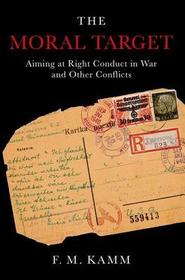
The Moral Target
Aiming at Right Conduct in War and Other Conflicts
Sorozatcím: Oxford Ethics Series;
-
10% KEDVEZMÉNY?
- A kedvezmény csak az 'Értesítés a kedvenc témákról' hírlevelünk címzettjeinek rendeléseire érvényes.
- Kiadói listaár GBP 28.49
-
13 611 Ft (12 962 Ft + 5% áfa)
Az ár azért becsült, mert a rendelés pillanatában nem lehet pontosan tudni, hogy a beérkezéskor milyen lesz a forint árfolyama az adott termék eredeti devizájához képest. Ha a forint romlana, kissé többet, ha javulna, kissé kevesebbet kell majd fizetnie.
- Kedvezmény(ek) 10% (cc. 1 361 Ft off)
- Kedvezményes ár 12 249 Ft (11 666 Ft + 5% áfa)
Iratkozzon fel most és részesüljön kedvezőbb árainkból!
Feliratkozom
13 611 Ft

Beszerezhetőség
Megrendelésre a kiadó utánnyomja a könyvet. Rendelhető, de a szokásosnál kicsit lassabban érkezik meg.
Why don't you give exact delivery time?
A beszerzés időigényét az eddigi tapasztalatokra alapozva adjuk meg. Azért becsült, mert a terméket külföldről hozzuk be, így a kiadó kiszolgálásának pillanatnyi gyorsaságától is függ. A megadottnál gyorsabb és lassabb szállítás is elképzelhető, de mindent megteszünk, hogy Ön a lehető leghamarabb jusson hozzá a termékhez.
A termék adatai:
- Kiadó OUP USA
- Megjelenés dátuma 2016. március 24.
- ISBN 9780190490638
- Kötéstípus Puhakötés
- Terjedelem276 oldal
- Méret 231x157x17 mm
- Súly 408 g
- Nyelv angol 0
Kategóriák
Rövid leírás:
The Moral Target: Aiming at Right Conduct in War and Other Conflicts comprises essays that discuss aspects of war and other conflicts in the light of nonconsequentialist ethical theory.
TöbbHosszú leírás:
The Moral Target: Aiming at Right Conduct in War and Other Conflicts comprises essays that discuss aspects of war and other conflicts in the light of both nonconsequentialist ethical theory and the views of such theorists as Barbara Herman, Jeff McMahan, Avishai Margalit, and Michael Walzer. The first essay deals with the relation between states of affairs whose termination justifies war and states of affairs that once achieved should put an end to war. The next few essays deal with conduct in war. They first consider the implications of general moral principles (including the Doctrine of Double Effect and Principle of Permissible Harm) for the permissibility of harm to combatants and noncombatants, and then whether factors unique to war should alter what is permissible. In particular, if the context of war should affect the relative violability of different combatants and different noncombatants, if terror killing combatants and/or noncombatants should ever be permissible, and if there is liability to harm in virtue of belonging to a group. The fifth essay examines how recent discussions by nonconsequentialists about redirection of threats (as in the famous Trolley Problem) may illuminate the moral status of collaboration that took place with Nazis during the Holocaust. What justice requires after conflict and how our ability to provide it affects the permissibility of starting war, is the next topic. Truth and reconciliation commissions and retribution post-conflict are discussed, and whether harm to civilians stemming from such procedures (and how the harm arises) bear on the permissibility of instituting the procedures. The three concluding essays deal with moral aspects of conflicts outside of standard war, including those involving the threat of terrorism, resistance to communal injustice (for example, in the case of the Taliban women), and the use of nuclear weapons for deterrence.
As I said, this has been a very limited of survey of these two books, which cover a wide range of topics and are extremely dense with argument?these questions are of great interest and importance. In all, there is an enormous amount for anyone interested the morality of conflict, or ethics generally, to learn from reading and thinking about these excellent books. They represent the cutting edge of work in applied ethics and moral theory.
Tartalomjegyzék:
INTRODUCTION
CHAPTER 1 MAKING WAR AND ITS CONTINUATION UNJUST
CHAPTER 2 CONDUCT IN WAR: JUSTIFICATIONS FOR KILLING NONCOMBATANTS IN WAR
CHAPTER 3 CONDUCT IN WAR: FAILURES OF JUST WAR THEORY
CHAPTER 4 CONDUCT IN WAR: THE MORALITY OF KILLING IN WAR
CHAPTER 5 COLLABORATION AND WITH THE ENEMY: HARMING SOME TO SAVE OTHERS FROM THE NAZIS
CHAPTER 6 POST CONFLICT: MORAL IMPROVISATION AND NEW OBLIGATIONS: THE CASE OF TRUTH COMMISSIONS
CHAPTER 7 POST CONFLICT: JUS POST BELL0, PROPORTIONALITY, AND REHABILITATION
CHAPTER 8 TERRORISM AND SEVERAL MORAL DISTINCTIONS
CHAPTER 9 SELF DEFENSE, RESISTANCE, AND SUICIDE: THE TALIBAN WOMEN
CHAPTER 10 NUCLEAR DETERRENCE AND NONCOMBATANTS

