

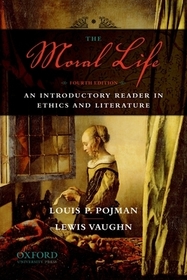
The Moral Life
An Introductory Reader in Ethics and Literature
-
10% KEDVEZMÉNY?
- A kedvezmény csak az 'Értesítés a kedvenc témákról' hírlevelünk címzettjeinek rendeléseire érvényes.
- Kiadói listaár GBP 52.99
-
25 315 Ft (24 110 Ft + 5% áfa)
Az ár azért becsült, mert a rendelés pillanatában nem lehet pontosan tudni, hogy a beérkezéskor milyen lesz a forint árfolyama az adott termék eredeti devizájához képest. Ha a forint romlana, kissé többet, ha javulna, kissé kevesebbet kell majd fizetnie.
- Kedvezmény(ek) 10% (cc. 2 532 Ft off)
- Kedvezményes ár 22 784 Ft (21 699 Ft + 5% áfa)
Iratkozzon fel most és részesüljön kedvezőbb árainkból!
Feliratkozom
25 315 Ft

Beszerezhetőség
Bizonytalan a beszerezhetőség. Érdemes még egyszer keresni szerzővel és címmel. Ha nem talál másik, kapható kiadást, forduljon ügyfélszolgálatunkhoz!
Why don't you give exact delivery time?
A beszerzés időigényét az eddigi tapasztalatokra alapozva adjuk meg. Azért becsült, mert a terméket külföldről hozzuk be, így a kiadó kiszolgálásának pillanatnyi gyorsaságától is függ. A megadottnál gyorsabb és lassabb szállítás is elképzelhető, de mindent megteszünk, hogy Ön a lehető leghamarabb jusson hozzá a termékhez.
A termék adatai:
- Kiadás sorszáma Fourth Edition
- Kiadó OUP USA
- Megjelenés dátuma 2010. június 3.
- ISBN 9780195396256
- Kötéstípus Puhakötés
- Terjedelem1014 oldal
- Méret 211x140x38 mm
- Súly 994 g
- Nyelv angol 0
Kategóriák
Hosszú leírás:
Now in its fourth edition, Louis P. Pojman and Lewis Vaughn's acclaimed The Moral Life: An Introductory Reader in Ethics and Literature brings together an extensive and varied collection of eighty-five classical and contemporary readings on ethical theory and practice. Integrating literature with philosophy in an innovative way, the book uses literary works to enliven and make concrete the ethical theory or applied issues addressed. Literary works by Angelou, Camus,
Hawthorne, Huxley, Ibsen, Le Guin, Melville, Orwell, Styron, Tolstoy, and many others lead students into such philosophical concepts and issues as relativism; utilitarianism; virtue ethics; the meaning of life; freedom and autonomy; sex, love, and marriage; animal rights; and terrorism. These topics are developed
further through readings by philosophers including Plato, Aristotle, Kant, Singer, Sartre, Nagel, and Thomson. This unique anthology emphasizes the personal dimension of ethics, which is often ignored or minimized in ethics texts. It also incorporates chapter introductions, study questions, suggestions for further reading, and biographical sketches of the writers.
The fourth edition features five new readings—by James Rachels, Alasdair MacIntyre, Michael Levin, John Corvino, and Stephen Nathanson—and a new appendix on how to write a philosophy paper. A new Companion Website features resources for both students and instructors including reading summaries; true/false, multiple-choice, and essay questions; and PowerPoint slides. Ideal for introductory ethics courses, The Moral Life, Fourth Edition, also provides
an engaging gateway into personal and social ethics for general readers.
Tartalomjegyzék:
*=New to this Edition
Each chapter ends with Further Readings.
Introduction: On the Nature of Morality
PART I. THE NATURE OF MORALITY: Good and Evil
1. What Is the Purpose of Morality?
William Golding, Lord of the Flies: A Moral Allegory
Louis P. Pojman, On the Nature and Purpose of Morality: Reflections on William Golding's Lord of the Flies
Thomas Hobbes
2. Good and Evil
Herman Melville
Fyodor Dostoevsky
William Styron
Philip Hallie
Stanley Benn
Friedrich Nietzsche
Richard Taylor
3. Is Everything Relative?
Herodotus
Ruth Benedict
* James Rachels
Jean Bethke Elshtain
Mary Midgley
Henrick Ibsen
PART II. MORAL THEORIES AND MORAL CHARACTER
4. Utilitarianism
Seaman Holmes and the Longboat of William Brown, Reported by John William Wallace
Jeremy Bentham
John Stuart Mill
Kai Nielsen
Bernard Williams
Ursula Le Guin
Aldous Huxley
5. Deontological Ethics
Immanuel Kant
William K. Frankena
W. D. Ross
R. M. MacIver
Richard Whatley
Ambrose Bierce
Charles Fried
Plato
Thomas Nagel
6. Virtue Ethics
* Alasdair MacIntyre
Aristotle
Bernard Mayo
J.O. Urmson
Nathaniel Hawthorne
William Frankena
7. Virtues and Vices
Jesus of Nazareth
Leo Tolstoy, How Much Land Does a Man Need? Greed
Immanuel Kant
Martin Gansberg
Epictetus and Others
Vice Admiral James Stockdale, The World of Epictetus: Courage and Endurance
PART III. MORAL ISSUES
8. Ethics and Egoism: Why Should We Be Moral?
Plato
Ayn Rand
Louis P. Pojman
James Rachels
9. Does Life Have Meaning?
Voltaire
Epicurus
Albert Camus
Louis P. Pojman
Viktor Frankl, The Human Search for Meaning: Reflections on Auschwitz
Siddhartha Gautama, the Buddha
Bertrand Russell
10. Freedom, Autonomy, and Self-Respect
Martin Luther King, Jr.
Maya Angelou
Stanley Milgram
Jean-Paul Sartre
Thomas E. Hill, Jr.
Kurt Vonnegut
PART IV. APPLIED ETHICS: Moral Problems
11. Sex, Love, and Marriage
John Barth
Immanuel Kant
John McMurtry, Monogamy: A Critique
Michael D. Bayles, Marriage, Love, and Procreation: A Critique of McMurtry
Bonnie Steinbock
C. S. Lewis
Jane English
* Michael Levin
* John Corvino 12. Is Abortion Morally Permissible?
Don Marquis
Judith Jarvis Thomson
Mary Anne Warren
Jane English, The Moderate Position: Beyond the Personhood Argument
13. The Morality of Euthanasia
Dan W. Brock
J. Gay-Williams
James Rachels
14. Our Duties to Animals
George Orwell
Peter Singer, Animal Liberation: All Animals Are Equal
Carl Cohen
15. Our Duties to the Environment
Robert Heilbroner
Garrett Hardin
William F. Baxter, People or Penguins: The Case for Optimal Pollution
16. International Justice and the Threat of Terrorism
God's Command to Destroy Jericho and Ai
* Stephen Nathanson
Thomas Nagel

