

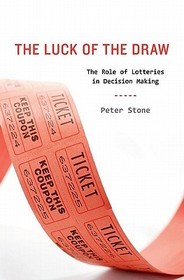
The Luck of the Draw
The Role of Lotteries in Decision Making
-
10% KEDVEZMÉNY?
- A kedvezmény csak az 'Értesítés a kedvenc témákról' hírlevelünk címzettjeinek rendeléseire érvényes.
- Kiadói listaár GBP 78.00
-
37 264 Ft (35 490 Ft + 5% áfa)
Az ár azért becsült, mert a rendelés pillanatában nem lehet pontosan tudni, hogy a beérkezéskor milyen lesz a forint árfolyama az adott termék eredeti devizájához képest. Ha a forint romlana, kissé többet, ha javulna, kissé kevesebbet kell majd fizetnie.
- Kedvezmény(ek) 10% (cc. 3 726 Ft off)
- Kedvezményes ár 33 538 Ft (31 941 Ft + 5% áfa)
Iratkozzon fel most és részesüljön kedvezőbb árainkból!
Feliratkozom
37 264 Ft

Beszerezhetőség
Megrendelésre a kiadó utánnyomja a könyvet. Rendelhető, de a szokásosnál kicsit lassabban érkezik meg.
Why don't you give exact delivery time?
A beszerzés időigényét az eddigi tapasztalatokra alapozva adjuk meg. Azért becsült, mert a terméket külföldről hozzuk be, így a kiadó kiszolgálásának pillanatnyi gyorsaságától is függ. A megadottnál gyorsabb és lassabb szállítás is elképzelhető, de mindent megteszünk, hogy Ön a lehető leghamarabb jusson hozzá a termékhez.
A termék adatai:
- Kiadó OUP USA
- Megjelenés dátuma 2011. május 5.
- ISBN 9780199756100
- Kötéstípus Keménykötés
- Terjedelem208 oldal
- Méret 157x236x22 mm
- Súly 408 g
- Nyelv angol 0
Kategóriák
Rövid leírás:
In The Luck of the Draw, Peter Stone surveys the substantial number of arguments for and against lotteries and argues that lotteries have only one crucial effect relevant to decision-making: they have the 'sanitizing effect' of preventing decisions from being made on the basis of reasons.
TöbbHosszú leírás:
A prominent scholar once noted that lotteries in politics and society--to break vote ties, assign students to schools, draft people into the military, select juries--are "at first thought absurd, and at second thought obvious." Lotteries have been part of politics since the Greek and Roman times, and they are used frequently in American politics today. When there is a two-to-two vote tie for prospective school board members, officials will often resort to flipping a coin (as happened recently in California). And in military drafts, the conventional wisdom is that random selection is far more just than non-lottery drafts. Northerners rioted against the perceived injustice of the non-random draft during the Civil War, and Americans by and large believed that student deferments subverted the justice of the draft during the Vietnam War.
Over the years, people who study and practice politics have devoted considerable effort to thinking about the legitimacy of lotteries and whether they are just or not under certain circumstances. Yet they have really only focused on lotteries on a case-by-case basis, and no one has ever developed a substantial and comprehensive political theory of lotteries. In The Luck of the Draw, Peter Stone does just that. Examining the wide range of arguments for and against lotteries, Stone comes to the startling conclusion that lotteries have only one crucial effect relevant to decision-making: they have the "sanitizing effect" of preventing decisions from being made on the basis of reasons. Stone readily admits that this rationale might sound absurd to us, but contends that in many instances it is vital for people to make decisions without any reasoned rationale to compel them. Sometimes, justice can only be carried out through random selection--a fundamental principle of the practice of lottery that Stone comes to call "The Just Lottery Rule." By developing innovative ways for interpreting this pervasive form of political practice, Stone provides us with a foundation for understanding how to best make use of lottery when making political decisions both large and small.
Stone does a wonderful job in unifying the discussion of scarce good lotteries under the umbrella of impartiality. ... the implementation of general criteria of justice ... is enough to make The Luck of Draw an excellent read.
Tartalomjegyzék:
Part I: The Logic of Random Selection
Why Lotteries?
1. The School Board Tosses a Coin
2. Lotteries, Lotteries Everywhere
3. Absurd yet Obvious
4. The Story So Far
5. The Argument to Come
What Do Lotteries Do?
1. What Is a Lottery?
2. Fundamental Features of Decision-Making
3. Decision-Making by Lottery
4. The Lottery Principle
5. Indeterminacy without Lotteries
6. Lotteries and Divination
Part II: Lotteries and Justice
Allocative Justice
1. The Relationship between Lotteries and Justice
2. The Just Lottery Rule
3. Consent, Opportunities, Expectations
Impartiality
1. What Does Allocative Justice Require?
2. Allocative Justice and Outcomes
3. Allocative Justice and Actions
4. Impartiality and Indeterminacy
5. The Right and the Good
The Implications of Impartiality
1. The Nature of the Impartiality Principle
2. Theories of Justice
3. Alternatives to Random Selection
Part III: Lotteries beyond Justice
The Idea of Sortition
1. Sortition in Practice
2. Sortition and Justice
3. Incentive Alignment
4. Descriptive Representation
5. Random Selection in Other
Conclusion
Bibliography

