

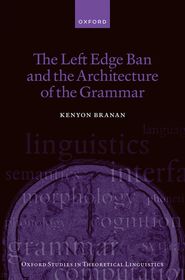
The Left Edge Ban and the Architecture of the Grammar
Sorozatcím: Oxford Studies in Theoretical Linguistics; 89;
-
10% KEDVEZMÉNY?
- A kedvezmény csak az 'Értesítés a kedvenc témákról' hírlevelünk címzettjeinek rendeléseire érvényes.
- Kiadói listaár GBP 88.00
-
39 732 Ft (37 840 Ft + 5% áfa)
Az ár azért becsült, mert a rendelés pillanatában nem lehet pontosan tudni, hogy a beérkezéskor milyen lesz a forint árfolyama az adott termék eredeti devizájához képest. Ha a forint romlana, kissé többet, ha javulna, kissé kevesebbet kell majd fizetnie.
- Kedvezmény(ek) 10% (cc. 3 973 Ft off)
- Kedvezményes ár 35 759 Ft (34 056 Ft + 5% áfa)
Iratkozzon fel most és részesüljön kedvezőbb árainkból!
Feliratkozom
39 732 Ft

Beszerezhetőség
Még nem jelent meg, de rendelhető. A megjelenéstől számított néhány héten belül megérkezik.
Why don't you give exact delivery time?
A beszerzés időigényét az eddigi tapasztalatokra alapozva adjuk meg. Azért becsült, mert a terméket külföldről hozzuk be, így a kiadó kiszolgálásának pillanatnyi gyorsaságától is függ. A megadottnál gyorsabb és lassabb szállítás is elképzelhető, de mindent megteszünk, hogy Ön a lehető leghamarabb jusson hozzá a termékhez.
A termék adatai:
- Kiadó OUP Oxford
- Megjelenés dátuma 2026. július 9.
- ISBN 9780192882363
- Kötéstípus Keménykötés
- Terjedelem256 oldal
- Méret 234x156 mm
- Nyelv angol 700
Kategóriák
Rövid leírás:
This book proposes and motivates a ban on words and sentences of a particular form, and shows that there are differences between how this ban is satisfied at the word level and at the sentence level. The strategies that each language employs are shown to account for a wide range of apparently disparate linguistic facts.
TöbbHosszú leírás:
This book proposes and motivates a ban on words and sentences of a particular form, and shows that there are differences between how this ban is satisfied at the word level and at the sentence level. One striking finding is that syntactic operations may serve as a means of avoiding violation of the ban, which might not be expected on a strictly feed-forward grammatical architecture. A theoretically interesting consequence of this is that the syntax must be able to see at least some information that the phonology can access, motivating an architecture of the grammar that is different from what is commonly assumed.
Empirically, this ban can account for a variety of apparently disparate linguistic facts including, but not limited to: cross-linguistic skews in attested stress patterns, morphophonological differences between prefixes and suffixes, restrictions on certain disharmonic word orders and cases where this restriction is apparently lifted, and a requirement that heavy elements undergo obligatory extraposition from a variety of fronted constituents. Each of these cases can be understood as the consequence of the grammar of a particular language employing a limited set of strategies to ensure that the proposed ban is satisfied.
Tartalomjegyzék:
Introduction
The LEB at the word level
Bridging the gap between syntax and phonology
The LEB at the clause level: Comparing two approaches
Derived positions and the limits of LEB repair
Conclusions and meditations on bigger picture issues

