

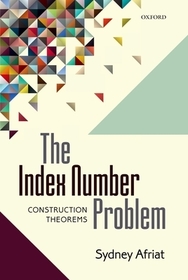
The Index Number Problem
Construction Theorems
-
10% KEDVEZMÉNY?
- A kedvezmény csak az 'Értesítés a kedvenc témákról' hírlevelünk címzettjeinek rendeléseire érvényes.
- Kiadói listaár GBP 140.00
-
63 210 Ft (60 200 Ft + 5% áfa)
Az ár azért becsült, mert a rendelés pillanatában nem lehet pontosan tudni, hogy a beérkezéskor milyen lesz a forint árfolyama az adott termék eredeti devizájához képest. Ha a forint romlana, kissé többet, ha javulna, kissé kevesebbet kell majd fizetnie.
- Kedvezmény(ek) 10% (kb. 6 321 Ft)
- Kedvezményes ár 56 889 Ft (54 180 Ft + 5% áfa)
Iratkozzon fel most és részesüljön kedvezőbb árainkból!
Feliratkozom
63 210 Ft

Beszerezhetőség
Megrendelésre a kiadó utánnyomja a könyvet. Rendelhető, de a szokásosnál kicsit lassabban érkezik meg.
Why don't you give exact delivery time?
A beszerzés időigényét az eddigi tapasztalatokra alapozva adjuk meg. Azért becsült, mert a terméket külföldről hozzuk be, így a kiadó kiszolgálásának pillanatnyi gyorsaságától is függ. A megadottnál gyorsabb és lassabb szállítás is elképzelhető, de mindent megteszünk, hogy Ön a lehető leghamarabb jusson hozzá a termékhez.
A termék adatai:
- Kiadó OUP Oxford
- Megjelenés dátuma 2014. február 27.
- ISBN 9780199670581
- Kötéstípus Keménykötés
- Terjedelem236 oldal
- Méret 237x162x21 mm
- Súly 510 g
- Nyelv angol
- Illusztrációk 9 Figures 0
Kategóriák
Rövid leírás:
This volume addresses the search for a true price index, the need to know how to convert an amount at one date into the right amount at another date. The longstanding question concerning how such an index should be constructed is known as 'The Index Number Problem'.
TöbbHosszú leírás:
A theft amounting to £1 was a capital offence in 1260 and a judge in 1610 affirmed the law could not then be applied since £1 was no longer what it was. Such association of money with a date is well recognized for its importance in very many connections. Thus arises the need to know how to convert an amount at one date into the right amount at another date: in other words, a price index.
The longstanding question concerning how such an index should be constructed is known as 'The Index Number Problem'. The ordinary consumer price index represents a practical response to this need. However the search for a true price index has given rise to extensive thought and theory to which an impressive number of economists have each contributed a word, or volume. However, there have been hold-ups at a basic level, which are addressed in this book. The approach brings the subject into involvement with utility construction on the basis of finite data, in a form referred to as 'Afriat's Theorem' but now with utility subject to constant (and also possibly approximate) returns.
Sydney Afriat, long acclaimed for his deep and elegant contributions to economic theory, provides in this book for the first time a definitive answer to the problem of converting a sum of money at one date into the appropriate amount at another, the resolution of which has defied the finest minds in economics for three generations.
Tartalomjegyzék:
Preface
Acknowledgements
Introduction
I The Index Number Problem
The New Formula
The Power Algorithm
Combinatorics
Consistency
Illustration
Bibliography
II Construction Theorems
The system of inequalities ars > xs - xr
Principles of Choice and Preference
Utility construction-revisited
The construction of separable utility functions from expenditure data
The Connection between Demand and Utility
Revealed Preference Revealed
Appendix: Terminology
Appendix 1. Constant returns, conical, homogeneous
Appendix 2. Notation
Appendix 3. Cost Efficient, Cost Effective
Appendix 4. Part, Chapter, Section
Note: RES 2011 Conference Preliminary to 'Afriat's Theorem and the Index Number Problem'

