

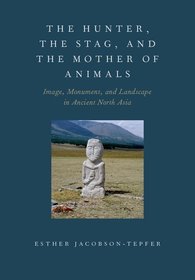
The Hunter, the Stag, and the Mother of Animals
Image, Monument, and Landscape in Ancient North Asia
-
10% KEDVEZMÉNY?
- A kedvezmény csak az 'Értesítés a kedvenc témákról' hírlevelünk címzettjeinek rendeléseire érvényes.
- Kiadói listaár GBP 120.00
-
54 180 Ft (51 600 Ft + 5% áfa)
Az ár azért becsült, mert a rendelés pillanatában nem lehet pontosan tudni, hogy a beérkezéskor milyen lesz a forint árfolyama az adott termék eredeti devizájához képest. Ha a forint romlana, kissé többet, ha javulna, kissé kevesebbet kell majd fizetnie.
- Kedvezmény(ek) 10% (kb. 5 418 Ft)
- Kedvezményes ár 48 762 Ft (46 440 Ft + 5% áfa)
Iratkozzon fel most és részesüljön kedvezőbb árainkból!
Feliratkozom
54 180 Ft

Beszerezhetőség
Megrendelésre a kiadó utánnyomja a könyvet. Rendelhető, de a szokásosnál kicsit lassabban érkezik meg.
Why don't you give exact delivery time?
A beszerzés időigényét az eddigi tapasztalatokra alapozva adjuk meg. Azért becsült, mert a terméket külföldről hozzuk be, így a kiadó kiszolgálásának pillanatnyi gyorsaságától is függ. A megadottnál gyorsabb és lassabb szállítás is elképzelhető, de mindent megteszünk, hogy Ön a lehető leghamarabb jusson hozzá a termékhez.
A termék adatai:
- Kiadó OUP USA
- Megjelenés dátuma 2015. május 28.
- ISBN 9780190202361
- Kötéstípus Keménykötés
- Terjedelem448 oldal
- Méret 236x165x33 mm
- Súly 1066 g
- Nyelv angol
- Illusztrációk 251 illustrations, with maps 0
Kategóriák
Rövid leírás:
Offers a stunning archaeological and art historical exploration of the changing traditions of belief in pre-Bronze and Bronze Age North Asia
TöbbHosszú leírás:
The Hunter, the Stag, and the Mother of Animals offers an in-depth exploration of the changing traditions of belief in pre-Bronze and Bronze Age North Asia. Esther Jacobson-Tepfer centers her argument on a female deity and her evolution up until the early Iron Age, across a 2,000 year period. Through the art historical and archaeological evidence of the symbolic systems left behind, she traces the progression of the deity from an originating animal mother through her incarnation as the mother of animals, her late embodiment as the guardian of the road to the land of the dead, the transformation of her essential liminality into the structures of predation and, in the form of a predated stag, her subsequent destruction. In detailed commentaries on rock art structures and monuments, Jacobson-Tepfer reconstructs and explores how the deity's power was embedded in the Janus-faced concept of life/death: how, in all her forms, the deity occupied the threshold between the worlds of humans and ancestors, humans and animals. More broadly, this study details how her fate was directly related to the sociological evolution at the onset of the Iron age: the transition of the cultures in South Siberia and Mongolia from hunting-based settlement to horse-dependent semi-nomadism, and with that the rise of a heroic narrative tradition. Jacobson-Tepfer has had unparalleled access to regional data still unavailable in the West, and the collection of this data in English as well as her extensive collection of color photographs and drawings will fill a gaping hole in the literature and prove invaluable to both archaeologists and art historians.The Hunter, the Stag, and the Mother of Animals will surely become a standard reference for both disciplines as well as a guide to those interested in rock art and beliefs systems more generally.
Professor Jacobson-Tepfer offers to readers her outstanding first-hand knowledge and deep understanding of unique Eurasian civilizations: the societies of ancient hunters, nomadic mounted pastoralists, and their animal symbolism. Archaeology, art history, and the history of religions, including shamanism, are synthesized by using careful scientific theoretical approaches.
Tartalomjegyzék:
List of Illustrations: Maps, Figures
Preface
Chapter One: The Transformation of Image, Object and Belief in Prehistoric North Asia
Chapter Two: The Appearance of the Animal Mother
Chapter Three: The Persistence of Liminal Beings
Chapter Four: The Mother of Animals
Chapter Five: The Emergence of Pictorial Narrative
Chapter Six: Intimations of Death and Transformation
Chapter Seven: The End of Naturalism in Nomadic Art
Chapter Eight: The Pivot Between Life and Death
Chapter Nine: Traces of Ancient Beliefs
Chapter Ten: The Archaeology of Belief
Appendix: The Dating of Rock Art
List of Abbreviations
Bibliography
Index

