

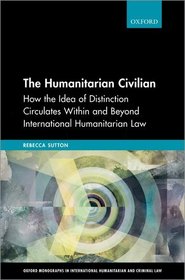
The Humanitarian Civilian
How the Idea of Distinction Circulates Within and Beyond International Humanitarian Law
Sorozatcím: Oxford Monographs in International Humanitarian & Criminal Law;
-
10% KEDVEZMÉNY?
- A kedvezmény csak az 'Értesítés a kedvenc témákról' hírlevelünk címzettjeinek rendeléseire érvényes.
- Kiadói listaár GBP 117.50
-
53 051 Ft (50 525 Ft + 5% áfa)
Az ár azért becsült, mert a rendelés pillanatában nem lehet pontosan tudni, hogy a beérkezéskor milyen lesz a forint árfolyama az adott termék eredeti devizájához képest. Ha a forint romlana, kissé többet, ha javulna, kissé kevesebbet kell majd fizetnie.
- Kedvezmény(ek) 10% (kb. 5 305 Ft)
- Kedvezményes ár 47 746 Ft (45 473 Ft + 5% áfa)
Iratkozzon fel most és részesüljön kedvezőbb árainkból!
Feliratkozom
53 051 Ft

Beszerezhetőség
Megrendelésre a kiadó utánnyomja a könyvet. Rendelhető, de a szokásosnál kicsit lassabban érkezik meg.
Why don't you give exact delivery time?
A beszerzés időigényét az eddigi tapasztalatokra alapozva adjuk meg. Azért becsült, mert a terméket külföldről hozzuk be, így a kiadó kiszolgálásának pillanatnyi gyorsaságától is függ. A megadottnál gyorsabb és lassabb szállítás is elképzelhető, de mindent megteszünk, hogy Ön a lehető leghamarabb jusson hozzá a termékhez.
A termék adatai:
- Kiadó OUP Oxford
- Megjelenés dátuma 2021. február 25.
- ISBN 9780198863816
- Kötéstípus Keménykötés
- Terjedelem258 oldal
- Méret 240x165x25 mm
- Súly 538 g
- Nyelv angol 85
Kategóriák
Rövid leírás:
One of the central principles of international humanitarian law is the principle of distinction between the civilian and the combatant. This book critically examines the situation of international humanitarian actors, showing how they struggle to protect and enhance their civilian status.
TöbbHosszú leírás:
In international humanitarian law (IHL), the principle of distinction delineates the difference between the civilian and the combatant, and it safeguards the former from being intentionally targeted in armed conflicts. This monograph explores the way in which the idea of distinction circulates within, and beyond, IHL. Taking a bottom-up approach, the multi-sited study follows distinction across three realms: the kinetic realm, where distinction is in motion in South Sudan; the pedagogical realm, where distinction is taught in civil-military training spaces in Europe; and the intellectual realm, where distinction is formulated and adjudicated in Geneva and the Hague.
Directing attention to international humanitarian actors, the book shows that these actors seize upon signifiers of 'civilianness' in everyday practice. To safeguard their civilian status, and to deflect any qualities of 'combatantness' that might affix to them, humanitarian actors strive to distinguish themselves from other international actors in their midst. The latter include peacekeepers working for the UN Mission in South Sudan (UNMISS), and soldiers who deploy with NATO missions. Crucially, some of the distinctions enacted cut along civilian-civilian lines, suggesting that humanitarian actors are longing for something more than civilian status - the 'civilian plus'. This special status presents a paradox: the appeal to the 'civilian plus' undermines general civilian protection, yet as the civilian ideal becomes increasingly beleaguered, a special civilian status appears ever more desirable. However disruptive these practices may be to the principle of distinction in IHL, the monograph emphasizes that even at the most normative level there is no bright line distinction to be found.
the text presents an insightful, new perspective that shows the reality of distinction as an inherently flawed yet useful concept.
Tartalomjegyzék:
Introduction
What is the distinction
Who draws the line
How is the line drawn
Where is the line drawn
Conclusion

