

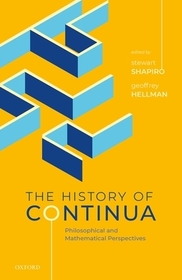
The History of Continua
Philosophical and Mathematical Perspectives
-
10% KEDVEZMÉNY?
- A kedvezmény csak az 'Értesítés a kedvenc témákról' hírlevelünk címzettjeinek rendeléseire érvényes.
- Kiadói listaár GBP 150.00
-
67 725 Ft (64 500 Ft + 5% áfa)
Az ár azért becsült, mert a rendelés pillanatában nem lehet pontosan tudni, hogy a beérkezéskor milyen lesz a forint árfolyama az adott termék eredeti devizájához képest. Ha a forint romlana, kissé többet, ha javulna, kissé kevesebbet kell majd fizetnie.
- Kedvezmény(ek) 10% (kb. 6 773 Ft)
- Kedvezményes ár 60 953 Ft (58 050 Ft + 5% áfa)
Iratkozzon fel most és részesüljön kedvezőbb árainkból!
Feliratkozom
67 725 Ft

Beszerezhetőség
Megrendelésre a kiadó utánnyomja a könyvet. Rendelhető, de a szokásosnál kicsit lassabban érkezik meg.
Why don't you give exact delivery time?
A beszerzés időigényét az eddigi tapasztalatokra alapozva adjuk meg. Azért becsült, mert a terméket külföldről hozzuk be, így a kiadó kiszolgálásának pillanatnyi gyorsaságától is függ. A megadottnál gyorsabb és lassabb szállítás is elképzelhető, de mindent megteszünk, hogy Ön a lehető leghamarabb jusson hozzá a termékhez.
A termék adatai:
- Kiadás sorszáma 1
- Kiadó OUP Oxford
- Megjelenés dátuma 2020. december 1.
- ISBN 9780198809647
- Kötéstípus Keménykötés
- Terjedelem588 oldal
- Méret 241x165x39 mm
- Súly 990 g
- Nyelv angol 42
Kategóriák
Rövid leírás:
Mathematical and philosophical thought about continuity has changed considerably over the ages, from Aristotle's insistence that a continuum is a unified whole, to the dominant account today, that a continuum is composed of infinitely many points. This book explores the key ideas and debates concerning continuity over more than 2500 years.
TöbbHosszú leírás:
Mathematical and philosophical thought about continuity has changed considerably over the ages. Aristotle insisted that continuous substances are not composed of points, and that they can only be divided into parts potentially. There is something viscous about the continuous. It is a unified whole. This is in stark contrast with the prevailing contemporary account, which takes a continuum to be composed of an uncountably infinite set of points. This vlume presents a collective study of key ideas and debates within this history.
The opening chapters focus on the ancient world, covering the pre-Socratics, Plato, Aristotle, and Alexander. The treatment of the medieval period focuses on a (relatively) recently discovered manuscript, by Bradwardine, and its relation to medieval views before, during, and after Bradwardine's time. In the so-called early modern period, mathematicians developed the calculus and, with that, the rise of infinitesimal techniques, thus transforming the notion of continuity. The main figures treated here include Galileo, Cavalieri, Leibniz, and Kant. In the early party of the nineteenth century, Bolzano was one of the first important mathematicians and philosophers to insist that continua are composed of points, and he made a heroic attempt to come to grips with the underlying issues concerning the infinite.
The two figures most responsible for the contemporary orthodoxy regarding continuity are Cantor and Dedekind. Each is treated in an article, investigating their precursors and influences in both mathematics and philosophy. A new chapter then provides a lucid analysis of the work of the mathematician Paul Du Bois-Reymond, to argue for a constructive account of continuity, in opposition to the dominant Dedekind-Cantor account. This leads to consideration of the contributions of Weyl, Brouwer, and Peirce, who once dubbed the notion of continuity "the master-key which . . . unlocks the arcana of philosophy". And we see that later in the twentieth century Whitehead presented a point-free, or gunky, account of continuity, showing how to recover points as a kind of "extensive abstraction". The final four chapters each focus on a more or less contemporary take on continuity that is outside the Dedekind-Cantor hegemony: a predicative approach, accounts that do not take continua to be composed of points, constructive approaches, and non-Archimedean accounts that make essential use of infinitesimals.
Mathematicians and philosophers alike will appreciate this carefully articulated study of mereology, rigorously detailed and beautifully presented.
Tartalomjegyzék:
Introduction
Divisibility or indivisibility: the notion of continuity from the Presocratics to Aristotle, Barbara Sattler
Contiguity, continuity and continuous change: Alexander of Aphrodisias on Aristotle, Orna Harari
Infinity and continuity: Thomas Bradwardine and his contemporaries, Edith Dudley Sylla
Continuous extension and indivisibles in Galileo, Samuel Levey
The indivisibles of the continuum: seventeenth- century adventures in infinitesimal mathematics, Douglas. M Jesseph
The continuum, the infinitely small, and the law of conti- nuity in Leibniz, Samuel Levey
Continuity and intuition in 18th century analysis and in Kant, Daniel Sutherland
Bolzano on continuity, P. Rusnock
Cantor and continuity, Akihiro Kanamori
Dedekind on continuity, Emmylou Haner and Dirk Schlimm
What is a number?: continua, magnitudes, quantities, Charles McCarty
Continuity and intuitionism, Charles McCarty
The Peircean continuum, Francisco Vargas and Matthew E. Moore
Points as higher-order constructs: Whitehead's method of extensive abstraction, Achille C. Varzi
The predicative conception of the continuum, Peter Koellner
Point-free continuum, Giangiacomo Gerla
Intuitionistic/constructive accounts of the continuum today, John L. Bell
Contemporary innitesimalist theories of continua and their late 19th and early 20th century forerunners, Philip Ehrlich

