

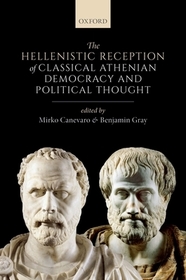
The Hellenistic Reception of Classical Athenian Democracy and Political Thought
-
10% KEDVEZMÉNY?
- A kedvezmény csak az 'Értesítés a kedvenc témákról' hírlevelünk címzettjeinek rendeléseire érvényes.
- Kiadói listaár GBP 132.50
-
59 823 Ft (56 975 Ft + 5% áfa)
Az ár azért becsült, mert a rendelés pillanatában nem lehet pontosan tudni, hogy a beérkezéskor milyen lesz a forint árfolyama az adott termék eredeti devizájához képest. Ha a forint romlana, kissé többet, ha javulna, kissé kevesebbet kell majd fizetnie.
- Kedvezmény(ek) 10% (cc. 5 982 Ft off)
- Kedvezményes ár 53 841 Ft (51 278 Ft + 5% áfa)
Iratkozzon fel most és részesüljön kedvezőbb árainkból!
Feliratkozom
59 823 Ft

Beszerezhetőség
Megrendelésre a kiadó utánnyomja a könyvet. Rendelhető, de a szokásosnál kicsit lassabban érkezik meg.
Why don't you give exact delivery time?
A beszerzés időigényét az eddigi tapasztalatokra alapozva adjuk meg. Azért becsült, mert a terméket külföldről hozzuk be, így a kiadó kiszolgálásának pillanatnyi gyorsaságától is függ. A megadottnál gyorsabb és lassabb szállítás is elképzelhető, de mindent megteszünk, hogy Ön a lehető leghamarabb jusson hozzá a termékhez.
A termék adatai:
- Kiadó OUP Oxford
- Megjelenés dátuma 2018. január 25.
- ISBN 9780198748472
- Kötéstípus Keménykötés
- Terjedelem374 oldal
- Méret 240x164x29 mm
- Súly 726 g
- Nyelv angol 0
Kategóriák
Rövid leírás:
The Hellenistic reception of Classical Athenian democracy and politics is comprehensively explored in this collection of essays, which span historical, philosophical, and literary approaches to the various ways in which Classical Athenian civic life and thought were emphasized, challenged, blunted, or reshaped in the Hellenistic world.
TöbbHosszú leírás:
In the Hellenistic period (c.323-31 BCE), Greek teachers, philosophers, historians, orators, and politicians found an essential point of reference in the democracy of Classical Athens and the political thought which it produced. However, while Athenian civic life and thought in the Classical period have been intensively studied, these aspects of the Hellenistic period have so far received much less attention. This volume seeks to bring together the two areas of research, shedding new light on these complementary parts of the history of the ancient Greek polis.
The essays collected here encompass historical, philosophical, and literary approaches to the various Hellenistic responses to and adaptations of Classical Athenian politics. They survey the complex processes through which Athenian democratic ideals of equality, freedom, and civic virtue were emphasized, challenged, blunted, or reshaped in different Hellenistic contexts and genres. They also consider the reception, in the changed political circumstances, of Classical Athenian non- and anti-democratic political thought. This makes it possible to investigate how competing Classical Athenian ideas about the value or shortcomings of democracy and civic community continued to echo through new political debates in Hellenistic cities and schools. Looking ahead to the Roman Imperial period, the volume also explores to what extent those who idealized Classical Athens as a symbol of cultural and intellectual excellence drew on, or forgot, its legacy of democracy and vigorous political debate. By addressing these different questions it not only tracks changes in practices and conceptions of politics and the city in the Hellenistic world, but also examines developing approaches to culture, rhetoric, history, ethics, and philosophy, and especially their relationships with politics.
While it is impossible to write a complete history of the Hellenistic world's relationship to earlier ages, or to fully understand the place of Classical Athens and its legacy in the public memory, civic life, cultural production, and institutions of the Hellenistic poleis, this volume represents an important step in that direction.
Tartalomjegyzék:
Frontmatter
List of Abbreviations
List of Contributors
Introduction
Part I: Early Hellenistic Responses to Classical Athenian Democracy and Political Thought
Stairway to Heaven: The Politics of Memory in Early Hellenistic Athens
Alexander the Great and Democracy in the Hellenistic World
Demosthenic Influences in Early Rhetorical Education: Hellenistic Rhetores and Athenian Imagination
Sophists, Epicureans, and Stoics
Comedy and the Athenian Ideal
Part II: Later Hellenistic and Early Imperial Developments in the Reception of Classical Athenian Politics
Polybius on 'Classical Athenian Imperial Democracy'
A Later Hellenistic Debate about the Value of Classical Athenian Civic Ideals? The Evidence of Epigraphy, Historiography, and Philosophy
Philanthropia, Athens, and Democracy in Diodorus Siculus: The Athenian Debate
Getting Over Athens: Re-Writing Hellenicity in the Early Roman History of Dionysius of Halicarnassus
Standing up to the Demos: Plutarch, Phocion, and the Democratic Life
The Orator in the Theatre: The End of Athenian Democracy in Plutarch s Phocion
Whatever Happened to Athens? Thoughts on the Great Convergence and Beyond
Endmatter
Bibliography
General Index
Index Locorum

