

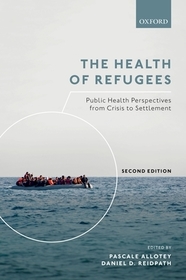
The Health of Refugees
Public Health Perspectives from Crisis to Settlement
-
10% KEDVEZMÉNY?
- A kedvezmény csak az 'Értesítés a kedvenc témákról' hírlevelünk címzettjeinek rendeléseire érvényes.
- Kiadói listaár GBP 44.49
-
21 255 Ft (20 242 Ft + 5% áfa)
Az ár azért becsült, mert a rendelés pillanatában nem lehet pontosan tudni, hogy a beérkezéskor milyen lesz a forint árfolyama az adott termék eredeti devizájához képest. Ha a forint romlana, kissé többet, ha javulna, kissé kevesebbet kell majd fizetnie.
- Kedvezmény(ek) 10% (cc. 2 126 Ft off)
- Kedvezményes ár 19 129 Ft (18 218 Ft + 5% áfa)
Iratkozzon fel most és részesüljön kedvezőbb árainkból!
Feliratkozom
21 255 Ft

Beszerezhetőség
Megrendelésre a kiadó utánnyomja a könyvet. Rendelhető, de a szokásosnál kicsit lassabban érkezik meg.
Why don't you give exact delivery time?
A beszerzés időigényét az eddigi tapasztalatokra alapozva adjuk meg. Azért becsült, mert a terméket külföldről hozzuk be, így a kiadó kiszolgálásának pillanatnyi gyorsaságától is függ. A megadottnál gyorsabb és lassabb szállítás is elképzelhető, de mindent megteszünk, hogy Ön a lehető leghamarabb jusson hozzá a termékhez.
A termék adatai:
- Kiadás sorszáma 2
- Kiadó OUP Oxford
- Megjelenés dátuma 2019. január 15.
- ISBN 9780198814733
- Kötéstípus Puhakötés
- Terjedelem320 oldal
- Méret 234x155x17 mm
- Súly 486 g
- Nyelv angol 0
Kategóriák
Rövid leírás:
This book traces the health repercussions on individuals and populations from the moment of forced mass movement due to conflict and other disasters, through to the process of resettlement in other countries. These issues are analysed and addressed within the context of other global public health priorities.
TöbbHosszú leírás:
At the moment, over 65 million people are forcibly displaced from their homes. The reasons for movement range from extreme weather conditions and environmental disasters, to war, civil and political crises, to the need for basic economic survival. Amongst these 65 million people are those that have been forced to leave a country that is no longer willing or able to offer protection and those who are displaced within their own country's borders.
In order to improve conditions for displaced people all over the globe, we need to look at the reason behind their move as this defines their migration status under international law. In its turn, the migration status affects the requirements of other countries to grant asylum, and the individual's right to protection and support. The definition of migration status and its implications has created tension in the public debate on refugees for decades and is today more relevant than ever.
In The Health of Refugees: Public Health Perspectives from Crisis to Settlement, the challenges and vulnerabilities created from this debate are addressed by public health policy makers, clinical practitioners, and researchers. An analysis of public health, international law, the history of migration, and the media's role in refugee health, it is a comprehensive and critical work with a strong message in favour of international and interdisciplinary cooperation. With a focus on what international obligations entail when it comes to refugees and migrants, the authors present a reinforced take on our collective responsibility to leave no one behind.
The Health of Refugees: Public Health Perspectives from Crisis to Settlement traces the health repercussions on individuals and populations from the moment of forced mass movement due to conflict and other disasters, through to the process of resettlement in other countries. These issues are addressed within the context of other global public health priorities, and are part of the book's critical analysis not only of the particular vulnerabilities created by mobility, but also how these interact and intersect with existing considerations across gender and age in health systems and international law. With a wider geographical area and case studies from all over the globe as a basis for the studies presented, this is a fully updated edition with new material discussing the current political landscape.
A truly multidisciplinary book, The Health of Refugees is ideal for public health practitioners, researchers, and postgraduate students. It is also an important work for those involved in non-governmental organisations, international aid, and international development. Furthermore, it provides a critical background for clinicians, mental health workers, and policymakers from health, welfare and migration.
This book is an invaluable, authoritative and insightful resource for the study of the responses to the health problems of refugees providing, with multiple examples, an excellent reference for many different individuals and bodies involved in developing a response to the health problems of refugees.
Tartalomjegyzék:
Part 1: Concepts and Context
Forced migration, globalisation and global public health
Humanitarianism, Refugees, Human Rights and Health
Social exclusion, othering and refugee health policy
Health in humanitarian crises
Part 2: Health Concerns
Populations in transition and post-settlement: an infectious diseases and travel medicine perspective
Mental health of refugees
Part 3: Impacts of Displacement
Urban refugees: The hidden population
Addressing the rights of women in conflict and humanitarian settings
The health challenges facing children on the move
The health impacts of displacement due to conflict on adolescents
Part 4: Case Studies in Research and Ethics
Methodological and ethical challenges in research with forcibly displaced populations
Conducting health research with resettled refugees in Australia: field sites, ethics and methods
The Politics of immigrant and refugee health in the United States
Dual loyalty, medical ethics and healthcare in offshore asylum seeker detention
Part 5: Conclusion
Controlling compassion: The media, refugees, and asylum seekers

