

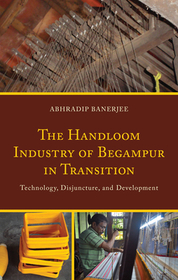
The Handloom Industry of Begampur in Transition
Technology, Disjuncture, and Development
-
18% KEDVEZMÉNY?
- Kiadói listaár GBP 85.00
-
38 377 Ft (36 550 Ft + 5% áfa)
Az ár azért becsült, mert a rendelés pillanatában nem lehet pontosan tudni, hogy a beérkezéskor milyen lesz a forint árfolyama az adott termék eredeti devizájához képest. Ha a forint romlana, kissé többet, ha javulna, kissé kevesebbet kell majd fizetnie.
- Kedvezmény(ek) 18% (cc. 6 908 Ft off)
- Kedvezményes ár 31 470 Ft (29 971 Ft + 5% áfa)
- A kedvezmény érvényes eddig: 2026. május 31.
31 470 Ft

Beszerezhetőség
Megrendelésre a kiadó utánnyomja a könyvet. Rendelhető, de a szokásosnál kicsit lassabban érkezik meg.
Why don't you give exact delivery time?
A beszerzés időigényét az eddigi tapasztalatokra alapozva adjuk meg. Azért becsült, mert a terméket külföldről hozzuk be, így a kiadó kiszolgálásának pillanatnyi gyorsaságától is függ. A megadottnál gyorsabb és lassabb szállítás is elképzelhető, de mindent megteszünk, hogy Ön a lehető leghamarabb jusson hozzá a termékhez.
A termék adatai:
- Kiadó Bloomsbury Publishing (UK)
- Megjelenés dátuma 2024. augusztus 30.
- Kötetek száma Hardback
- ISBN 9781666960587
- Kötéstípus Keménykötés
- Terjedelem218 oldal
- Méret 235.97x160.27x19.558 mm
- Súly 476 g
- Nyelv angol
- Illusztrációk 34 BW Illustrations, 5 Tables 541
Kategóriák
Hosszú leírás:
"The Handloom Industry of Begampur in Transition: Technology, Disjuncture and Development provides an ethnographic description of the handloom industry of the Begampur region, Hooghly district, West Bengal, India. While explaining the process of transformation within the industry, Abhradip Banerjee explores the uneasy relationship between technology, disjuncture, and development that has impacted the lives of this particular group of artisans for more than two decades. The novelty of this book lies in Banerjee's approach, which allowed him to perceive and analyze the process of transition within the handloom weaving tradition of Begampur region from a more inclusive perspective, miles away from the pitfall of gross ""technological determinism."" The ""sociotechnical approach allowed him to gauge, analyze, and incorporate several important but neglected dimensions of this transformation, which were otherwise missing in many historiographic or empirical accounts regarding the process of industrialization, deindustrialization, and class formation in India."
TöbbTartalomjegyzék:
List of Tables and Figures
Foreword
Acknowledgments
Introduction: Why Handlooms? Excavating the Trope
Handloom Industry and the Indian Economy
Perspectives on Indian Handlooms and the De-Industrialization Debate
Within a Maze: My Early Research and Involvement
Anthropology of Craft and Craftsmen: Concepts, Dimensions and Theoretical Perspectives
The Backdrop of the Present Research
The Handloom Industry of Begampur in Transition: Technology, Disjuncture and Development
Methodology
Structure of the Book
Chapter 1: The Setting: People, the Place, Economy, and Lives
History and Geographical Location of this Region
Geology and Climate
Flora and Fauna
Population and the Ethnic Composition
Education
Occupations
Infrastructure and Healthcare Facilities
Literary and Cultural Traditions
Chapter 2: Tracing the Historical and Cultural Landscape of the Handloom Industry in Begampur: From Past to the Present
Historical And Cultural Geography of Indian Handlooms
Handloom Industry of Bengal
Handloom Weaving Tradition in Begampur and its Evolution
Chapter 3: The Social and the Religious Life Handloom Weavers in Begampur Region
Ethnic Origin and Religious Cohabitation
Marriage
Family
Kinship
Life-Cycle Rituals
Religious Ceremonies and Festivals
Chapter 4: The Craft of Handloom Weaving: Technology, Processes, Work Coordination, Products and their Market
Loom and Other Implements
Knowledge and Skills in Different Stages of Cloth Production
Work Coordination and Division of Labour
Raw Materials, Products and their Market
Chapter 5: The Disjuncture and Juxtapositions of Cloth Production, Organization and Marketing
Individual Creative Identity vs. Community-Level Collective Production
Traditional Artisanal Craft vs. Technology-Driven Commercialized Mass-Production
The Informal vs. Formal Organizational Setup: The Issue of Dependence and Relative Independence
Empowerment vs. Exploitation: Types of Contracts and the Relations in Production
The Utility Products vs. Items with High Aesthetic Content
The Issue of Local vs. Global: Local Identity vs. the Process of Homogenization
Chapter 6: Handloom Weavers Cooperatives Societies in Begampur: A Failed Experiment?
A Brief History of Handloom Weavers' Cooperative in India
Handloom Weavers Cooperative Societies in Begampur Region
Rise of Begampur Handloom Cluster Society
Conclusion
Notes
Glossary
References
Index
About the Author

