

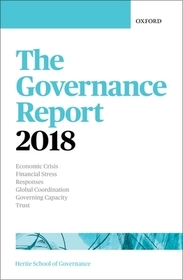
The Governance Report 2018
Sorozatcím: Hertie Governance Report;
-
10% KEDVEZMÉNY?
- A kedvezmény csak az 'Értesítés a kedvenc témákról' hírlevelünk címzettjeinek rendeléseire érvényes.
- Kiadói listaár GBP 15.99
-
7 219 Ft (6 875 Ft + 5% áfa)
Az ár azért becsült, mert a rendelés pillanatában nem lehet pontosan tudni, hogy a beérkezéskor milyen lesz a forint árfolyama az adott termék eredeti devizájához képest. Ha a forint romlana, kissé többet, ha javulna, kissé kevesebbet kell majd fizetnie.
- Kedvezmény(ek) 10% (kb. 722 Ft)
- Kedvezményes ár 6 497 Ft (6 188 Ft + 5% áfa)
Iratkozzon fel most és részesüljön kedvezőbb árainkból!
Feliratkozom
7 219 Ft

Beszerezhetőség
Megrendelésre a kiadó utánnyomja a könyvet. Rendelhető, de a szokásosnál kicsit lassabban érkezik meg.
Why don't you give exact delivery time?
A beszerzés időigényét az eddigi tapasztalatokra alapozva adjuk meg. Azért becsült, mert a terméket külföldről hozzuk be, így a kiadó kiszolgálásának pillanatnyi gyorsaságától is függ. A megadottnál gyorsabb és lassabb szállítás is elképzelhető, de mindent megteszünk, hogy Ön a lehető leghamarabb jusson hozzá a termékhez.
A termék adatai:
- Kiadó OUP Oxford
- Megjelenés dátuma 2018. szeptember 10.
- ISBN 9780198821496
- Kötéstípus Puhakötés
- Terjedelem136 oldal
- Méret 234x158x7 mm
- Súly 220 g
- Nyelv angol 0
Kategóriák
Rövid leírás:
The Governance Report 2018 examines the performance of coutnries before and after the great financial crisis and analyses how countries have faired and whether they are better prepared to avoid or withstand another similar crisis.
TöbbHosszú leírás:
The Global Financial Crisis (GFC) of 2008-9 was the greatest economic stress test since the 1940s. It put not only financial markets and currencies at risk; entire economies and political systems were threatened as the GFC soon revealed major governance shortcomings and weaknesses felt across a wide spectrum of policy fields. Globalization seemed in jeopardy, the Washington Consensus of neoliberal policies broken, and democratic backsliding set in as populism and protectionism began to take root.
The GFC triggered many responses to improve governance through reforms and regulatory measures of many kinds across a wide range of fields: most prominently in finance and banking, but also in fiscal policy, trade, labor markets and social security. Ten years after the GFC, the 2018 Governance Report takes stock and asks:
How have countries fared, and are they better prepared to avoid or withstand another crisis of GFC proportions? To answer this question, the 2018 Report focuses on the performance of countries before and after the GFC. Using elaborate indicator and data systems, applying state-of-the-art analytics, and covering a wide range of countries, it offers a systematic comparison of governance performance from three perspectives: What public goods are being provided, at what quality and to what effect? How ready are countries to address governance challenges in the context of globalization? What are the administrative capacities of the public sector? With measures taken before the GFC and today, these perspectives on governance performance provide important benchmarks for measuring both resilience and progress and can assist policymakers in designing effective solutions.
Tartalomjegyzék:
Preface
Acknowledgements
List of Figures, Tables, and Boxes
List of Abbreviations
1. Ten Years After: The Global Financial and Economic Crisis-Impact and Implications
Helmut K. Anheier, Sonja Kaufmann, and Sebastian Ziaja
2. Has Fiscal Policy Returned to Pre-crisis Levels?
Mark Hallerberg
3. Governing Capactities After the Global Financial and Ecnomic Crisis: Depleted, Refilled, or Steady State?
Kai Wegrich and Sebastian Ziaja
4. A Decade-long Grievance? The Global Financial and Economic Crisis' Impact on Institutional Trust
Luciana Cingolani
5. Is Global Governance Passé?
Jean Pisani-Ferry
6. Global Crises and Governance: Lessons, Implications, Recommendations
Helmut K. Anheier, Luciana Cingolani, Mark Hallerberg, Sonja Kaufmann, Regina A. List, Jean Pisani-Ferry, Kai Wegrich, and Sebastian Ziaja
References
About the Contributors

