

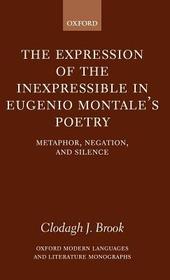
The Expression of the Inexpressible in Eugenio Montale's Poetry
Metaphor, Negation, and Silence
Sorozatcím: Oxford Modern Languages and Literature Monographs;
-
10% KEDVEZMÉNY?
- A kedvezmény csak az 'Értesítés a kedvenc témákról' hírlevelünk címzettjeinek rendeléseire érvényes.
- Kiadói listaár GBP 155.00
-
69 982 Ft (66 650 Ft + 5% áfa)
Az ár azért becsült, mert a rendelés pillanatában nem lehet pontosan tudni, hogy a beérkezéskor milyen lesz a forint árfolyama az adott termék eredeti devizájához képest. Ha a forint romlana, kissé többet, ha javulna, kissé kevesebbet kell majd fizetnie.
- Kedvezmény(ek) 10% (kb. 6 998 Ft)
- Kedvezményes ár 62 984 Ft (59 985 Ft + 5% áfa)
Iratkozzon fel most és részesüljön kedvezőbb árainkból!
Feliratkozom
69 982 Ft

Beszerezhetőség
Megrendelésre a kiadó utánnyomja a könyvet. Rendelhető, de a szokásosnál kicsit lassabban érkezik meg.
Why don't you give exact delivery time?
A beszerzés időigényét az eddigi tapasztalatokra alapozva adjuk meg. Azért becsült, mert a terméket külföldről hozzuk be, így a kiadó kiszolgálásának pillanatnyi gyorsaságától is függ. A megadottnál gyorsabb és lassabb szállítás is elképzelhető, de mindent megteszünk, hogy Ön a lehető leghamarabb jusson hozzá a termékhez.
A termék adatai:
- Kiadó OUP Oxford
- Megjelenés dátuma 2002. március 7.
- ISBN 9780199248988
- Kötéstípus Keménykötés
- Terjedelem208 oldal
- Méret 223x144x16 mm
- Súly 356 g
- Nyelv angol 0
Kategóriák
Rövid leírás:
This book locates the greatest Italian poet of the twentieth century, Eugenio Montale, firmly within European Modernism. It shows that he, like many writers of this period, was fascinated with the problems of language and expression. The book's main focus is the intriguing relationship between the word and what lies beyond the word.
TöbbHosszú leírás:
'It is impossible to say just what I mean!' Prufrock's frustration in Eliot's celebrated poem underlines the pessimistic view of language at the heart of much Modernist poetry. Locating the greatest Italian poet of the twentieth century, Eugenio Montale, firmly within European Modernism, this book examines the struggle with language that is central to his work. What can a poet do when words fail him? Does he put down his pen, retreat into silence? Does he seek instead to push language towards its limits, and, if so, what tools can he employ? What part does metaphor, the via negativa, allusive or understated writing have in this process? These are just some of the issues that Clodagh J. Brook seeks to address. In its unravelling of the inexpressibility paradox, her book offers a new reading of Montale's early verse, and reveals how in articles and metapoetic comments Montale gives us insights into both his poetics and the whole process of expression.
The grasp of European modernist literature shown in Brook's work is firm; although the story has been told before, it is a pleasure to read such a nuanced, yet concise, review of Dante's and Leopardi's views on inexpressibility, of modernism's debt to symbolist poetry, and of Nietzsche's role in the fracturing of certainties that underpinned prior vast systems of thought in which the ability of language to express fully had not been put into radical doubt ... thoughtful and thought-provoking book.
Tartalomjegyzék:
Preface
Introduction: The Development of the Inexpressibility Topos in European Literature
Eugenio Montale and the Inexpressible
Metaphor and Figurative Language
Negation
Silence
Appendix: Differentiating Figurative Language from 'Dead' Metaphor and Literal Language
Bibliography
Index

