

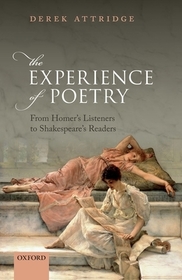
The Experience of Poetry
From Homer's Listeners to Shakespeare's Readers
-
10% KEDVEZMÉNY?
- A kedvezmény csak az 'Értesítés a kedvenc témákról' hírlevelünk címzettjeinek rendeléseire érvényes.
- Kiadói listaár GBP 88.00
-
39 732 Ft (37 840 Ft + 5% áfa)
Az ár azért becsült, mert a rendelés pillanatában nem lehet pontosan tudni, hogy a beérkezéskor milyen lesz a forint árfolyama az adott termék eredeti devizájához képest. Ha a forint romlana, kissé többet, ha javulna, kissé kevesebbet kell majd fizetnie.
- Kedvezmény(ek) 10% (kb. 3 973 Ft)
- Kedvezményes ár 35 759 Ft (34 056 Ft + 5% áfa)
Iratkozzon fel most és részesüljön kedvezőbb árainkból!
Feliratkozom
39 732 Ft

Beszerezhetőség
Megrendelésre a kiadó utánnyomja a könyvet. Rendelhető, de a szokásosnál kicsit lassabban érkezik meg.
Why don't you give exact delivery time?
A beszerzés időigényét az eddigi tapasztalatokra alapozva adjuk meg. Azért becsült, mert a terméket külföldről hozzuk be, így a kiadó kiszolgálásának pillanatnyi gyorsaságától is függ. A megadottnál gyorsabb és lassabb szállítás is elképzelhető, de mindent megteszünk, hogy Ön a lehető leghamarabb jusson hozzá a termékhez.
A termék adatai:
- Kiadó OUP Oxford
- Megjelenés dátuma 2019. március 5.
- ISBN 9780198833154
- Kötéstípus Keménykötés
- Terjedelem462 oldal
- Méret 238x165x28 mm
- Súly 910 g
- Nyelv angol
- Illusztrációk 37 Illustrations 0
Kategóriák
Rövid leírás:
An account of the performance of poetry from late Antiquity to the Renaissance that explores the role and importance of poetry in western culture.
TöbbHosszú leírás:
Was the experience of poetry--or a cultural practice we now call poetry--continuously available across the two-and-a-half millennia from the composition of the Homeric epics to the publication of Ben Jonson's Works and the death of Shakespeare in 1616? How did the pleasure afforded by the crafting of language into memorable and moving rhythmic forms play a part in the lives of hearers and readers in Ancient Greece and Rome, Europe during Late Antiquity and the Middle Ages, and Britain during the Renaissance?
In tackling these questions, this book first examines the evidence for the performance of the Iliad and the Odyssey and of Ancient Greek lyric poetry, the impact of the invention of writing on Alexandrian verse, the performances of poetry that characterized Ancient Rome, and the private and public venues for poetic experience in Late Antiquity. It moves on to deal with medieval verse, exploring the oral traditions that spread across Europe in the vernacular languages, the place of manuscript transmission, the shift from roll to codex and from papyrus to parchment, and the changing audiences for poetry. A final part investigates the experience of poetry in the English Renaissance, from the manuscript verse of Henry VIII's court to the anthologies and collections of the late Elizabethan era. Among the topics considered in this part are the importance of the printed page, the continuing significance of manuscript circulation, the performance of poetry in pageants and progresses, and the appearance of poets on the Elizabethan stage. In tracking both continuity and change across these many centuries, the book throws fresh light on the role and importance of poetry in western culture.
It is bracing to follow a prominent senior scholar in his exploration of so many centuries—millennia encountered not with any ex cathedra jadedness but with open enthusiasm that should immediately engage readers at every academic level.
Tartalomjegyzék:
Preface
Introduction
PART ONE: Ancient Greece
Homeric Greece: Courts and Singers
Archaic to Classical Greece: Festivals and Rhapsodes
Classical Greece to Ptolemaic Alexandria: Writers and Readers
PART TWO: Ancient Rome and Late Antiquity
Ancient Rome: The Republic and the Augustan Age
Ancient Rome: The Empire after Augustus
Late Antiquity: Latin and Greek, Private, Public, Popular
PART THREE: The Middle Ages
Early Medieval Poetry: Vernacular Versifying
The Twelfth and Thirteenth Centuries: Performing Genres
Lyric, Romance, and Alliterative Verse in Fourteenth-Century England
Chaucer, Gower, and Fifteenth-Century Poetry in English
PART FOUR: The English Renaissance
Early Tudor Poetry: Courtliness and Print
Late Elizabethan and Early Jacobean Poetry: The Circulation of Verse
Late Elizabethan and Early Jacobean Poetry: The Idea of the Poet
Bibliography

