

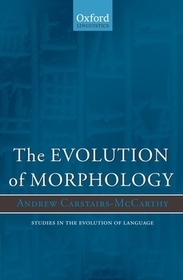
The Evolution of Morphology
Sorozatcím: Studies in the Evolution of Language; 14;
-
10% KEDVEZMÉNY?
- A kedvezmény csak az 'Értesítés a kedvenc témákról' hírlevelünk címzettjeinek rendeléseire érvényes.
- Kiadói listaár GBP 132.50
-
59 823 Ft (56 975 Ft + 5% áfa)
Az ár azért becsült, mert a rendelés pillanatában nem lehet pontosan tudni, hogy a beérkezéskor milyen lesz a forint árfolyama az adott termék eredeti devizájához képest. Ha a forint romlana, kissé többet, ha javulna, kissé kevesebbet kell majd fizetnie.
- Kedvezmény(ek) 10% (kb. 5 982 Ft)
- Kedvezményes ár 53 841 Ft (51 278 Ft + 5% áfa)
Iratkozzon fel most és részesüljön kedvezőbb árainkból!
Feliratkozom
59 823 Ft

Beszerezhetőség
Megrendelésre a kiadó utánnyomja a könyvet. Rendelhető, de a szokásosnál kicsit lassabban érkezik meg.
Why don't you give exact delivery time?
A beszerzés időigényét az eddigi tapasztalatokra alapozva adjuk meg. Azért becsült, mert a terméket külföldről hozzuk be, így a kiadó kiszolgálásának pillanatnyi gyorsaságától is függ. A megadottnál gyorsabb és lassabb szállítás is elképzelhető, de mindent megteszünk, hogy Ön a lehető leghamarabb jusson hozzá a termékhez.
A termék adatai:
- Kiadó OUP Oxford
- Megjelenés dátuma 2010. január 14.
- ISBN 9780199299782
- Kötéstípus Keménykötés
- Terjedelem268 oldal
- Méret 239x161x19 mm
- Súly 558 g
- Nyelv angol 0
Kategóriák
Rövid leírás:
This book considers the evolution of the grammatical structure of words in the contexts of human evolution and the origins of language. The author challenges the conventional views of the relationship between syntax and morphology, the adaptationist view of language evolution, and the notion that language in some way reflects 'laws of form'.
TöbbHosszú leírás:
This book considers the evolution of the grammatical structure of words in the more general contexts of human evolution and the origins of language. The consensus in many fields is that language is well designed for its purpose, and became so either through natural selection or by virtue of non-biological constraints on how language must be structured. Andrew Carstairs-McCarthy argues that in certain crucial respects language is not optimally designed. This can be seen, he suggests, in the existence of not one but two kinds of grammatical organization - syntax and morphology - and in the morphological and morpho-phonological complexity which leads to numerous departures from the one-form-one-meaning principle.
Having discussed the issue of good and bad design in a wider biological context, the author shows that conventional explanations for the nature of morphology do not work. Its poor design features arose, he argues, from two characteristics present when the ancestors of modern humans had a vocabulary but no grammar. One of these was a synonymy-avoidance expectation, while the other was an articulatory and phonological apparatus that encouraged the development of new synonyms. Morphology developed in response to these conflicting pressures.
In this stimulating and carefully argued account Professor McCarthy offers a powerful challenge to conventional views of the relationship between syntax and morphology, to the adaptationist view of language evolution, and to the notion that language in some way reflects 'laws of form'. This fundamental contribution to understanding the nature and evolution of language will be of wide interest to linguists of all theoretical persuasions as well as to scholars in cognitive science and anthropology.
a highly stimulating book based on insightful analyses of linguistic data. It raises a number of theoretical issues that are of interest to linguists, including cognitive linguists, far beyond the circle of morphologists. And it confronts the reader with some really challenging new perspectives on how to look at the way human languages work.
Tartalomjegyzék:
Design in Language and Design in Biology
Why There is Morphology: Traditional Accounts
A Cognitive-Articulatory Dilemma
Modes of Synonymy Avoidance
The Ancestors of Affixes
The Ancestors of Stem Alternants
Derivation, Compounding, and Lexical Storage
Morphological homonymy and Morphological Meanings
Conclusions

