

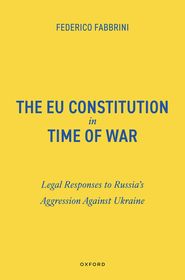
The EU Constitution in Time of War
Legal Responses to Russia’s Aggression Against Ukraine
-
20% KEDVEZMÉNY?
- A kedvezmény csak az 'Értesítés a kedvenc témákról' hírlevelünk címzettjeinek rendeléseire érvényes.
- Kiadói listaár GBP 100.00
-
45 150 Ft (43 000 Ft + 5% áfa)
Az ár azért becsült, mert a rendelés pillanatában nem lehet pontosan tudni, hogy a beérkezéskor milyen lesz a forint árfolyama az adott termék eredeti devizájához képest. Ha a forint romlana, kissé többet, ha javulna, kissé kevesebbet kell majd fizetnie.
- Kedvezmény(ek) 20% (cc. 9 030 Ft off)
- Kedvezményes ár 36 120 Ft (34 400 Ft + 5% áfa)
- A kedvezmény érvényes eddig: 2026. június 30.
Iratkozzon fel most és részesüljön kedvezőbb árainkból!
Feliratkozom
45 150 Ft

Beszerezhetőség
Megrendelésre a kiadó utánnyomja a könyvet. Rendelhető, de a szokásosnál kicsit lassabban érkezik meg.
Why don't you give exact delivery time?
A beszerzés időigényét az eddigi tapasztalatokra alapozva adjuk meg. Azért becsült, mert a terméket külföldről hozzuk be, így a kiadó kiszolgálásának pillanatnyi gyorsaságától is függ. A megadottnál gyorsabb és lassabb szállítás is elképzelhető, de mindent megteszünk, hogy Ön a lehető leghamarabb jusson hozzá a termékhez.
A termék adatai:
- Kiadó OUP Oxford
- Megjelenés dátuma 2025. február 26.
- ISBN 9780198963486
- Kötéstípus Keménykötés
- Terjedelem192 oldal
- Méret 16x164x240 mm
- Súly 436 g
- Nyelv angol 674
Kategóriák
Rövid leírás:
Russia's aggression of Ukraine forced the European Union to face the modern realities of hard power. In this book, Federico Fabbrini examines the EU's legal responses to Russia's aggression, exploring how the EU has taken ground-breaking measures to deal with war, but also highlighting the constitutional challenges that have emerged from EU action.
TöbbHosszú leírás:
Russia's illegal aggression against Ukraine has been a watershed moment for the European Union (EU). The return of large-scale conventional warfare to the European continent, unseen since the Second World War, shattered the illusion of perpetual peace and forced the EU to confront the reality of hard power. Originally created to maintain internal peace, the EU was never conceived to handle the challenges of war. Yet, the war in Ukraine required the EU to repurpose its machinery of government to do just that.
Embracing a comparative analytical framework, this book examines how the EU constitution has functioned in response to Russia's aggression. It scrutinizes the EU's legal reactions across five key policy areas: foreign, security, and defence policy; economic and fiscal policy; justice and home affairs; energy and industrial policy; and enlargement and reform. In doing so, it investigates whether the EU constitution has enabled the EU to respond effectively to the war, how EU treaties have been interpreted to authorize war-related actions, and whether these responses have adhered to constitutional limits.
Advancing a threefold argument, this book asserts that the EU constitution has demonstrated sufficient flexibility to permit wartime actions. Secondly, it highlights the limitations exposed by the return of conventional warfare in Europe, noting structural constraints and governance shortcomings that hinder decisive action, and instances where laws inadequately constrain EU action, particularly regarding fundamental rights and the rule of law. Finally, it evaluates the long-term constitutional implications of war for EU governance and proposes legal reforms that could shape a more perfect EU for both times of war and peace.
The author reflects on the possibility that the war in Ukraine could lead to constitutional changes. [...] Although the book is written by a legal expert, it offers sharp political insights and very useful reflections.
Tartalomjegyzék:
Introduction
To 'provide for the common defense': developments in foreign affairs and defence
To 'promote the general welfare': developments in fiscal and economic policy
To 'establish justice': developments in justice and home affairs
To 'insure domestic tranquility': developments in energy and industrial policy
To 'secure the blessings of liberty': developments in enlargement and reforms
Conclusion

