

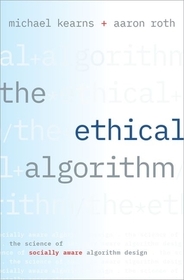
The Ethical Algorithm
The Science of Socially Aware Algorithm Design
-
10% KEDVEZMÉNY?
- A kedvezmény csak az 'Értesítés a kedvenc témákról' hírlevelünk címzettjeinek rendeléseire érvényes.
- Kiadói listaár GBP 24.99
-
11 282 Ft (10 745 Ft + 5% áfa)
Az ár azért becsült, mert a rendelés pillanatában nem lehet pontosan tudni, hogy a beérkezéskor milyen lesz a forint árfolyama az adott termék eredeti devizájához képest. Ha a forint romlana, kissé többet, ha javulna, kissé kevesebbet kell majd fizetnie.
- Kedvezmény(ek) 10% (kb. 1 128 Ft)
- Kedvezményes ár 10 154 Ft (9 671 Ft + 5% áfa)
Iratkozzon fel most és részesüljön kedvezőbb árainkból!
Feliratkozom
11 282 Ft

Beszerezhetőség
Megrendelésre a kiadó utánnyomja a könyvet. Rendelhető, de a szokásosnál kicsit lassabban érkezik meg.
Why don't you give exact delivery time?
A beszerzés időigényét az eddigi tapasztalatokra alapozva adjuk meg. Azért becsült, mert a terméket külföldről hozzuk be, így a kiadó kiszolgálásának pillanatnyi gyorsaságától is függ. A megadottnál gyorsabb és lassabb szállítás is elképzelhető, de mindent megteszünk, hogy Ön a lehető leghamarabb jusson hozzá a termékhez.
A termék adatai:
- Kiadó OUP USA
- Megjelenés dátuma 2020. január 23.
- ISBN 9780190948207
- Kötéstípus Keménykötés
- Terjedelem230 oldal
- Méret 236x155x22 mm
- Súly 522 g
- Nyelv angol
- Illusztrációk 30 figures 0
Kategóriák
Rövid leírás:
Algorithms have made our lives more efficient and entertaining--but not without a significant cost. Can we design a better future, one in which societial gains brought about by technology are balanced with the rights of citizens? The Ethical Algorithm offers a set of principled solutions based on the emerging and exciting science of socially aware algorithm design.
TöbbHosszú leírás:
Over the course of a generation, algorithms have gone from mathematical abstractions to powerful mediators of daily life. In evolving from static computer programs hand-coded by engineers to the products of machine learning, these technologies have made our lives more efficient, more entertaining, and, sometimes, better informed. At the same time, complex algorithms are increasingly crushing the basic rights of individual citizens. Allegedly anonymized datasets and statistical models routinely leak our most sensitive personal information; applications for everything from loans to college reflect racial and gender bias. Meanwhile, users manipulate algorithms to "game" search engines, spam filters, online reviewing services and navigation apps.
Understanding and improving the science behind the algorithms that run our lives is quickly becoming one of the most pressing issues of this century. Traditional solutions, such as laws, regulations and watchdog groups, have proven woefully inadequate, at best. Derived from the cutting-edge of scientific research, The Ethical Algorithm offers a new approach: a set of principled solutions based on the emerging and exciting science of socially aware algorithm design. Weaving together the science behind algorithm design with stories of citizens, lawyers, scientists, and activists experiencing the trial-and-error of research in real-time, Michael Kearns and Aaron Roth present a strikingly original way forward, showing how we can begin to work together to protect people from the unintended impacts of algorithms--and, sometimes, protect the science that could save us from ourselves.
...the authors take us on a journey through the main socio-algorithmic problems representing social constraints upon algorithms, their consequences and trade-offs. [T]hey provide concrete technical solutions for the challenges discussed throughout the book's 5 chapters: privacy, fairness, user-data-algorithm feedback loop, data-driven scientific discoveries and (brief) thoughts on the ethical issues (transparency, accountability, morality) yet to be pursued scientifically.
Tartalomjegyzék:
Introduction
Chapter 1: Algorithmic Privacy: The Power of Randomization
Chapter 2: Fairness: Discriminating Algorithms
Chapter 3: Games People Play (With Algorithms)
Chapter 4: Lost in the Garden: Led Astray by Data
Chapter 5: Risky Business: Interpretability, Morality, and the Singularity
Some Concluding Thoughts
Acknowledgements
Notes

