

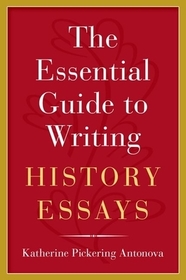
The Essential Guide to Writing History Essays
-
10% KEDVEZMÉNY?
- A kedvezmény csak az 'Értesítés a kedvenc témákról' hírlevelünk címzettjeinek rendeléseire érvényes.
- Kiadói listaár GBP 102.50
-
46 278 Ft (44 075 Ft + 5% áfa)
Az ár azért becsült, mert a rendelés pillanatában nem lehet pontosan tudni, hogy a beérkezéskor milyen lesz a forint árfolyama az adott termék eredeti devizájához képest. Ha a forint romlana, kissé többet, ha javulna, kissé kevesebbet kell majd fizetnie.
- Kedvezmény(ek) 10% (cc. 4 628 Ft off)
- Kedvezményes ár 41 651 Ft (39 668 Ft + 5% áfa)
Iratkozzon fel most és részesüljön kedvezőbb árainkból!
Feliratkozom
46 278 Ft

Beszerezhetőség
Megrendelésre a kiadó utánnyomja a könyvet. Rendelhető, de a szokásosnál kicsit lassabban érkezik meg.
Why don't you give exact delivery time?
A beszerzés időigényét az eddigi tapasztalatokra alapozva adjuk meg. Azért becsült, mert a terméket külföldről hozzuk be, így a kiadó kiszolgálásának pillanatnyi gyorsaságától is függ. A megadottnál gyorsabb és lassabb szállítás is elképzelhető, de mindent megteszünk, hogy Ön a lehető leghamarabb jusson hozzá a termékhez.
A termék adatai:
- Kiadó OUP USA
- Megjelenés dátuma 2020. február 20.
- ISBN 9780190271152
- Kötéstípus Keménykötés
- Terjedelem330 oldal
- Méret 159x241x25 mm
- Súly 601 g
- Nyelv angol 0
Kategóriák
Rövid leírás:
The Essential Guide to Writing History Essays is a practical handbook for students doing history coursework at undergraduate or master's levels. Chapters focus on each common type of history writing assignment, with concrete, step-by-step instructions, exercises, and examples tailored to the specific goals of each assignment type.
TöbbHosszú leírás:
The Essential Guide to Writing History Essays is a step-by-step guide to the typical assignments of any undergraduate or master's-level history program in North America. Effective writing is a process of discovery, achieved through the continual act of making choices--what to include or exclude, how to order elements, and which style to choose--each according to the author's goals and the intended audience. The book integrates reading and specialized vocabulary with writing and revision and addresses the evolving nature of digital media while teaching the terms and logic of traditional sources and the reasons for citation as well as the styles. This approach to writing not only helps students produce an effective final product and build from writing simple, short essays to completing a full research thesis, it also teaches students why and how an essay is effective, empowering them to approach new writing challenges with the freedom to find their own voice.
TöbbTartalomjegyzék:
1 ORIENTATION
1.1 How to Use This Book
1.2 How to Interpret Instructions
1.3 What's Different about College History
2 WHAT IS ACADEMIC WRITING?
2.1 The Virtues of Academic Writing
2.2 Academic Structure
2.3 Academic Style
2.4 The Writing Process
2.5 The Vices of Academic Writing
2.6 What Academic Writing Is Not
2.7 Who Is the Academic Reader?
2.8 Why Practice Academic Writing?
3 WHAT IS HISTORY?
3.1 Questions Historians Ask
3.2 How Historians Work
3.3 Why Everyone Should Take a History Class
3.4 What Is the History Major?
3.5 What Comes after the History Degree?
4 THE SHORT-ANSWER IDENTIFICATION ESSAY
4.1 What's Your Goal?
4.2 Studying Textbooks and Taking Lecture Notes
4.3 Brainstorming Lists
4.4 Distilling: Choosing the Right Details
4.5 Explaining Significance
4.6 Revising: Packing Your Sentences
4.7 Revising: Cutting the Crap
4.8 Revising: Grading Yourself
4.9 Proofreading: Handwriting, Spelling, and Grammar
4.10 In-Class Exams: Strategizing
5 THE RESPONSE PAPER
5.1 What's Your Goal?
5.2 Reading Academic History (Secondary Sources)
5.3 Reading: Annotating Your Text
5.4 Afternotes for a Secondary Source
5.5 Distilling an Argument
5.6 Responding to a Reading
5.7 Revising: Structure and Weight
5.8 Revising: Showing, Not Telling
5.9 Revising: Handling Quotes and Paraphrases
5.10 Revising: Word Choice
5.11 Revising: Cutting More Crap
5.12 Revising: Testing Your Draft
5.13 Proofreading: Grammar and Usage Errors
6 THE SHORT ANALYTICAL ESSAY
6.1 What's Your Goal?
6.2 Understanding the Prompt
6.3 Studying for Analytical Essays
6.4 Brainstorming: Evidence
6.5 Brainstorming: Claims
6.6 Brainstorming: Multiple Causes
6.7 Brainstorming: Addressing Counter-Arguments
6.8 Drafting: Argument-Based Outlining
6.9 Revising: Logic
6.10 Revising: Structure
6.11 Revising: Showing Your Work
6.12 Revising: Identifying Style Problems
6.13 Revising: Transitions
6.14 Proofreading: Past Tense Verbs
7 IMAGINATIVE PROJECTS
7.1 What's Your Goal?
7.2 Types of Imaginative Projects
7.3 Reading for Imaginative Projects
7.4 Brainstorming: What to Know or Invent
7.5 Brainstorming: Taking a Stand
7.6 Drafting: Playing with Ideas
7.7 Revising: Substance
7.8 Revising: Language and Style
7.9 Revising: Special Formatting
7.10 Citing and Attributing Sources
8 THE HISTORIOGRAPHICAL ESSAY
8.1 What's Your Goal?
8.2 Reading Conversations
8.3 Drafting: Conversations
8.4 Drafting: Book Reviews
8.5 Evaluating Contributions
8.6 Finding Your Contribution
8.7 Composing a Title
8.8 Revision: Structure
8.9 Revision: Subject and Verb Tests
8.10 Revision: Using Feedback
8.11 Revision: Grading Yourself
8.12 Proofreading: A Checklist
9 PRIMARY SOURCE INTERPRETATION
9.1 What's Your Goal?
9.2 What Is a Primary Source?
9.3 How Historians Use Primary Sources
9.4 Text: Sourcing Documents
9.5 Text: Document Types
9.6 Reading Primary Sources
9.7 Afternotes for a Primary Source
9.8 What Is Context?
9.9 What Is Subtext?
9.10 Brainstorming: Context and Subtext
9.11 Drafting: Analyzing Subtext
9.12 Drafting: Significance
9.13 Revising: Claims
9.14 Revising: Structure
9.15 Revising: Quoting Primary Sources
9.16 Revising: Learning from Models
9.17 Revising: Grading Yourself
9.18 Proofreading
10 HISTORICAL RESEARCH
10.1 What's Your Goal?
10.2 Using Your Library
10.3 Managing Information
10.4 Secondary Source Types
10.5 Tertiary Source Types
10.6 Internet Sources
10.7 Judging Relevance
10.8 Judging Quality
10.9 Identifying Conversations & Managing Scope
10.10 Citing Sources
10.11 Annotating a Bibliography
11 THE RESEARCH ESSAY
11.1 What's Your Goal?
11.2 Topics and Research Questions
11.3 Writing Process
11.4 Argument Types
11.5 Brainstorming Argument
11.6 Research Proposals
11.7 Drafting: Incorporating Sources
11.8 Drafting: Joining the Conversation
11.9 Revising: Ideas
11.10 Revising: Expressing Uncertainty and Limits
11.11 Revising: Structure
11.12 Revising: Getting Feedback
11.13 Revising: Style and Clarity
11.14 Revising: Grading Yourself
11.15 Proofreading and Formatting
11.16 Writing an Abstract
Appendix 1: Quick Reference
Appendix 2: Further Reading and Future Writing
Appendix 3: Note to Instructors

