

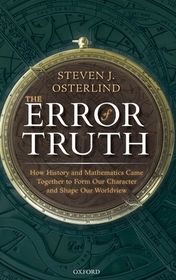
The Error of Truth
How History and Mathematics Came Together to Form Our Character and Shape Our Worldview
-
10% KEDVEZMÉNY?
- A kedvezmény csak az 'Értesítés a kedvenc témákról' hírlevelünk címzettjeinek rendeléseire érvényes.
- Kiadói listaár GBP 35.99
-
16 249 Ft (15 475 Ft + 5% áfa)
Az ár azért becsült, mert a rendelés pillanatában nem lehet pontosan tudni, hogy a beérkezéskor milyen lesz a forint árfolyama az adott termék eredeti devizájához képest. Ha a forint romlana, kissé többet, ha javulna, kissé kevesebbet kell majd fizetnie.
- Kedvezmény(ek) 10% (kb. 1 625 Ft)
- Kedvezményes ár 14 624 Ft (13 928 Ft + 5% áfa)
Iratkozzon fel most és részesüljön kedvezőbb árainkból!
Feliratkozom
16 249 Ft

Beszerezhetőség
Megrendelésre a kiadó utánnyomja a könyvet. Rendelhető, de a szokásosnál kicsit lassabban érkezik meg.
Why don't you give exact delivery time?
A beszerzés időigényét az eddigi tapasztalatokra alapozva adjuk meg. Azért becsült, mert a terméket külföldről hozzuk be, így a kiadó kiszolgálásának pillanatnyi gyorsaságától is függ. A megadottnál gyorsabb és lassabb szállítás is elképzelhető, de mindent megteszünk, hogy Ön a lehető leghamarabb jusson hozzá a termékhez.
A termék adatai:
- Kiadó OUP Oxford
- Megjelenés dátuma 2019. február 7.
- ISBN 9780198831600
- Kötéstípus Keménykötés
- Terjedelem352 oldal
- Méret 241x164x25 mm
- Súly 730 g
- Nyelv angol
- Illusztrációk 79 0
Kategóriák
Rövid leírás:
The Error of Truth recounts the astonishing and unexpected tale of how quantitative thinking came to be, and considers how seeing the world through a quantitate lens has shaped our perception of the world we live in.
TöbbHosszú leírás:
Quantitative thinking is our inclination to view natural and everyday phenomena through a lens of measurable events, with forecasts, odds, predictions, and likelihood playing a dominant part.
The Error of Truth recounts the astonishing and unexpected tale of how quantitative thinking came to be, and its rise to primacy in the nineteenth and early twentieth centuries. Additionally, it considers how seeing the world through a quantitative lens has shaped our perception of the world we live in, and explores the lives of the individuals behind its early establishment.
This worldview was unlike anything humankind had before, and it came about because of a momentous human achievement: we had learned how to measure uncertainty. Probability as a science was conceptualised. As a result of probability theory, we now had correlations, reliable predictions, regressions, the bellshaped curve for studying social phenomena, and the psychometrics of educational testing.
Significantly, these developments happened during a relatively short period in world history— roughly, the 130-year period from 1790 to 1920, from about the close of the Napoleonic era, through the Enlightenment and the Industrial Revolutions, to the end of World War I. At which time, transportation had advanced rapidly, due to the invention of the steam engine, and literacy rates had increased exponentially. This brief period in time was ready for fresh intellectual activity, and it gave a kind of impetus for the probability inventions.
Quantification is now everywhere in our daily lives, such as in the ubiquitous microchip in smartphones, cars, and appliances; in the Bayesian logic of artificial intelligence, as well as applications in business, engineering, medicine, economics, and elsewhere. Probability is the foundation of quantitative thinking. The Error of Truth tells its story— when, why, and how it happened.
The book is, in general, well-written, and the author writes in an accessible style, reflecting that the book is intended for a general audience with no, or little, previous knowledge of mathematics and probability theory...The book tells an important and interesting story with a good balance between sections that describe the general historical events from the considered period and parts that explain the mathematical accomplishments.
Tartalomjegyzék:
The Remarkable Story
The Context
Beginning in Observation
The Patterns of Large Numbers
The Bell Curve Takes Shape
Evidence and Probability Data
At Least Squares
Coming to Everyman
Probably a Distribution
Average Man
Rare Events
Regression to the Mean
Interrelated and Correlated
Discrepancy to Variability
Related to Relativity
Psychometrics and Psychological Tests
The Arts and the Age of the Chip
The Sum of It All

