

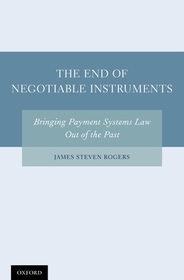
The End of Negotiable Instruments
Bringing Payment Systems Law Out of the Past
-
10% KEDVEZMÉNY?
- A kedvezmény csak az 'Értesítés a kedvenc témákról' hírlevelünk címzettjeinek rendeléseire érvényes.
- Kiadói listaár GBP 112.50
-
50 793 Ft (48 375 Ft + 5% áfa)
Az ár azért becsült, mert a rendelés pillanatában nem lehet pontosan tudni, hogy a beérkezéskor milyen lesz a forint árfolyama az adott termék eredeti devizájához képest. Ha a forint romlana, kissé többet, ha javulna, kissé kevesebbet kell majd fizetnie.
- Kedvezmény(ek) 10% (cc. 5 079 Ft off)
- Kedvezményes ár 45 714 Ft (43 538 Ft + 5% áfa)
Iratkozzon fel most és részesüljön kedvezőbb árainkból!
Feliratkozom
50 793 Ft

Beszerezhetőség
Megrendelésre a kiadó utánnyomja a könyvet. Rendelhető, de a szokásosnál kicsit lassabban érkezik meg.
Why don't you give exact delivery time?
A beszerzés időigényét az eddigi tapasztalatokra alapozva adjuk meg. Azért becsült, mert a terméket külföldről hozzuk be, így a kiadó kiszolgálásának pillanatnyi gyorsaságától is függ. A megadottnál gyorsabb és lassabb szállítás is elképzelhető, de mindent megteszünk, hogy Ön a lehető leghamarabb jusson hozzá a termékhez.
A termék adatai:
- Kiadó OUP USA
- Megjelenés dátuma 2012. január 12.
- ISBN 9780199856220
- Kötéstípus Keménykötés
- Terjedelem288 oldal
- Méret 147x213x22 mm
- Súly 417 g
- Nyelv angol 0
Kategóriák
Rövid leírás:
In The End of Negotiable Instruments: Bringing Payments Systems Law Out of the Past, author James Rogers challenges the basic assumptions of the law of checks and notes and its history, and provides a well-reasoned account of how the law could be changed to better suit the evolution of new payment technologies.
TöbbHosszú leírás:
In The End of Negotiable Instruments: Bringing Payments Systems Law Out of the Past, author James Rogers challenges the basic assumptions of the law of checks and notes and its history, and provides a well-reasoned account of how the law could be changed to better suit the evolution of new payment technologies.
The modern American law of payment systems is in disarray. Efforts to create a unified body of law for payment systems have so far been unsuccessful. Part of the reason for that failure is the assumption that the existing law works well for the traditional paper-based check system, and that problems have been created only by the evolution of new technologies. The End of Negotiable Instruments argues that this assumption is unfounded. The basic law of checks is itself anachronistic. There are no other books that undertake a similar analysis--there are legal treatises on the law of checks and notes, but all of them take for granted the basic assumptions challenged in this book. Several articles were published in the late twentieth century concerning the dispute over the application of certain doctrines of traditional negotiable instruments law to modern consumer finance transactions, but none of this literature went on to consider the broader question of whether there is anything worthwhile left in negotiable instruments law.
...the most refreshingly lucid analysis and enlightened criticism of the subject that I have ever read.
Tartalomjegyzék:
Introduction
Chapter 1 The Sorry State of Modern Payment Systems Law
Chapter 2 The Puzzling Persistence of the Law of Checks and Notes
Chapter 3 Paperless Paper
Chapter 4 Reports of the Death of the Holder in Due Course Doctrine Are Greatly Exaggerated.
Chapter 5 A Visit to the Museum of Negotiable Instruments Law
Chapter 6 The Bank Always Loses
Chapter 7 Are Checks Ever Transferred?
Chapter 8 What Would a Modern Law of Promissory Notes Look Like?
Chapter 9 What Would a Modern Law of Checks Look Like?
Chapter 10 Overcoming the Past
Index

