

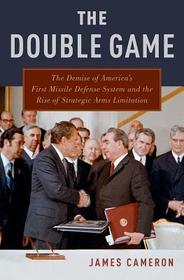
The Double Game
The Demise of America's First Missile Defense System and the Rise of Strategic Arms Limitation
-
10% KEDVEZMÉNY?
- A kedvezmény csak az 'Értesítés a kedvenc témákról' hírlevelünk címzettjeinek rendeléseire érvényes.
- Kiadói listaár GBP 88.00
-
39 732 Ft (37 840 Ft + 5% áfa)
Az ár azért becsült, mert a rendelés pillanatában nem lehet pontosan tudni, hogy a beérkezéskor milyen lesz a forint árfolyama az adott termék eredeti devizájához képest. Ha a forint romlana, kissé többet, ha javulna, kissé kevesebbet kell majd fizetnie.
- Kedvezmény(ek) 10% (cc. 3 973 Ft off)
- Kedvezményes ár 35 759 Ft (34 056 Ft + 5% áfa)
Iratkozzon fel most és részesüljön kedvezőbb árainkból!
Feliratkozom
39 732 Ft

Beszerezhetőség
Megrendelésre a kiadó utánnyomja a könyvet. Rendelhető, de a szokásosnál kicsit lassabban érkezik meg.
Why don't you give exact delivery time?
A beszerzés időigényét az eddigi tapasztalatokra alapozva adjuk meg. Azért becsült, mert a terméket külföldről hozzuk be, így a kiadó kiszolgálásának pillanatnyi gyorsaságától is függ. A megadottnál gyorsabb és lassabb szállítás is elképzelhető, de mindent megteszünk, hogy Ön a lehető leghamarabb jusson hozzá a termékhez.
A termék adatai:
- Kiadó OUP USA
- Megjelenés dátuma 2017. december 7.
- ISBN 9780190459925
- Kötéstípus Keménykötés
- Terjedelem248 oldal
- Méret 155x239x22 mm
- Súly 499 g
- Nyelv angol 0
Kategóriák
Rövid leírás:
Drawing on declassified records of presidential conversations, this book shows how presidents John F. Kennedy, Lyndon Johnson, and Richard Nixon engaged in a double game, hiding their true beliefs behind a façade of strategic language while secretly grappling with the complex realities of the nuclear age.
TöbbHosszú leírás:
How did the United States move from position of nuclear superiority over the Soviet Union at the beginning of the 1960s to a period of arms control based on nuclear parity the doctrine of mutual assured destruction in 1972? Drawing on declassified records of conversations between three presidents and their most trusted advisors, this book provides a new and fascinating answer to this question. John F. Kennedy, Lyndon Johnson, and Richard Nixon struggled to reconcile their own personal convictions on the nuclear arms race with the very different views of the public and Congress. In doing so they engaged in a double game, hiding their true beliefs behind a façade of strategic language while grappling in private with the complex realities of the nuclear age.
The book shows how Kennedy and Johnson consistently worried about the domestic political costs of their actions, pushing ahead with an anti-ballistic missile (ABM) system for the United States for fear of the domestic political consequences of scrapping both the system and the doctrine of strategic superiority on which it was based. By contrast, the abrupt change in U.S. public and congressional opinion in 1969 forced Nixon to give up America's first ABM and the U.S. lead in offensive ballistic missiles through agreements with the Soviet Union, despite his conviction that the U.S. needed a nuclear edge over the USSR to maintain the security of the West.
By placing this dynamic at the center of the story, the book provides a completely new overarching interpretation of this pivotal period in the development of U.S. nuclear policy.
For some 50 years, Washington and Moscow have been involved in a bilateral process of arms limitation and reduction that appears to be coming to an end... It is natural to return to the beginning of this process to try to understand how this system of restraints emerged. As James Cameron argues in The Double Game, we've been wrong about what motivated strategic arms limitation all along.
Tartalomjegyzék:
Acknowledgments
Abbreviations
Introduction
Ch. 1. Rational Superiority, Crises, and Arms Control, 1961-1963
Ch. 2. The Great Society and the Politics of Assured Destruction, 1963-1966
Ch. 3. First Steps toward SALT, 1966-1969
Ch. 4. Collapse of the Consensus and the Struggle for Coherence, 1969-1970
Ch. 5. Reconciliation with Necessity and the Race to the Summit, 1970-1972
Conclusion: The Double Game
Notes
Sources
Index

