

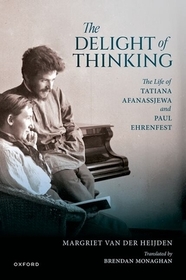
The Delight of Thinking
The Life of Tatiana Afanassjewa and Paul Ehrenfest
-
10% KEDVEZMÉNY?
- A kedvezmény csak az 'Értesítés a kedvenc témákról' hírlevelünk címzettjeinek rendeléseire érvényes.
- Kiadói listaár GBP 49.99
-
23 882 Ft (22 745 Ft + 5% áfa)
Az ár azért becsült, mert a rendelés pillanatában nem lehet pontosan tudni, hogy a beérkezéskor milyen lesz a forint árfolyama az adott termék eredeti devizájához képest. Ha a forint romlana, kissé többet, ha javulna, kissé kevesebbet kell majd fizetnie.
- Kedvezmény(ek) 10% (cc. 2 388 Ft off)
- Kedvezményes ár 21 494 Ft (20 471 Ft + 5% áfa)
Iratkozzon fel most és részesüljön kedvezőbb árainkból!
Feliratkozom
23 882 Ft

Beszerezhetőség
Még nem jelent meg, de rendelhető. A megjelenéstől számított néhány héten belül megérkezik.
Why don't you give exact delivery time?
A beszerzés időigényét az eddigi tapasztalatokra alapozva adjuk meg. Azért becsült, mert a terméket külföldről hozzuk be, így a kiadó kiszolgálásának pillanatnyi gyorsaságától is függ. A megadottnál gyorsabb és lassabb szállítás is elképzelhető, de mindent megteszünk, hogy Ön a lehető leghamarabb jusson hozzá a termékhez.
A termék adatai:
- Kiadó OUP Oxford
- Megjelenés dátuma 2026. április 2.
- ISBN 9780198927099
- Kötéstípus Keménykötés
- Terjedelem408 oldal
- Méret 234x156 mm
- Nyelv angol
- Illusztrációk 45 photographs 700
Kategóriák
Rövid leírás:
The Viennese Paul Ehrenfest and the Kiev-born Tatiana Afanassjewa built a home in Leiden, Netherlands, which became an oasis for thinkers from all over the world. Einstein, Ehrenfest's best friend, often stayed there. This is their story.
TöbbHosszú leírás:
Paul Ehrenfest grew up in a middle-class Jewish family in Vienna. Tatiana Afanassjewa came from a wealthy family in St Petersburg. Their love of science brought them together at the beginning of the twentieth century and led them to Leiden in the Netherlands.
There, the ebullient Ehrenfest built up an enormous international network of mostly physicists. Afanassjewa worked -- inevitably -- mainly at home, among the children, on the theory of heat, and thought about the didactics of geometry and how to 'teach children to think'. And as Europe grew darker and darker, the 'bright' Russian house that Afanassjewa had designed blossomed into an oasis for thinkers from all over the world. The list of signatures on the wall of the guest room includes the names of sixteen Nobel Prize winners, including Niels Bohr and, of course, Albert Einstein, Ehrenfest's best friend.
Over the past few years, Margriet van der Heijden has delved into the archives to tell the story of Ehrenfest and Afanassjewa and their microcosm, which fell apart when Hitler came to power in 1933. While on the run in England, Einstein heard that Ehrenfest had taken his own life. Afanassjewa had to survive without her professor, who, while "dancing in front of the blackboard", had made physics enchanting. Van der Heijden tells their story using many new documents from the Ehrenfest Family Archive and highlighting not only Ehrenfest's contributions to physics, but especially also those of Afanassjewa whose work on thermodynamics, dimensional analysis and the didactics of geometry has previously gotten less attention.
This is a joint biography of two significant scientists of the early 20th century whose lives and work and marriage are explored fully within that difficult period of rapid scientific advance, cultural hurdles, and political and social upheaval. Unlike many others, it gives full personal and scientific attention to both partners in this marriage. It provides a very informative and at times heartbreaking account of the hurdles, struggles and triumphs experienced by each, and especially by Tatiana Afanassjewa as a female student and scientist in that era.
Tartalomjegyzék:
Part 1
You shall see the ocean later: Growing up with older brothers
Not moonlight but rather sunlight: Well brought up in St Petersburg
Boltzmann and Columbus: Voyages of discovery in physics
Sailing the Sahara: Raised and constrained in St Petersburg
Between gods and humans: The Mecca of science
Don't ever smoke: A shared passion kindles love
Gleaning knowledge: Leiden canals, Russian novels and Göttingen mathematics
Aversion and love: Seeking a sense of self
Ill at ease in Vienna: Study, discussions and strolling with a pram
First publications: Unemployed but working
Happy in Göttingen: Travelling, thinking, writing
Dangerous experiments: A Russian beard and feeling at home
A sombre honorary secretary: Arduous success in Russia
Rest, cleanliness and regularity: A daughter and a spa
It could have been so wonderful here: Inaccessible German-speaking universities
A big, dear boy: Meeting Einstein
Coincidence and new opportunities: Farewell to St Petersburg
Part 2
The man in the empty sphere: A flying start in Leiden
Water to the left, water to the right and water in between: Cosmopolitans in a provincial town
War and friends: Leiden 1914
Oasis in an ugly world: Work, war and Witte Rozenstraat
The red professor and the Russian princess: Happiness in wartime
Ups and downs: Bankruptcy, peace and another son
Physics curator: Bohr as Rembrandt and Einstein as Holbein
Physics at the highest level: Just not for women
Einstein, Wassik and Russians: Concerns far and wide
Second rate and second class: Capitalism and socialism, men and women
Two worlds: American girls and 'male logic'
Warm people and thermodynamics: Paul's network and Tanya's science
Physics curator 2.0: Passionately interested in people's fate
Part 3
Falling behind: Mathematics in Moscow and mathematics as a blight
Escapism: Radios and travelling
Love is no longer enough: Nelly, Russia and the Nazis
Broken: A hopeless deed in a hopeless world
Part 4
Loss after loss: If only we could just be eyes
Finding joy in less: Writing and thinking to the end
Epilogue

