

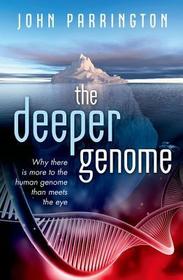
The Deeper Genome
Why there is more to the human genome than meets the eye
-
10% KEDVEZMÉNY?
- A kedvezmény csak az 'Értesítés a kedvenc témákról' hírlevelünk címzettjeinek rendeléseire érvényes.
- Kiadói listaár EUR 18.99
-
7 417 Ft (7 064 Ft + 5% áfa)
Az ár azért becsült, mert a rendelés pillanatában nem lehet pontosan tudni, hogy a beérkezéskor milyen lesz a forint árfolyama az adott termék eredeti devizájához képest. Ha a forint romlana, kissé többet, ha javulna, kissé kevesebbet kell majd fizetnie.
- Kedvezmény(ek) 10% (kb. 742 Ft)
- Kedvezményes ár 6 675 Ft (6 358 Ft + 5% áfa)
Iratkozzon fel most és részesüljön kedvezőbb árainkból!
Feliratkozom
7 417 Ft

Beszerezhetőség
A kiadónál véglegesen elfogyott, nem rendelhető. Érdemes újra keresni a címmel, hátha van újabb kiadás.
Why don't you give exact delivery time?
A beszerzés időigényét az eddigi tapasztalatokra alapozva adjuk meg. Azért becsült, mert a terméket külföldről hozzuk be, így a kiadó kiszolgálásának pillanatnyi gyorsaságától is függ. A megadottnál gyorsabb és lassabb szállítás is elképzelhető, de mindent megteszünk, hogy Ön a lehető leghamarabb jusson hozzá a termékhez.
A termék adatai:
- Kiadó Oxford University Press
- Megjelenés dátuma 2015. május 28.
- ISBN 9780199688739
- Kötéstípus Keménykötés
- Terjedelem272 oldal
- Méret 233x156x25 mm
- Súly 540 g
- Nyelv angol
- Illusztrációk Approximately 20 black and white illustrations 0
Kategóriák
Rövid leírás:
Mapping the human genome proved to be just the beginning in understanding our genes, what makes us human, and how we can use the knowledge to cure inherited diseases. John Parrington describes an emerging picture of our genome, in 3D, with many non-gene players and environmental influences, that is far more complex and subtle than we ever imagined.
TöbbHosszú leírás:
Over a decade ago, as the Human Genome Project completed its mapping of the entire human genome, hopes ran high that we would rapidly be able to use our knowledge of human genes to tackle many inherited diseases, and understand what makes us unique among animals. But things didn't turn out that way. For a start, we turned out to have far fewer genes than originally thought - just over 20,000, the same sort of number as a fruit fly or worm. What's more, the
proportion of DNA consisting of genes coding for proteins was a mere 2%. So, was the rest of the genome accumulated 'junk'?
Things have changed since those early heady days of the Human Genome Project. But the emerging picture is if anything far more exciting. In this book, John Parrington explains the key features that are coming to light - some, such as the results of the international ENCODE programme, still much debated and controversial in their scope. He gives an outline of the deeper genome, involving layers of regulatory elements controlling and coordinating the switching on and off of genes; the impact of
its 3D geometry; the discovery of a variety of new RNAs playing critical roles; the epigenetic changes influenced by the environment and life experiences that can make identical twins different and be passed on to the next generation; and the clues coming out of comparisons with the genomes of
Neanderthals as well as that of chimps about the development of our species. We are learning more about ourselves, and about the genetic aspects of many diseases. But in its complexity, flexibility, and ability to respond to environmental cues, the human genome is proving to be far more subtle than we ever imagined.
an excellent synthesis of what is currently understood about the human genome. It corrects claims of omniscience and shows just how wrong informed predictions turned out to be
Tartalomjegyzék:
Introduction: What are genes?
The Inheritors
Life as a Code
Switches and Signals
The Spacious Genome
RNA Out of the Shadows
It's a Jungle in There!
The Genome in 3D
The Jumping Genes
The Marks of Lamarck
Genes and Disease
What Makes us Human?
The Real Human Genome
Conclusion
References
Index

