

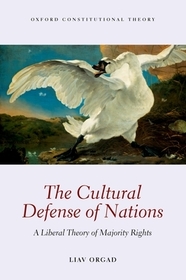
The Cultural Defense of Nations
A Liberal Theory of Majority Rights
Sorozatcím: Oxford Constitutional Theory;
-
10% KEDVEZMÉNY?
- A kedvezmény csak az 'Értesítés a kedvenc témákról' hírlevelünk címzettjeinek rendeléseire érvényes.
- Kiadói listaár GBP 40.99
-
19 582 Ft (18 650 Ft + 5% áfa)
Az ár azért becsült, mert a rendelés pillanatában nem lehet pontosan tudni, hogy a beérkezéskor milyen lesz a forint árfolyama az adott termék eredeti devizájához képest. Ha a forint romlana, kissé többet, ha javulna, kissé kevesebbet kell majd fizetnie.
- Kedvezmény(ek) 10% (cc. 1 958 Ft off)
- Kedvezményes ár 17 624 Ft (16 785 Ft + 5% áfa)
Iratkozzon fel most és részesüljön kedvezőbb árainkból!
Feliratkozom
19 582 Ft

Beszerezhetőség
Megrendelésre a kiadó utánnyomja a könyvet. Rendelhető, de a szokásosnál kicsit lassabban érkezik meg.
Why don't you give exact delivery time?
A beszerzés időigényét az eddigi tapasztalatokra alapozva adjuk meg. Azért becsült, mert a terméket külföldről hozzuk be, így a kiadó kiszolgálásának pillanatnyi gyorsaságától is függ. A megadottnál gyorsabb és lassabb szállítás is elképzelhető, de mindent megteszünk, hogy Ön a lehető leghamarabb jusson hozzá a termékhez.
A termék adatai:
- Kiadó OUP Oxford
- Megjelenés dátuma 2017. május 25.
- ISBN 9780198806912
- Kötéstípus Puhakötés
- Terjedelem304 oldal
- Méret 234x155x16 mm
- Súly 462 g
- Nyelv angol 0
Kategóriák
Rövid leírás:
Addressing one of the greatest challenges facing liberalism today, this book asks if it is legally and morally defensible for a liberal state to restrict immigration in order to preserve the cultural rights of majority groups. Orgad proposes a liberal approach to this dilemma and explores its dimensions, justifications, and limitations.
TöbbHosszú leírás:
Never in human history has so much attention been paid to human movement. Global migration yields demographic shifts of historical significance, profoundly shaking up world politics as has been seen in the refugee crisis, the Brexit referendum, and the 2016 US election.
The Cultural Defense of Nations addresses one of the greatest challenges facing liberalism today: is a liberal state justified in restricting immigration and access to citizenship in order to protect its majority culture? Liberal theorists and human rights advocates recognize the rights of minorities to maintain their unique cultural identity, but assume that majorities have neither a need for similar rights nor a moral ground for defending them. The majority culture, so the argument goes, "can take care of itself." However, with more than 250 million immigrants worldwide, majority groups increasingly seek to protect what they consider to be their national identity. In recent years, liberal democracies have introduced proactive immigration and citizenship policies that are designed to defend the majority culture.
This book shifts the focus from the prevailing discussion of cultural minority rights and, for the first time, addresses the cultural rights of majorities. It proposes a new approach by which liberal democracies can welcome immigrants without fundamentally changing their cultural heritage, forsaking their liberal traditions, or slipping into extreme nationalism.
Disregarding the topic of cultural majority rights is not only theoretically wrong, but also politically unwise. With forms of "majority nationalism" rising and the growing popularity of extreme right-wing parties in the West, the time has come to liberally address contemporary challenges.
By exploring the ethics of immigration laws, Orgad's work brings original insights to theories on immigration. His views are a step beyond the typical freedom of association argument... Orgad's work suggests that even where there is a right to exclude, this right ought to be constrained so that liberal democracies do not descend into illiberal societies.
Tartalomjegyzék:
Introduction: Citizen Makers
Part I: Before the Majority Becomes the Minority
New Challenge
Demographic Anxiety
Cultural Defense
Part II: Legitimate and Illegitimate Defense
Illiberal Liberalism
Majority Rights
National Constitutionalism
Conclusion: Immigration Policy and Constitutional Identity

