

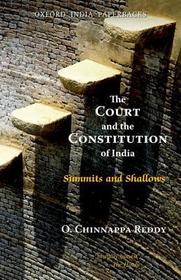
The Court and the Constitution of India
Summit and Shallows
-
10% KEDVEZMÉNY?
- A kedvezmény csak az 'Értesítés a kedvenc témákról' hírlevelünk címzettjeinek rendeléseire érvényes.
- Kiadói listaár GBP 14.99
-
6 767 Ft (6 445 Ft + 5% áfa)
Az ár azért becsült, mert a rendelés pillanatában nem lehet pontosan tudni, hogy a beérkezéskor milyen lesz a forint árfolyama az adott termék eredeti devizájához képest. Ha a forint romlana, kissé többet, ha javulna, kissé kevesebbet kell majd fizetnie.
- Kedvezmény(ek) 10% (kb. 676 Ft)
- Kedvezményes ár 6 091 Ft (5 801 Ft + 5% áfa)
Iratkozzon fel most és részesüljön kedvezőbb árainkból!
Feliratkozom
6 767 Ft

Beszerezhetőség
Csak rendelésre kapható a kiadónál, kissé időigényes.
Why don't you give exact delivery time?
A beszerzés időigényét az eddigi tapasztalatokra alapozva adjuk meg. Azért becsült, mert a terméket külföldről hozzuk be, így a kiadó kiszolgálásának pillanatnyi gyorsaságától is függ. A megadottnál gyorsabb és lassabb szállítás is elképzelhető, de mindent megteszünk, hogy Ön a lehető leghamarabb jusson hozzá a termékhez.
A termék adatai:
- Kiadó OUP India
- Megjelenés dátuma 2010. május 20.
- ISBN 9780198066286
- Kötéstípus Puhakötés
- Terjedelem392 oldal
- Méret 218x140x23 mm
- Súly 438 g
- Nyelv angol 0
Kategóriák
Rövid leírás:
Written by one of the Supreme Court's most respected judges, this book is a collection of essays on contemporary public law in India and the role of the Supreme Court in formulating it.
TöbbHosszú leírás:
This book provides a comprehensive narrative of the working of the Supreme Court of India. It assesses the collective strength and fragility of the Supreme Court as an institution of governance. The author traces the establishment of the Supreme Court of India and studies its role vis-a-vis the Constitution, examining the challenges which the court has had to face in nearly six decades. Covering areas such as rule of law, human rights, personal liberty, secularism, gender justice, rights of minorities, etc., the author analyses the various judgments given by the Supreme Court, highlighting where it has failed or faultered and where its role has been exemplary. He also examines the Indian Judiciary's relations with the Executive and the Legislature and studies the manner in which the constitution was amended from time to time, critically examining the 'objective' and 'purpose' of these amendments. The author also critically examines the judgments of the court dealing with the appointment and transfer of judges, arguing that independence of the Judiciary is not a luxury but a constitutional imperative, necessary to sustain and stabilize democracy.
TöbbTartalomjegyzék:
Acknowledgements
Foreword
Introduction
The Heritage
Building a Castle, But Not in the Air: The Making of the Constitution
A Brief Outline of the Constitution
Gopalan, Preventive Detention and Habeas Corpus
Crossroads, Champakam Dorairajan and the First Amendment
The Early Struggles and Peace at Last: Land Reforms, Golaknath, Kesavananda, and Articles 31-B and 31-C
The Terms of the Armistice: Basic Features of the Constitution
Democracy Denuded: The Aftermath of Kesavananda, Emergency, and Supersession of Judges
All this and Heaven too: Directive Principles of State Policy
Smoothening the Creases: Equality before Law
Ladders to Climb and Bridges to Cross: Reservations, Scheduled Castes, Scheduled Tribes, and Backward Classes
Reentry of Eve in the Garden of Eden: Women and Women's Rights
The Garden of Fruits and Flowers: Right to Life
Each for All and All for Each: Socialism
'May Your Religion be the Welfare of Humanity': Secularism
Minorities and Minority Institutions
Labour Law
To Speak or Not to Speak: Freedom of Expression
The Sword of Damocles: Contempt of Court
The State, its Instrumentalities and Agencies
Each for All, All for Each: Federalism, the Union and the State
To be Heard or Not to be Heard: Natural Justice and the Supreme Court
The Taming of the Shrew: Administrative Law
Whither Has the Magic of the Flowers and Fruits Gone?: Environmental Law
Explaining the Judicial Universe: Judicial Activism
The Garden is Open to the Public: Public Interest Litigation
Choosing the Ruler: Elections
A Contribution and Not an Exaction: Taxation
The Invasions and the Defences: Crime and Criminal Law
Conscience Keepers of the Law: Judges and Courts
Conclusion
Case Index
Subject Index

