

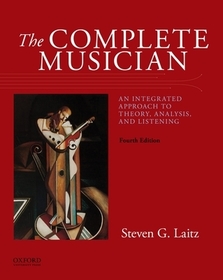
The Complete Musician
An Integrated Approach to Theory, Analysis, and Listening
-
10% KEDVEZMÉNY?
- A kedvezmény csak az 'Értesítés a kedvenc témákról' hírlevelünk címzettjeinek rendeléseire érvényes.
- Kiadói listaár GBP 151.99
-
72 613 Ft (69 155 Ft + 5% áfa)
Az ár azért becsült, mert a rendelés pillanatában nem lehet pontosan tudni, hogy a beérkezéskor milyen lesz a forint árfolyama az adott termék eredeti devizájához képest. Ha a forint romlana, kissé többet, ha javulna, kissé kevesebbet kell majd fizetnie.
- Kedvezmény(ek) 10% (cc. 7 261 Ft off)
- Kedvezményes ár 65 351 Ft (62 240 Ft + 5% áfa)
Iratkozzon fel most és részesüljön kedvezőbb árainkból!
Feliratkozom
72 613 Ft

Beszerezhetőség
A kiadónál véglegesen elfogyott, nem rendelhető. Érdemes újra keresni a címmel, hátha van újabb kiadás.
Why don't you give exact delivery time?
A beszerzés időigényét az eddigi tapasztalatokra alapozva adjuk meg. Azért becsült, mert a terméket külföldről hozzuk be, így a kiadó kiszolgálásának pillanatnyi gyorsaságától is függ. A megadottnál gyorsabb és lassabb szállítás is elképzelhető, de mindent megteszünk, hogy Ön a lehető leghamarabb jusson hozzá a termékhez.
A termék adatai:
- Kiadás sorszáma 4
- Kiadó OUP USA
- Megjelenés dátuma 2016. január 14.
- ISBN 9780199347094
- Kötéstípus Puhakötés
- Terjedelem960 oldal
- Méret 203x251x35 mm
- Súly 1520 g
- Nyelv angol 0
Kategóriák
Rövid leírás:
.
TöbbHosszú leírás:
Beginning with music fundamentals, The Complete Musician covers all the topics necessary for a thorough understanding of undergraduate music theory by focusing on music in context. Rather than rote learning of concepts and memorizing terms, The Complete Musician emphasizes how theory informs the work of performers. Composers respond not only to their instincts, experiences, and training in every work they write; they also follow certain ideals and models when appropriate, and modify them to fit their own personal vision. Theory is not a "theoretical" activity; it is a living one that responds to how music is composed and performed. Understanding how theory intersects with composition and performance is key to seeing its relevance to students' wider musical lives. The Complete Musician makes this connection.
The best book on the market. It has a superior balance of basic and complex concepts, terms, exercises, and examples." - Peter Susser, Columbia University
Tartalomjegyzék:
Preface
Part 1: The Foundations of Tonal Music
Chapter 1A: Musical Space
Chapter 1B: Musical Time: Pulse, Rhythm, and Meter
Chapter 2: Harnessing Space and Time: Introduction to Melody and Two-Voice Counterpoint
Chapter 3: Musical Density: Triads, Seventh Chords, and Texture
Part 2: Merging Melody and Harmony
Chapter 4: When Harmony, Melody, and Rhythm Converge
Chapter 5: Tonic and Dominant as Tonal Pillars and Introduction to Voice Leading
Chapter 6: The Impact of Melody, Rhythm, and Meter on Harmony; Introduction to V7; and Harmonizing Florid Melodies
Chapter 7: Contrapuntal Expansions of Tonic and Dominant: Six-Three Chords
Chapter 8: More Contrpuntal Expansions: Inversions of V7, Introduction to Leading-Tone Seventh Chords, and Reduction and Elavoration
Part 3: A New Harmonic Function, The Phrase Model, and Additional Melodic and Harmonic Embellishments
Chapter 9: The Pre-Dominant Function and the Phrase Model
Chapter 10: Accented and Chromatic Embellishing Tones
Chapter 11: Six-Four Chords, Revisiting the Subdominant, and Summary of Contrapuntal Expansions
Chapter 12: The Pre-Dominant Refines the Phrase Model
Part 4: New Chords and New Forms
Chapter 13: The Submediant: A New Diatonic Harmony, and Further Extensions of the Phrase Model
Chapter 14: The Mediant, the Back-Relating Dominant, and a Synthesis of Diatonic Harmonic Relationships
Chapter 15: The Period
Chapter 16: Other Small Musical Structures: Sentences, Double Periods, and Modified Periods
Chapter 17: Harmonic Sequences
Part 5: Functional Chromaticism
Chapter 18: Applied Chords
Chapter 19: Tonicization and Modulation
Chapter 20: Binary Form and Variations
Part 6: Expressive Chromaticism
Chapter 21: Modal Mixture
Chapter 22: Expansion of Modal Mixture Harmonies: Chromatic Modulation and the German Lied
Chapter 23: The Neapolitan Chord (bII)
Chapter 24: The Augmented Sixth Chord
Part 7: Large Forms: Ternary, Rondo, Sonata
Chapter 25: Ternary Form
Chapter 26: Rondo
Chapter 27: Sonata Form
Part 8: Introduction to Nineteenth-Century Harmony: The Shirt from Asymmetry to Symmetry
Chapter 28: New Harmonic Tendencies
Chapter 29: Melodic and Harmonic Symmetry Combine: Chromatic Sequences
Part 9: Twentieth and Twenty-First-Century Music
Chapter 30: Vestiges of Common Practice and the Rise of a New Sound World
Chapter 31: Noncentric Music: Atonal Concepts and Analytical Methodology
Chapter 32: New Rhythmic and Metric Possibilities, Ordered PC Relations, and Twelve-Tone Techniques
Appendices
Appndix 1: Invertible Counterpoint, Compound Melody, and Implied Harmonies
Appendix 2: The Motive
Appendix 3: Additional Harmonic-Sequence Topics
Appendix 4: Abbreviations and Acronyms
Appendix 5: Selected Answers to Textbook Exercises
Glossary
Index

