

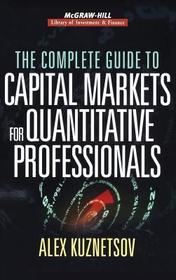
The Complete Guide to Capital Markets for Quantitative Professionals
Sorozatcím: McGraw-Hill Library of Investment and Finance;
-
10% KEDVEZMÉNY?
- A kedvezmény csak az 'Értesítés a kedvenc témákról' hírlevelünk címzettjeinek rendeléseire érvényes.
- Kiadói listaár GBP 85.99
-
38 824 Ft (36 975 Ft + 5% áfa)
Az ár azért becsült, mert a rendelés pillanatában nem lehet pontosan tudni, hogy a beérkezéskor milyen lesz a forint árfolyama az adott termék eredeti devizájához képest. Ha a forint romlana, kissé többet, ha javulna, kissé kevesebbet kell majd fizetnie.
- Kedvezmény(ek) 10% (kb. 3 883 Ft)
- Kedvezményes ár 34 941 Ft (33 278 Ft + 5% áfa)
Iratkozzon fel most és részesüljön kedvezőbb árainkból!
Feliratkozom
38 824 Ft

Beszerezhetőség
Megrendelésre a kiadó utánnyomja a könyvet. Rendelhető, de a szokásosnál kicsit lassabban érkezik meg.
Why don't you give exact delivery time?
A beszerzés időigényét az eddigi tapasztalatokra alapozva adjuk meg. Azért becsült, mert a terméket külföldről hozzuk be, így a kiadó kiszolgálásának pillanatnyi gyorsaságától is függ. A megadottnál gyorsabb és lassabb szállítás is elképzelhető, de mindent megteszünk, hogy Ön a lehető leghamarabb jusson hozzá a termékhez.
A termék adatai:
- Kiadó McGraw Hill
- Megjelenés dátuma 2006. december 16.
- ISBN 9780071468299
- Kötéstípus Keménykötés
- Terjedelem600 oldal
- Méret 233x218x38 mm
- Súly 934 g
- Nyelv angol 0
Kategóriák
Hosszú leírás:
The Complete Guide to Capital Markets for Quantitative Professionals is a comprehensive resource for readers with a background in science and technology who want to transfer their skills to the financial industry.
It is written in a clear, conversational style and requires no prior knowledge of either finance or financial analytics. The book begins by discussing the operation of the financial industry and the business models of different types of Wall Street firms, as well as the job roles those with technical backgrounds can fill in those firms. Then it describes the mechanics of how these firms make money trading the main financial markets (focusing on fixed income, but also covering equity, options and derivatives markets), and highlights the ways in which quantitative professionals can participate in this money-making process. The second half focuses on the main areas of Wall Street technology and explains how financial models and systems are created, implemented, and used in real life. This is one of the few books that offers a review of relevant literature and Internet resources.
The Complete Guide to Capital Markets for Quantitative Professionals is a comprehensive resource for readers with a background in science and technology who want to transfer their skills to the financial industry.
It is written in a clear, conversational style and requires no prior knowledge of either finance or financial analytics. The book begins by discussing the operation of the financial industry and the business models of different types of Wall Street firms, as well as the job roles those with technical backgrounds can fill in those firms. Then it describes the mechanics of how these firms make money trading the main financial markets (focusing on fixed income, but also covering equity, options and derivatives markets), and highlights the ways in which quantitative professionals can participate in this money-making process. The second half focuses on the main areas of Wall Street technology and explains how financial models and systems are created, implemented, and used in real life. This is one of the few books that offers a review of relevant literature and Internet resources.
TöbbTartalomjegyzék:
Introduction
Part I: Financial Industry
1: Financial Markets
2: Market Participants
3: Financial Institutions and Their People
Part II: Markets
4: Markets and the Economy
5: US Treasury Market
6: Equity Markets
7: Financial Futures
8: Interest Rate Swaps and Options
9: Inflation Trading
10: Agencies and Mortgages
11: Credit and Credit Derivatives
Part III: Technology Areas
12: Product Data
13: Analytics and Modeling
14: Market Data
15: Trading Systems
16: Risk Managment
17: RManagementnd Strategy
Part IV: Technology Practices
18: Production Cycle
19: Development Cycle
20: Applicaton Support and PApplicationagement
Conclusion
Appendices
Több
