

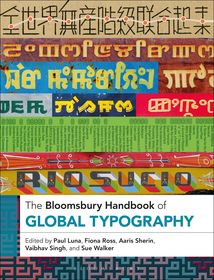
The Bloomsbury Handbook of Global Typography
Sorozatcím: Bloomsbury Visual Arts Handbooks;
-
18% KEDVEZMÉNY?
- Kiadói listaár GBP 130.00
-
58 695 Ft (55 900 Ft + 5% áfa)
Az ár azért becsült, mert a rendelés pillanatában nem lehet pontosan tudni, hogy a beérkezéskor milyen lesz a forint árfolyama az adott termék eredeti devizájához képest. Ha a forint romlana, kissé többet, ha javulna, kissé kevesebbet kell majd fizetnie.
- Kedvezmény(ek) 18% (kb. 10 565 Ft)
- Kedvezményes ár 48 130 Ft (45 838 Ft + 5% áfa)
- A kedvezmény érvényes eddig: 2026. augusztus 31.
48 130 Ft

Beszerezhetőség
Becsült beszerzési idő: A Prosperónál jelenleg nincsen raktáron, de a kiadónál igen. Beszerzés kb. 3-5 hét..
A Prosperónál jelenleg nincsen raktáron.
Why don't you give exact delivery time?
A beszerzés időigényét az eddigi tapasztalatokra alapozva adjuk meg. Azért becsült, mert a terméket külföldről hozzuk be, így a kiadó kiszolgálásának pillanatnyi gyorsaságától is függ. A megadottnál gyorsabb és lassabb szállítás is elképzelhető, de mindent megteszünk, hogy Ön a lehető leghamarabb jusson hozzá a termékhez.
A termék adatai:
- Kiadó Bloomsbury Publishing (UK)
- Megjelenés dátuma 2026. február 19.
- ISBN 9781350336384
- Kötéstípus Keménykötés
- Terjedelem528 oldal
- Méret 248x192x38 mm
- Súly 1640 g
- Nyelv
- Illusztrációk 350 colour illus 664
Kategóriák
Hosszú leírás:
This new handbook takes the broadest possible view of typography, defining it as 'design for reading'. It considers all kinds of reading matter and visual communication systems; digital, environmental, printed, and produced by hand.
By offering a rich collection of texts that are genuinely international in authorship and in scope, it seeks to rebalance the Western bias of so many books on the subject. It gives space to new voices and emerging standpoints about the global nature of design, the needs of particular communities of readers, and about the need for inclusivity and historical understanding in design practice and research.
Thirty-seven chapters by forty-three contributors show the interdisciplinary range of research in typography today, exemplifying the relationship between history, theory, and practice that is at the heart of the discipline. They feature over 500 illustrations, mostly in colour, and full bibliographic references.
Topics include:
Typography and sociolinguistics
Frameworks for considering scripts and multilingual documents
Historical and contemporary Arabic-script typographic practice
Designing fonts for marginalized communities in Asia, Africa, and North America
The earliest movable type in China in the tenth century
Understanding Japanese and Korean typography
Approaches to legibility
Western influence on the typography of indigenous writing systems
Political and technological factors that shape typography
Experimental and commercial publishing contexts
The type design industry today
Typography in the environment
Tartalomjegyzék:
Introduction
1. The skeletons and dresses of writing systems: A (grapho)linguistic perspective on graphic structure and variation
Dimitrios Meletis
2. Putting the world's writing systems into print: Triumphs and tribulations
Graham Shaw
3. The origin and development of early Chinese movable type
Xunchang Cheng
4. Type design as a collaborative process with particular reference to South Asian scripts
Fiona Ross
5. A framework for research-informed typeface design: Starting with Greek
Gerry Leonidas
6. Analysing the typography of bilingual documents: Descriptive frameworks for graphical and spatial attributes of text
Keith Tam
7. Some influences on legibility: Who or what has changed notions of legibility through time?
Mary C. Dyson , Niki Sioki, and Mila Waldeck
8. The work of text in the age of digital information: Who (or what) makes typographic decisions?
John Hudson
9. The process of shaping text: An engineer's perspective
Simon Cozens
10. Change in the digital type industry
Dan Rhatigan, Doug Wilson , and David Lemon
11. The straitjacket of modernity : The New Nagari project and typeface design in India
Vaibhav Singh
12. Hebrew type designs of the 1950s : Typographic building blocks of a new nation
Adi Stern
13. The impact of Latinization on Armenian reading matter: A case study in newspapers
Elena Papassissa
14. The peculiarities of Cyrillic letterforms: Design variation and correlation in Russian typefaces
Maxim Zhukov
15. Cyrillic beyond Russia: Four reflections in history
John Hudson
16. Latin American vernacular lettering
Priscila L. Farias
17. Sea facing: Typography at the English seaside
Justin Burns
18. Drawing Ireland's new typographic horizons
Clare Bell
19. Type-like: The special case of stencil work
Eric Kindel
20. Analysing typographic meaning-making in urban spaces: Four illustrative case studies
Irmi Wachendorff
21. Twentieth-century Black American design in context
Greg Bunbury
22. The calligraphy, lettering, and typography of Louise E. Jefferson: A Black woman designer in twentieth-century America
Tasheka Arceneaux-Sutton
23. Experimental publishing: Alternative networked cultures and new archival initiatives
Ruth Blacksell
24. The clothes words wear: Mapping meaning in dictionaries through typography
Paul Luna
25. Aspects of inclusive text design
Sofie Beier
26. Towards understanding diversity in Arabic typestyles: A study of readers' preferences in Arabic typefaces for text composition
Mohamad Dakak
27. Infinite loops: On the contours of Chinese type
Caspar Lam and YuJune Park
28. A Japanese typography primer: Unity from diversity
Mariko Takagi
29. Hangeul, the script of expansion and harmonization
Yanghee Ryu
30. From reed to steel: The origins of nasta'liq type-making in nineteenth-century Istanbul and Cairo
Borna Izadpanah
31. Reading text in Square Kufic: Deciphering calligraphy in complex graphic forms
Mamoun Sakkal
32. Secondary styles in Georgian typography
Ana Sanikidze
33. Modified Arabic scripts used by Uyghur, Kazakh, and Kyrgyz speakers in Xinjiang, China
Huati Wulan
34. Democratizing effective typographic expression: The role of Meitei Mayek in local and global communication
Neelakash Kshetrimayum
35. Native American typography: Reinforcing cultural identity
Juliet Shen
36. A typeface design for Africa: Designing a multi-script typeface family
Mark Jamra and Neil Patel
37. Typography's duty to language: Figurations of language in twentieth-century typographic discourse
Robin Fuller

