

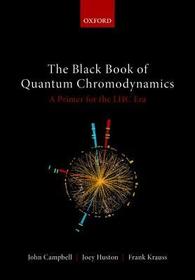
The Black Book of Quantum Chromodynamics
A Primer for the LHC Era
-
10% KEDVEZMÉNY?
- A kedvezmény csak az 'Értesítés a kedvenc témákról' hírlevelünk címzettjeinek rendeléseire érvényes.
- Kiadói listaár GBP 84.00
-
37 926 Ft (36 120 Ft + 5% áfa)
Az ár azért becsült, mert a rendelés pillanatában nem lehet pontosan tudni, hogy a beérkezéskor milyen lesz a forint árfolyama az adott termék eredeti devizájához képest. Ha a forint romlana, kissé többet, ha javulna, kissé kevesebbet kell majd fizetnie.
- Kedvezmény(ek) 10% (kb. 3 793 Ft)
- Kedvezményes ár 34 133 Ft (32 508 Ft + 5% áfa)
Iratkozzon fel most és részesüljön kedvezőbb árainkból!
Feliratkozom
37 926 Ft

Beszerezhetőség
Megrendelésre a kiadó utánnyomja a könyvet. Rendelhető, de a szokásosnál kicsit lassabban érkezik meg.
Why don't you give exact delivery time?
A beszerzés időigényét az eddigi tapasztalatokra alapozva adjuk meg. Azért becsült, mert a terméket külföldről hozzuk be, így a kiadó kiszolgálásának pillanatnyi gyorsaságától is függ. A megadottnál gyorsabb és lassabb szállítás is elképzelhető, de mindent megteszünk, hogy Ön a lehető leghamarabb jusson hozzá a termékhez.
A termék adatai:
- Kiadó OUP Oxford
- Megjelenés dátuma 2017. december 14.
- ISBN 9780199652747
- Kötéstípus Keménykötés
- Terjedelem768 oldal
- Méret 253x181x41 mm
- Súly 1591 g
- Nyelv angol
- Illusztrációk 35 color and 270 grayscale line figures 0
Kategóriák
Rövid leírás:
This book provides an in-depth introduction to the particle physics of current and future experiments at particle accelerators. The book will provide the reader with an overview of practically all aspects of the strong interaction necessary to understand and appreciate modern particle phenomenology at the energy frontier.
TöbbHosszú leírás:
This is an open access title. It is available to read and download as a free PDF version on Oxford Academic and is made available under a Creative Commons Attribution 4.0 licence.
The Black Book of Quantum Chromodynamics is an in-depth introduction to the particle physics of current and future experiments at particle accelerators. The book offers the reader an overview of practically all aspects of the strong interaction necessary to understand and appreciate modern particle phenomenology at the energy frontier. It assumes a working knowledge of quantum field theory at the level of introductory textbooks used for advanced undergraduate or in standard postgraduate lectures. The book expands this knowledge with an intuitive understanding of relevant physical concepts, an introduction to modern techniques, and their application to the phenomenology of the strong interaction at the highest energies. Aimed at graduate students and researchers, it also serves as a comprehensive reference for LHC experimenters and theorists.
This book offers an exhaustive presentation of the technologies developed and used by practitioners in the field of fixed-order perturbation theory and an overview of results relevant for the ongoing research programme at the LHC. It includes an in-depth description of various analytic resummation techniques, which form the basis for our understanding of the QCD radiation pattern and how strong production processes manifest themselves in data, and a concise discussion of numerical resummation through parton showers, which form the basis of event generators for the simulation of LHC physics, and their matching and merging with fixed-order matrix elements. It also gives a detailed presentation of the physics behind the parton distribution functions, which are a necessary ingredient for every calculation relevant for physics at hadron colliders such as the LHC, and an introduction to non-perturbative aspects of the strong interaction, including inclusive observables such as total and elastic cross sections, and non-trivial effects such as multiple parton interactions and hadronization. The book concludes with a useful overview contextualising data from previous experiments such as the Tevatron and the Run I of the LHC which have shaped our understanding of QCD at hadron colliders.
The three authors of the Black Book of of Quantum Chromodynamics are leading world experts in the field and have produced an authoritative and comprehensive text on the subject. There is a wealth of information for students of particle physics and for researchers in high energy physics which has never before been collected together in one place.
Tartalomjegyzék:
Introduction
Hard Scattering Formalism
QCD at Fixed Order: Technology
QCD at Fixed Order: Processes
QCD to All Orders
Parton Distribution Functions
Soft QCD
Data at thE TEVATRON
Data at the LHC
Summary
Appendix A: Mathematical Background
Appendix B: The Standard Model
Appendix C: Catani-Seymour Subtraction

