

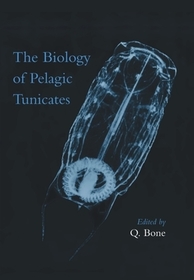
The Biology of Pelagic Tunicates
-
10% KEDVEZMÉNY?
- A kedvezmény csak az 'Értesítés a kedvenc témákról' hírlevelünk címzettjeinek rendeléseire érvényes.
- Kiadói listaár GBP 155.00
-
69 982 Ft (66 650 Ft + 5% áfa)
Az ár azért becsült, mert a rendelés pillanatában nem lehet pontosan tudni, hogy a beérkezéskor milyen lesz a forint árfolyama az adott termék eredeti devizájához képest. Ha a forint romlana, kissé többet, ha javulna, kissé kevesebbet kell majd fizetnie.
- Kedvezmény(ek) 10% (cc. 6 998 Ft off)
- Kedvezményes ár 62 984 Ft (59 985 Ft + 5% áfa)
Iratkozzon fel most és részesüljön kedvezőbb árainkból!
Feliratkozom
69 982 Ft

Beszerezhetőség
Megrendelésre a kiadó utánnyomja a könyvet. Rendelhető, de a szokásosnál kicsit lassabban érkezik meg.
Why don't you give exact delivery time?
A beszerzés időigényét az eddigi tapasztalatokra alapozva adjuk meg. Azért becsült, mert a terméket külföldről hozzuk be, így a kiadó kiszolgálásának pillanatnyi gyorsaságától is függ. A megadottnál gyorsabb és lassabb szállítás is elképzelhető, de mindent megteszünk, hogy Ön a lehető leghamarabb jusson hozzá a termékhez.
A termék adatai:
- Kiadó OUP Oxford
- Megjelenés dátuma 1998. január 8.
- ISBN 9780198540243
- Kötéstípus Keménykötés
- Terjedelem354 oldal
- Méret 255x199x25 mm
- Súly 882 g
- Nyelv angol
- Illusztrációk frontispiece, numerous halftones and line figures, tables 0
Kategóriák
Rövid leírás:
Pelagic Tunicates play an important role in the sea as filter feeding animals of the macroplankton in geochemical cycling. This is the first book in fifty years to provide a full account of all the Tunicate groups. It should therefore be of enormous value to plankton workers, containing keys to aid identification. For the aid of researchers, the authors have highlighted areas where further work is needed.
TöbbHosszú leírás:
Pelagic tunicates are fascinating for their beauty, remarkable in most cases for their curious and even bizarre life cycles, and often notable for extraordinarily rapid growth. Furthermore, in recent years their major importance in the economy of the sea has been recognized.
Although the now outdated encyclopaedic texts of the 1930s dealt with pelagic tunicates, the results of much subsequent physiological and ecological work have only appeared in scattered articles. This book is unique in giving a modern account of the biology of pelagic tunicates, with much new and unpublished information. Different chapters treat such topics as the ecological impact of salp blooms, locomotion by jet propulsion, the affinities of different groups, and the abundance and distribution of each group. Updated classification and identification keys to every pelagic tunicate now known are included.
The Biology of Pelagic Tunicates will be useful to all plankton workers, and may perhaps stimulate ecologists, physiologists, and geneticists to begin work on a somewhat neglected group of animals that offer some unusual advantages for different kinds of study.
Tartalomjegyzék:
Introduction
Chapter 1 - Anatomy of Thaliacea
Chapter 2 - Anatomy of Appendicularia
Chapter 3 - Locomotion, locomotor muscles and buoyancy
Chapter 4 - Nervous system, sense organs and excitable epithelia
Chapter 5 - Feeding and energetics of Thaliaceans
Chapter 6 - The Appendicularian house
Chapter 7 - Salp and pyrosomid blooms and their importance in biogeochemical cycles
Chapter 8 - Feeding and metabolism of appendicularians
Chapter 9 - Life history of the appendicularians
Chapter 10 - The role of appendicularia in marine food webs
Chapter 11 - The parasites and predators of Thaliacea
Chapter 12 - Bioluminescence in the Appendicularia
Chapter 13 - The cladistic biogeography of salps and pyrosomas
Chapter 14 - Appendicularian distribution and zoogeography
Chapter 15 - Molecular phylogeny of tunicates. A preliminary study using 28 Sribosomal RNA partial sequences: implications in terms of evolution and ecology
Chapter 16 - The relationships and systematics of the Thaliacea, with keys for identification
Chapter 17 - The classification of Appendicularia
References
Taxonomic Index
Subject Index

