

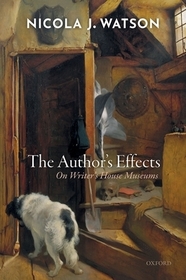
The Author's Effects
On Writer's House Museums
-
10% KEDVEZMÉNY?
- A kedvezmény csak az 'Értesítés a kedvenc témákról' hírlevelünk címzettjeinek rendeléseire érvényes.
- Kiadói listaár GBP 44.99
-
20 312 Ft (19 345 Ft + 5% áfa)
Az ár azért becsült, mert a rendelés pillanatában nem lehet pontosan tudni, hogy a beérkezéskor milyen lesz a forint árfolyama az adott termék eredeti devizájához képest. Ha a forint romlana, kissé többet, ha javulna, kissé kevesebbet kell majd fizetnie.
- Kedvezmény(ek) 10% (kb. 2 031 Ft)
- Kedvezményes ár 18 281 Ft (17 411 Ft + 5% áfa)
Iratkozzon fel most és részesüljön kedvezőbb árainkból!
Feliratkozom
20 312 Ft

Beszerezhetőség
Megrendelésre a kiadó utánnyomja a könyvet. Rendelhető, de a szokásosnál kicsit lassabban érkezik meg.
Why don't you give exact delivery time?
A beszerzés időigényét az eddigi tapasztalatokra alapozva adjuk meg. Azért becsült, mert a terméket külföldről hozzuk be, így a kiadó kiszolgálásának pillanatnyi gyorsaságától is függ. A megadottnál gyorsabb és lassabb szállítás is elképzelhető, de mindent megteszünk, hogy Ön a lehető leghamarabb jusson hozzá a termékhez.
A termék adatai:
- Kiadó OUP Oxford
- Megjelenés dátuma 2020. január 16.
- ISBN 9780198847571
- Kötéstípus Keménykötés
- Terjedelem350 oldal
- Méret 236x160x25 mm
- Súly 720 g
- Nyelv angol
- Illusztrációk 24 Illustrations 0
Kategóriák
Rövid leírás:
A fascinating account of the emergence of the writer's house museum over the course of the nineteenth century in Britain, Europe, and North America. It considers the museum as a cultural form and asks why it appeared and how it has constructed authorial afterlife for readers individually and collectively.
TöbbHosszú leírás:
The Author's Effects: On the Writer's House Museum is the first book to describe how the writer's house museum came into being as a widespread cultural phenomenon across Britain, Europe, and North America. Exploring the ways that authorship has been mythologised through the conventions of the writer's house museum, The Author's Effects anatomises the how and why of the emergence, establishment, and endurance of popular notions of authorship in relation to creativity.
It traces how and why the writer's bodily remains, possessions, and spaces came to be treasured in the late eighteenth and nineteenth centuries, as a prelude to the appearance of formal writer's house museums. It ransacks more than 100 museums and archives to tell the stories of celebrated and paradigmatic relics--Burns' skull, Keats' hair, Petrarch's cat, Poe's raven, Brontë's bonnet, Dickinson's dress, Shakespeare's chair, Austen's desk, Woolf's spectacles, Hawthorne's window, Freud's mirror, Johnson's coffee-pot and Bulgakov's stove, amongst many others. It investigates houses within which nineteenth-century writers mythologised themselves and their work--Thoreau's cabin and Dumas' tower, Scott's Abbotsford and Irving's Sunnyside. And it tracks literary tourists of the past to such long-celebrated literary homes as Petrarch's Arquà, Rousseau's Ile St Pierre, and Shakespeare's Stratford to find out what they thought and felt and did, discovering deep continuities with the redevelopment of Shakespeare's New Place for 2016.
Oxford University Press has produced a handsome illustrated volume that holds much to engage and instruct a literate reader interested in cultural heritage and European and North American literatures ... Watson has an eye for vivid and since-forgotten topics such as the poet Cowper's nightcap, so famous that it became a kind of icon in a poem by Browning, and the theme of headgear leads us to Jo's writing cap in Little Women and Ibsen's top hat on display in Oslo. Watson spins museological gold from the mundane (massively plural) accretions of writerly lives and readerly immersion.
Tartalomjegyzék:
Introduction
Remains: Burns' skull and Keats' hair
Bodies: Petrarch's cat and Poe's Raven
Clothing: Brontë's bonnet and Dickinson's dress
Furniture: Shakespeare's chair and Austen's desk
Household Effects: Johnson's coffee-pot and Twain's effigy
Glass: Woolf's spectacles and Freud's mirror
Outhouses: Thoreau's cabin and Dumas' prison
Enchanted Ground: Scott's Abbotsford, Irving's Sunnyside, Shakespeare's New Place
Exit through the Gift-shop

