

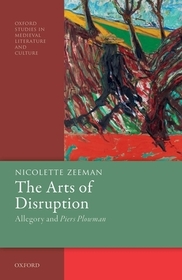
The Arts of Disruption
Allegory and Piers Plowman
Sorozatcím: Oxford Studies in Medieval Literature and Culture;
-
10% KEDVEZMÉNY?
- A kedvezmény csak az 'Értesítés a kedvenc témákról' hírlevelünk címzettjeinek rendeléseire érvényes.
- Kiadói listaár GBP 112.50
-
53 746 Ft (51 187 Ft + 5% áfa)
Az ár azért becsült, mert a rendelés pillanatában nem lehet pontosan tudni, hogy a beérkezéskor milyen lesz a forint árfolyama az adott termék eredeti devizájához képest. Ha a forint romlana, kissé többet, ha javulna, kissé kevesebbet kell majd fizetnie.
- Kedvezmény(ek) 10% (cc. 5 375 Ft off)
- Kedvezményes ár 48 372 Ft (46 068 Ft + 5% áfa)
Iratkozzon fel most és részesüljön kedvezőbb árainkból!
Feliratkozom
53 746 Ft

Beszerezhetőség
Megrendelésre a kiadó utánnyomja a könyvet. Rendelhető, de a szokásosnál kicsit lassabban érkezik meg.
Why don't you give exact delivery time?
A beszerzés időigényét az eddigi tapasztalatokra alapozva adjuk meg. Azért becsült, mert a terméket külföldről hozzuk be, így a kiadó kiszolgálásának pillanatnyi gyorsaságától is függ. A megadottnál gyorsabb és lassabb szállítás is elképzelhető, de mindent megteszünk, hogy Ön a lehető leghamarabb jusson hozzá a termékhez.
A termék adatai:
- Kiadó OUP Oxford
- Megjelenés dátuma 2020. augusztus 6.
- ISBN 9780198860242
- Kötéstípus Keménykötés
- Terjedelem466 oldal
- Méret 236x162x29 mm
- Súly 840 g
- Nyelv angol
- Illusztrációk 24 Illustrations 35
Kategóriák
Rövid leírás:
This volume offers original readings of Piers Plowman and rethinks the genre of allegorical narrative in the Middle Ages. It presents five studies of allegorical narratives with implications for different aspects of medieval culture.
TöbbHosszú leírás:
The monograph series Oxford Studies in Medieval Literature and Culture showcases the plurilingual and multicultural quality of medieval literature and actively seeks to promote research that not only focuses on the array of subjects medievalists now pursue - in literature, theology, and philosophy, in social, political, jurisprudential, and intellectual history, the history of art, and the history of science - but also that combines these subjects productively. It offers innovative studies on topics that may include, but are not limited to, manuscript and book history; languages and literatures of the global Middle Ages; race and the post-colonial; the digital humanities, media and performance; music; medicine; the history of affect and the emotions; the literature and practices of devotion; the theory and history of gender and sexuality, ecocriticism and the environment; theories of aesthetics; medievalism.
The Arts of Disruption: Allegory and Piers Plowman offers a series of new readings of the allegorical poem Piers Plowman: but it is also a book about allegory. It argues not just that there are distinctively disruptive 'arts' that occur in allegory, but that allegory, because it is interested in the difficulty of making meaning, is itself a disruptive art. The book approaches this topic via the study of five medieval allegorical narrative structures that exploit diegetic conflict and disruption. Although very different, they all bring together contrasting descriptions of spiritual process, in order to develop new understanding and excite moral or devotional change. These five structures are: the paradiastolic 'hypocritical figure' (such as vices masked by being made to look like 'adjacent' virtues), personification debate, violent language and gestures of apophasis, narratives of bodily decline, and grail romance. Each appears in a range of texts, which the book explores, along with other connected materials in medieval rhetoric, logic, grammar, spiritual thought, ethics, medicine, and romance iconography. These allegorical narrative structures appear radically transformed in Piers Plowman, where the poem makes further meaning out of the friction between them. Much of the allegorical work of the poem occurs at the points of their intersection, and within the conceptual gaps that open up between them. Ranging across a wide variety of medieval allegorical texts, the book shows from many perspectives allegory's juxtaposition of the heterogeneous and its questioning of supposed continuities.
Zeeman offers significant and often surprising illuminations of Langland's poem by juxtaposing its most insistent structures with their parallels in adjacent discourses.
Tartalomjegyzék:
Introduction: Allegory and Undoing
Excursus: Personifications in Dialogue and Debate
Part 1
The Hypocritical Figure
Ethical Adjacency in Piers Plowman
Part 2
Animate Oppositions
Opposition and Debate in Piers Plowman
Part 3
Anger, Insult, and Rebuff
Sharp Words and Violent Gestures in Piers Plowman
Part 4
Natural Entropy and Piers Plowman
The Sad Vices
Part 5
Piers Plowman and the Grail Romances
Tales of Piers and Perceval: Langland, Romance Aventure, and Doing well
Conclusion: Undoing Well
Appendix: Langland and Marguerite Porete

