

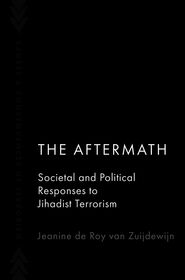
The Aftermath
Societal and Political Responses to Jihadist Terrorism
Sorozatcím: Causes and Consequences of Terrorism;
-
10% KEDVEZMÉNY?
- A kedvezmény csak az 'Értesítés a kedvenc témákról' hírlevelünk címzettjeinek rendeléseire érvényes.
- Kiadói listaár GBP 29.99
-
13 540 Ft (12 895 Ft + 5% áfa)
Az ár azért becsült, mert a rendelés pillanatában nem lehet pontosan tudni, hogy a beérkezéskor milyen lesz a forint árfolyama az adott termék eredeti devizájához képest. Ha a forint romlana, kissé többet, ha javulna, kissé kevesebbet kell majd fizetnie.
- Kedvezmény(ek) 10% (kb. 1 354 Ft)
- Kedvezményes ár 12 186 Ft (11 606 Ft + 5% áfa)
Iratkozzon fel most és részesüljön kedvezőbb árainkból!
Feliratkozom
13 540 Ft

Beszerezhetőség
Becsült beszerzési idő: A Prosperónál jelenleg nincsen raktáron, de a kiadónál igen. Beszerzés kb. 3-5 hét..
A Prosperónál jelenleg nincsen raktáron.
Why don't you give exact delivery time?
A beszerzés időigényét az eddigi tapasztalatokra alapozva adjuk meg. Azért becsült, mert a terméket külföldről hozzuk be, így a kiadó kiszolgálásának pillanatnyi gyorsaságától is függ. A megadottnál gyorsabb és lassabb szállítás is elképzelhető, de mindent megteszünk, hogy Ön a lehető leghamarabb jusson hozzá a termékhez.
A termék adatai:
- Kiadó OUP USA
- Megjelenés dátuma 2025. szeptember 30.
- ISBN 9780197686348
- Kötéstípus Puhakötés
- Terjedelem312 oldal
- Méret 232x160x18 mm
- Súly 449 g
- Nyelv angol 625
Kategóriák
Rövid leírás:
This book uses examples from Belgium, France, Germany, and the United Kingdom to explore the patterns of political and societal responses to terrorist attacks, raise questions about the efficacy of terrorism as a violent communication strategy, and formulate concrete recommendations for policymakers and professionals working to increase resilience and limit the impact of terrorism.
TöbbHosszú leírás:
Terrorist attacks are a means to an end. Terrorists use violence to spread fear and garner attention in order to achieve political or ideological goals. Beyond the direct damage, the societal and political responses of different audiences largely determine the impact of an attack. How different audiences respond to terrorism remains understudied, which hampers our ability to understand the extent to which terrorism can be considered (un)successful.
This book provides an in-depth examination of responses to jihadist terrorism in four countries: Belgium, France, Germany, and the United Kingdom. Introducing one of the most comprehensive qualitative datasets on the topic, Jeanine de Roy van Zuijdewijn explores the patterns of responses, raises questions about the efficacy of terrorism as a violent communication strategy, and formulates concrete recommendations for policymakers and professionals working to increase resilience and limit the impact of terrorism on societies. She shows how some responses from authorities and citizens were well-choreographed, with solidarity and unity leading the charge, while other attacks revealed deep polarization and division. Ultimately, the book zooms in on the process of meaning-making: how authorities and citizens attempted to place the attacks in a larger interpretive framework by way of using frames, rituals, and symbols directly after and around the first anniversary of the attacks.
Combining insights and concepts from various academic disciplines with an empirically driven approach, this book offers an in-depth look at the impact of terrorist attacks to understand how societies are dealing with one of the most pressing security threats of today.
Tartalomjegyzék:
Chapter One: The Aftermath
Chapter Two: Studying What Happens During the Aftermath
Chapter Three: What We Feared Has Happened (The Brussels Attacks)
Chapter Four: Vive La République (The Nice Attack)
Chapter Five: Unimpressed or Agitated (The Berlin Attack)
Chapter Six: Don't Look Back in Anger (The Manchester Attack)
Chapter Seven: From Cooperation to Contestation
Chapter Eight: Conclusions and Recommendations for Policymakers
Acknowledgements
Notes
Bibliography
Index

