

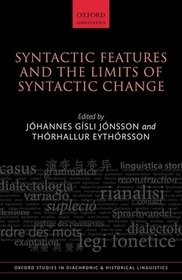
Syntactic Features and the Limits of Syntactic Change
Sorozatcím: Oxford Studies in Diachronic and Historical Linguistics; 43;
-
10% KEDVEZMÉNY?
- A kedvezmény csak az 'Értesítés a kedvenc témákról' hírlevelünk címzettjeinek rendeléseire érvényes.
- Kiadói listaár GBP 125.00
-
56 437 Ft (53 750 Ft + 5% áfa)
Az ár azért becsült, mert a rendelés pillanatában nem lehet pontosan tudni, hogy a beérkezéskor milyen lesz a forint árfolyama az adott termék eredeti devizájához képest. Ha a forint romlana, kissé többet, ha javulna, kissé kevesebbet kell majd fizetnie.
- Kedvezmény(ek) 10% (cc. 5 644 Ft off)
- Kedvezményes ár 50 794 Ft (48 375 Ft + 5% áfa)
Iratkozzon fel most és részesüljön kedvezőbb árainkból!
Feliratkozom
56 437 Ft

Beszerezhetőség
Becsült beszerzési idő: A Prosperónál jelenleg nincsen raktáron, de a kiadónál igen. Beszerzés kb. 3-5 hét..
A Prosperónál jelenleg nincsen raktáron.
Why don't you give exact delivery time?
A beszerzés időigényét az eddigi tapasztalatokra alapozva adjuk meg. Azért becsült, mert a terméket külföldről hozzuk be, így a kiadó kiszolgálásának pillanatnyi gyorsaságától is függ. A megadottnál gyorsabb és lassabb szállítás is elképzelhető, de mindent megteszünk, hogy Ön a lehető leghamarabb jusson hozzá a termékhez.
A termék adatai:
- Kiadó OUP Oxford
- Megjelenés dátuma 2021. március 11.
- ISBN 9780198832584
- Kötéstípus Keménykötés
- Terjedelem448 oldal
- Méret 241x160x29 mm
- Súly 822 g
- Nyelv angol 69
Kategóriák
Rövid leírás:
This volume brings together the latest diachronic research on syntactic features and their role in restricting syntactic change. The chapters explore topics relating to all three domains of the clause as well as issues in methodology and modelling, drawing on data from a range of languages and dialects.
TöbbHosszú leírás:
This volume brings together the latest diachronic research on syntactic features and their role in restricting syntactic change. The chapters address a central theoretical issue in diachronic syntax: whether syntactic variation can always be attributed to differences in the features of items in the lexicon, as the Borer-Chomsky conjecture proposes. In answering this question, all the chapters develop analyses of syntactic change couched within a formalist framework in which rich hierarchical structures and abstract features of various kinds play an important role. The first three parts of the volume explore the different domains of the clause, namely the C-domain, the T-domain and the ?P/VP-domain respectively, while chapters in the final part are concerned with establishing methodology in diachronic syntax and modelling linguistic correspondences. The contributors draw on extensive data from a large number of languages and dialects, including several that have received little attention in the literature on diachronic syntax, such as Romeyka, a Greek variety spoken in Turkey, and Middle Low German, previously spoken in northern Germany. Other languages are explored from a fresh theoretical perspective, including Hungarian, Icelandic, and Austronesian languages. The volume sheds light not only on specific syntactic changes from a cross-linguistic perspective but also on broader issues in language change and linguistic theory.
TöbbTartalomjegyzék:
Introduction: Syntactic features and the limits of syntactic change
Part I: The Left Periphery
Degree semantics, polarity, and the grammaticalization of comparative operators into complementizers
Cyclic change in Hungarian relative clauses
Diachronic change and feature instability: The cycles of Fin in Romanian obligatory control
Null subjects in Middle Low German: Diachronic stability and change
Part II: The T-domain
Feature reanalysis and the Latin origin of Romance Negative Concord
Degrammaticalization of pronominal clitics in Slavic
(In)vulnerable inflected infinitives as complements to modals: Evidence from Galician and Romeyka
Assessing phonological correlates of syntactic change: The case of Late Latin weak BE
Investigating the past of the futurate present
Part III: Case marking
From lexical to dependent: The case of the Greek dative
The nature and origin of syntactic ergativity in Austronesian languages
Featural dynamics in morphosyntactic change
Part IV: Syntactic reconstruction
Syntactic reconstruction based on linguistic fossils: Object-marking in Uralic
Regular syntactic change and syntactic reconstruction

