

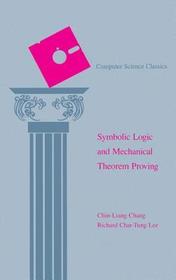
Symbolic Logic and Mechanical Theorem Proving
-
10% KEDVEZMÉNY?
- A kedvezmény csak az 'Értesítés a kedvenc témákról' hírlevelünk címzettjeinek rendeléseire érvényes.
- Kiadói listaár EUR 57.95
-
22 635 Ft (21 557 Ft + 5% áfa)
Az ár azért becsült, mert a rendelés pillanatában nem lehet pontosan tudni, hogy a beérkezéskor milyen lesz a forint árfolyama az adott termék eredeti devizájához képest. Ha a forint romlana, kissé többet, ha javulna, kissé kevesebbet kell majd fizetnie.
- Kedvezmény(ek) 10% (kb. 2 264 Ft)
- Kedvezményes ár 20 371 Ft (19 401 Ft + 5% áfa)
Iratkozzon fel most és részesüljön kedvezőbb árainkból!
Feliratkozom
22 635 Ft

Beszerezhetőség
Megrendelésre a kiadó utánnyomja a könyvet. Rendelhető, de a szokásosnál kicsit lassabban érkezik meg.
Why don't you give exact delivery time?
A beszerzés időigényét az eddigi tapasztalatokra alapozva adjuk meg. Azért becsült, mert a terméket külföldről hozzuk be, így a kiadó kiszolgálásának pillanatnyi gyorsaságától is függ. A megadottnál gyorsabb és lassabb szállítás is elképzelhető, de mindent megteszünk, hogy Ön a lehető leghamarabb jusson hozzá a termékhez.
A termék adatai:
- Kiadó Elsevier Science
- Megjelenés dátuma 1973. június 15.
- ISBN 9780121703509
- Kötéstípus Keménykötés
- Terjedelem331 oldal
- Méret 228x152 mm
- Súly 640 g
- Nyelv angol 0
Kategóriák
Hosszú leírás:
This book contains an introduction to symbolic logic and a thorough discussion of mechanical theorem proving and its applications. The book consists of three major parts. Chapters 2 and 3 constitute an introduction to symbolic logic. Chapters 4-9 introduce several techniques in mechanical theorem proving, and Chapters 10 an 11 show how theorem proving can be applied to various areas such as question answering, problem solving, program analysis, and program synthesis.
TöbbTartalomjegyzék:
?Preface
Acknowledgments
1. Introduction
1.1 Artificial Intelligence, Symbolic Logic, and Theorem Proving
1.2 Mathematical Background
References
2. The Propositional Logic
2.1 Introduction
2.2 Interpretations of Formulas in the Propositional Logic
2.3 Validity and Inconsistency in the Propositional Logic
2.4 Normal Forms in the Propositional Logic
2.5 Logical Consequences
2.6 Applications of the Propositional Logic
References
Exercises
3. The First-Order Logic
3.1 Introduction
3.2 Interpretations of Formulas in the First-Order Logic
3.3 Prenex Normal Forms in the First-Order Logic
3.4 Applications of the First-Order Logic
References
Exercises
4. Herbrand's Theorem
4.1 Introduction
4.2 Skolem Standard Forms
4.3 The Herbrand Universe of a Set of Clauses
4.4 Semantic Trees
4.5 Herbrand's Theorem
4.6 Implementation of Herbrand's Theorem
References
Exercises
5. The Resolution Principle
5.1 Introduction
5.2 The Resolution Principle for the Propositional Logic
5.3 Substitution and Unification
5.4 Unification Algorithm
5.5 The Resolution Principle for the First-Order Logic
5.6 Completeness of the Resolution Principle
5.7 Examples Using the Resolution Principle
5.8 Deletion Strategy
References
Exercises
6. Semantic Resolution and Lock Resolution
6.1 Introduction
6.2 An Informal Introduction to Semantic Resolution
6.3 Formal Definitions and Examples of Semantic Resolution
6.4 Completeness of Semantic Resolution
6.5 Hyperresolution and the Set-of-Support Strategy: Special Cases of Semantic Resolution
6.6 Semantic Resolution Using Ordered Clauses
6.7 Implementation of Semantic Resolution
6.8 Lock Resolution
6.9 Completeness of Lock Resolution
References
Exercises
7. Linear Resolution
7.1 Introduction
7.2 Linear Resolution
7.3 Input Resolution and Unit Resolution
7.4 Linear Resolution Using Ordered Clauses and the Information of Resolved Literals
7.5 Completeness of Linear Resolution
7.6 Linear Deduction and Tree Searching
7.7 Heuristics in Tree Searching
7.8 Estimations of Evaluation Functions
References
Exercises
8. The Equality Relation
8.1 Introduction
8.2 Unsatisfiability under Special Classes of Models
8.3 Paramodulation-An Inference Rule for Equality
8.4 Hyperparamodulation
8.5 Input and Unit Paramodulations
8.6 Linear Paramodulation
References
Exercises
9. Some Proof Procedures Based on Herbrand's Theorem
9.1 Introduction
9.2 The Prawitz Procedure
9.3 The V-Resolution Procedure
9.4 Pseudosemantic Trees
9.5 A Procedure for Generating Closed Pseudosemantic Trees
9.6 A Generalization of the Splitting Rule of Davis and Putnam
References
Exercises
10. Program Analysis
10.1 Introduction
10.2 An Informal Discussion
10.3 Formal Definitions of Programs
10.4 Logical Formulas Describing the Execution of a Program
10.5 Program Analysis by Resolution
10.6 The Termination and Response of Programs
10.7 The Set-of-Support Strategy and the Deduction of the Halting Clause
10.8 The Correctness and Equivalence of Programs
10.9 The Specialization of Programs
References
Exercises
11. Deductive Question Answering, Problem Solving, and Program Synthesis
11.1 Introduction
11.2 Class A Questions
11.3 Class B Questions
11.4 Class C Questions
11.5 Class D Questions
11.6 Completeness of Resolution for Deriving Answers
11.7 The Principles of Program Synthesis
11.8 Primitive Resolution and Algorithm A (A Program-Synthesizing Algorithm)
11.9 The Correctness of Algorithm A
11.10 The Application of Induction Axioms to Program Synthesis
11.11 Algorithm A (An Improved Program-Synthesizing Algorithm)
References
Exercises
12. Concluding Remarks
References
Appendix A
A.1 A Computer Program Using Unit Binary Resolution
A.2 Brief Comments on the Program
A.3 A Listing of the Program
A.4 Illustrations
References
Appendix B
Bibliography
Index

