

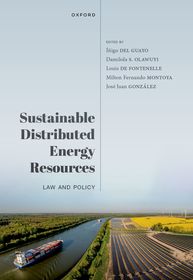
Sustainable Distributed Energy Resources
Law and Policy
-
10% KEDVEZMÉNY?
- A kedvezmény csak az 'Értesítés a kedvenc témákról' hírlevelünk címzettjeinek rendeléseire érvényes.
- Kiadói listaár GBP 130.00
-
58 695 Ft (55 900 Ft + 5% áfa)
Az ár azért becsült, mert a rendelés pillanatában nem lehet pontosan tudni, hogy a beérkezéskor milyen lesz a forint árfolyama az adott termék eredeti devizájához képest. Ha a forint romlana, kissé többet, ha javulna, kissé kevesebbet kell majd fizetnie.
- Kedvezmény(ek) 10% (kb. 5 870 Ft)
- Kedvezményes ár 52 826 Ft (50 310 Ft + 5% áfa)
Iratkozzon fel most és részesüljön kedvezőbb árainkból!
Feliratkozom
58 695 Ft

Beszerezhetőség
Becsült beszerzési idő: A Prosperónál jelenleg nincsen raktáron, de a kiadónál igen. Beszerzés kb. 3-5 hét..
A Prosperónál jelenleg nincsen raktáron.
Why don't you give exact delivery time?
A beszerzés időigényét az eddigi tapasztalatokra alapozva adjuk meg. Azért becsült, mert a terméket külföldről hozzuk be, így a kiadó kiszolgálásának pillanatnyi gyorsaságától is függ. A megadottnál gyorsabb és lassabb szállítás is elképzelhető, de mindent megteszünk, hogy Ön a lehető leghamarabb jusson hozzá a termékhez.
A termék adatai:
- Kiadó OUP Oxford
- Megjelenés dátuma 2026. április 16.
- ISBN 9780198991915
- Kötéstípus Keménykötés
- Terjedelem416 oldal
- Méret 252x176x28 mm
- Súly 881 g
- Nyelv angol 679
Kategóriák
Rövid leírás:
A global, comparative study of the legal and sustainability challenges of distributed energy resources (DERs), this volume offers practical tools and governance strategies to support inclusive, secure, and decentralised energy systems for the future.
TöbbHosszú leírás:
Distributed energy resources (DERs) such as solar panels, microgrids, and residential battery storage are reshaping electricity systems by enabling autonomous consumption and localised generation. They challenge the traditional centralised power model and offer significant potential for decarbonisation, decentralisation, digitisation, and democratisation—essential pillars for the energy transition.
However, the DER revolution is not purely technological; it beckons important legal and policy changes too. While the need for DERs is widely recognised, their design, financing, and implementation can present complex economic, environmental, social, and governance risks including land tenure issues, legal liability, and protracted disputes. Electricity laws and policies—often drafted decades ago—are increasingly ill-equipped to address the challenges of integrating these technologies.
At the same time, communities are demanding a greater role in shaping DER law and policy, calling for inclusive frameworks that ensure equitable access, data privacy, consumer protection, participation, human rights, and gender justice—particularly in low-income and indigenous communities.
Sustainable Distributed Energy Resources: Law and Policy explores how legal and regulatory systems worldwide are responding to these challenges. Through a sustainability lens, it offers practical tools for managing legal, contractual, and governance risks across the DER value chain and presents a roadmap for improving coherence in the design, financing, generation, and consumption of DERs. It also highlights the role of energy entrepreneurship education in building a secure and inclusive energy future.
*****
This book is the result of a long-standing collaboration between the International Bar Association's Section on Energy, Environment, Natural Resources, and Infrastructure Law (IBA SEERIL), Oxford University Press (OUP), and the Academic Advisory Group (AAG) of IBA SEERIL. The International Bar Association is the world's largest organization of lawyers and bar associations. As an active section of the IBA, SEERIL leads public interest initiatives and keeps its members informed about key developments across its six committees: Environment, Health and Safety Law; International Construction Projects; Mining Law; Oil and Gas Law; Power Law; and Water Law. The AAG is a network of academics engaged in research and teaching in areas relevant to SEERIL's work.
Tartalomjegyzék:
Introduction: Distributed Energy Resources as the New Electricity Paradigm: Legal Context and Principles
Part I. DERs and the Sustainable Decarbonization of Electricity Systems
International Law on Distributed Energy Resources
From Coal to Distributed Energy: Sustainable Decarbonization and Decentralization of Electricity Systems
Land Tenure, Project Siting, and Environmental Aspects of DERs
Sustainability Challenges of Small Modular Reactors in Distributed Energy Systems
Distributed Energy Storage
Part II. Sustainable Decentralization and Digitalization of Energy Systems
Cross-border Distributed Energy in the EU
Decentralization with Distributed Energy Resources in New Zealand
Decentralizing China's Energy Future
Energy Decentralization and Human Rights in Mexico
Behind-the-Meter Distributed Generation: Lessons from the United States
Financing Distributed Energy Infrastructure: The Role of Islamic Finance
Demand-Side Aggregation of Distributed Energy Resources
Digitization of Networks and Data Protection
Part III. Sustainable Democratization of Energy Systems
The Role of Active Consumers in Decentralized Energy Systems
Sustainable Energy Democratization Through Community-Centric Models
The Role of Energy Communities in a New Decentralized Energy Model: Legal Progress and Challenges in Colombia
Gender Justice and Decentralized Energy Resources: Perspectives from the United Kingdom and Nigeria
Eco-Entrepreneurship Law and Distributed Energy Resources
Entrepreneurial Legal Education and Energy Democratization: An Indigenous Renewable Distributed Energy Clinic

